
By Claudine Raschi, MS · Last updated: November 2026
Quick Answer: What Is an Incentive Program Annual Planning Calendar?
An incentive program annual planning calendar assigns every design, audit, launch and reconciliation task for your rebate, SPIFF and co-op programs to a month and an owner. It keeps channel programs from drifting.
Why Do Channel Incentive Programs Drift Without a Calendar?
Channel programs rarely fail in one dramatic moment. They drift. Eligibility rules go stale, accruals are estimated late, and a holiday SPIFF gets approved after the window to communicate it has closed. An incentive program annual planning calendar turns those recurring surprises into scheduled work.
McKinsey & Company’s distributor guidance makes a related point: even when distribution strategies are initially effective, problems may occur if manufacturers fail to reevaluate them periodically. It is a semiconductor-industry article, but the principle travels. A channel incentive planning calendar is how we build periodic reevaluation into the year instead of leaving it to chance.
This guide is about the calendar for programs that pay partners, dealers and distributors. It is not about budgeting for your own employees, which we cover in our guide to budgeting for annual employee incentives.
What Does This Calendar Assume About Your Fiscal Year?
We assume a January to December fiscal year, with rebates, SPIFFs and co-op or market development funds all running at once. Quarter one covers design, budget and compliance setup. Quarter two is the mid-year audit and adjustment. Quarter three is holiday and year-end SPIFF planning, and quarter four is launch, accrual, reconciliation and next-year preparation.
If your fiscal year starts in another month, shift every month in this incentive program annual planning calendar to match. Count forward from your fiscal start instead of from January. Keep one fixed anchor: for Form 1099-NEC, the IRS instructions state a January 31 deadline, and it does not move with your fiscal year.
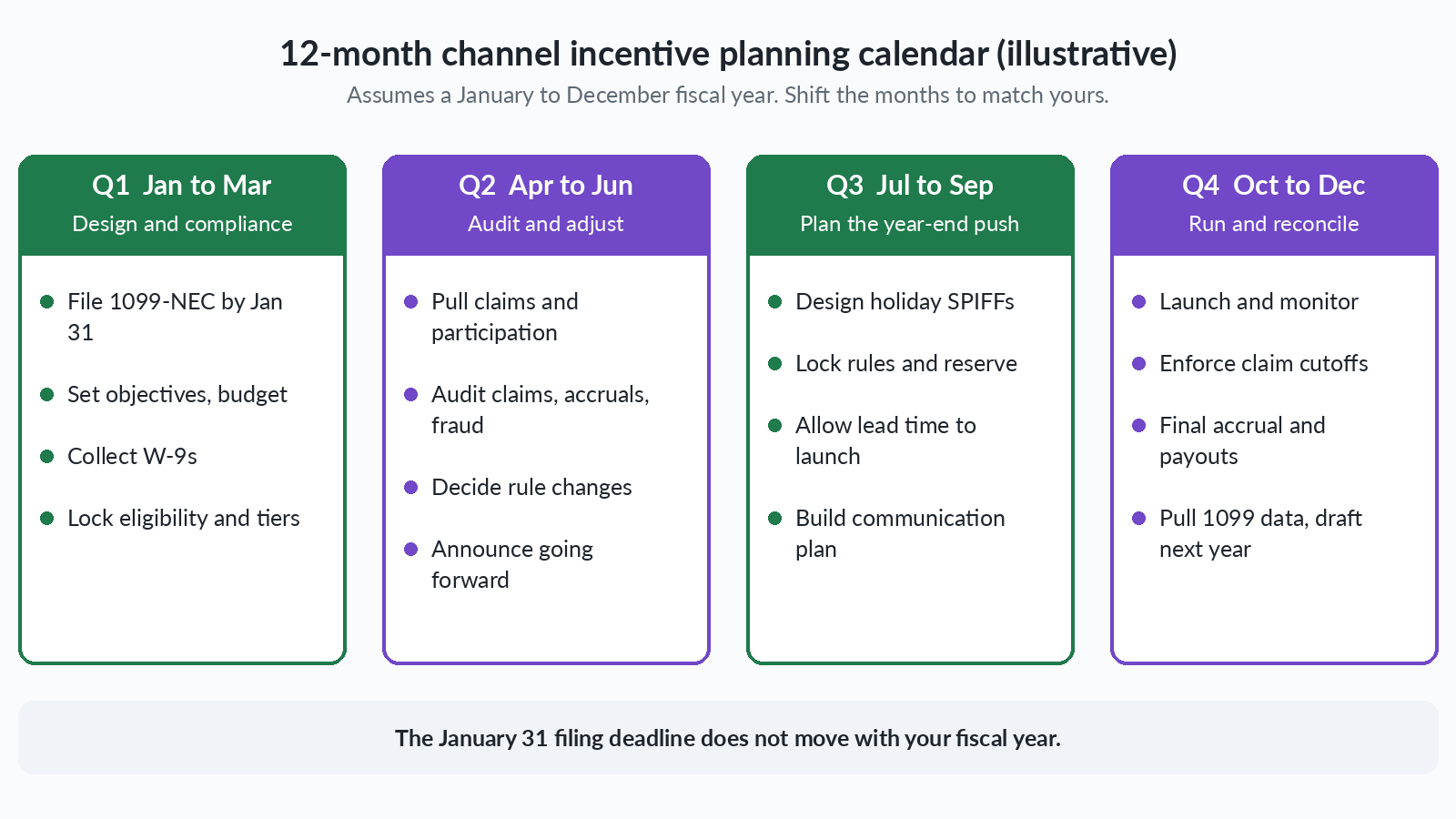
Q1 (January to March): What Should We Lock Down First?
The first quarter of your incentive program calendar sets the rules the rest of the year depends on. Start by confirming objectives and budget, then write down eligibility and tier rules before any partner asks about them. If you are building or revisiting tiers, see our post on channel partner tier program design.
Prior-year reconciliation also belongs here. Close out last year’s claims, true up accruals against actual payouts, and record what worked and what did not. For the accrual side, see our guide to distributor rebate accrual.
Tax setup is easy to push down the list, so we put it in quarter one. For Form 1099-NEC, the IRS instructions for Forms 1099-MISC and 1099-NEC state that you are required to furnish payee statements and file with the IRS by January 31.
For tax years beginning after 2025, the instructions also say the minimum threshold for reporting certain payments increased to $2,000 and may be adjusted for inflation beginning in calendar year 2027. Which form applies to your payments, and how your own program is treated, are questions for a tax advisor.
The IRS Form W-9 instructions explain that Form W-9 is used by persons required to file information returns to get the payee’s correct name and taxpayer identification number. The IRS page does not state a timing rule, so this is our recommendation: collect W-9s before the first payout so year-end reporting is not a scramble.
Q2 (April to June): How Do We Run a Mid-Year Audit?
The second quarter is for looking at real data in your channel program calendar. Review claims, accruals, participation and fraud signals against the plan you set in quarter one. For the audit itself, see our channel incentive program audit guide. For disputed claims, see our posts on co-op marketing claims fraud and co-op fund clawback.
McKinsey & Company’s distributor guidance says manufacturers should closely examine all distribution data, including detailed sales information for individual regions, products and customers. That is a good checklist for a mid-year program audit. Look for regions where participation is thin, products that are not moving, and customers that fall outside the behavior you meant to reward.
Adjust rules carefully. The same guidance says manufacturers should not change the incentive system in any way that would penalize distributors, such as by compressing margins to achieve short-term gains. Our recommendation is to apply changes going forward, announce them early, and explain the reason in plain language.
Q3 (July to September): How Early Should We Plan Holiday and Year-End SPIFFs?
Plan them in the third quarter of the incentive calendar and lock the rules before the fourth-quarter launch. That means deciding eligible products, payout amounts, start and end dates, and claim cutoffs while there is still time to test and communicate. For compliance terms, see our guide to SPIFF program compliance.
Lead time matters. On our channel incentive programs page, we state that our standard deployment runs 4 weeks from signed agreement to live program, including participant portal, admin dashboard, fulfillment integration, and tax and year-end reporting setup. A fourth-quarter program signed in September leaves little slack, so confirm the timeline for your own program.
Build a communication calendar alongside the rules: an announcement, reminders during the program, and a clear last-claim date. Also consider holding back part of the budget for opportunities that appear late in the year. Treat the size of that reserve as a judgment call for your finance team.
One note on tax scope. IRS Publication 15-B says cash and cash equivalent fringe benefits, such as gift cards, are never excludable as a de minimis benefit, but that guidance is about benefits to your own employees. Holiday awards to your own staff are treated differently from awards to channel partners’ reps, so check both with a tax advisor.

Q4 (October to December): What Happens at Launch and Year-End?
Quarter four of your incentive program annual planning calendar is for execution and close. Launch the programs you locked in quarter three, then monitor participation weekly so you can fix communication gaps while the program is still running. For launch planning, see our guide to making a new incentive program succeed.
Set claim cutoff dates early enough for finance to process them. Then complete the final accrual and reconciliation, and schedule payouts with your tax advisor’s guidance on which tax year each payment belongs to. Pull the payout data for 1099 reporting as soon as the year closes, because the January 31 deadline in the IRS instructions arrives quickly.
Start the next-year planning calendar before December ends. Capture what you learned, draft objectives, and send the first budget scenarios to finance. For measuring results, see our post on SPIFF program ROI metrics.
What Does an Incentive Program Annual Planning Calendar Look Like?
The table below puts the quarters into one view. Use it as a starting template for your incentive program calendar, then add program-specific dates for each rebate, SPIFF and co-op fund.
| Month | Main task | Owner | Output |
|---|---|---|---|
| January | Furnish and file Form 1099-NEC (confirm other forms with a tax advisor), close prior-year claims | Finance, legal/tax | Filed forms, final prior-year payout report |
| February | Set objectives and budget, collect W-9s before first payouts | Channel marketing, finance | Approved budget, W-9 file for new payees |
| March | Finalize eligibility and tier rules | Channel marketing, sales ops | Published program terms |
| April | Pull claims and participation data | Sales ops | Data set for mid-year review |
| May | Audit claims, accruals and fraud signals | Finance, channel marketing | Audit findings and accrual true-up |
| June | Decide and announce rule adjustments | Channel marketing, legal/tax | Change notice to partners |
| July | Design holiday and year-end SPIFFs | Channel marketing, sales ops | Draft SPIFF rules and budget request |
| August | Lock rules, hold-back and approvals | Finance, legal/tax | Signed-off rules and reserve decision |
| September | Sign agreement, build communication plan | Channel marketing | Launch-ready program and message calendar |
| October | Launch and monitor participation | Channel marketing, sales ops | Weekly participation view |
| November | Enforce claim cutoffs, begin final accrual | Finance, sales ops | Cutoff notice and accrual estimate |
| December | Reconcile, pay out, pull 1099 data, draft next year | Finance, channel marketing | Reconciled books, 1099 data, next-year draft |
Should We Run Contests Monthly or Quarterly?
There is no universal answer for your contest calendar. A Fortune 500 Tier 1 auto parts supplier client ran quarterly contests, such as a random drawing of all eligible submissions for a chance to win an all-inclusive trip. It increased salesperson activity and program website access by nearly 50 percent.
Another client, an automotive brand, pays $20 per monthly product education video and quiz to dealer salespeople. It tracks participation as a KPI for area sales managers and sends a monthly new education plus an email reminder to keep the brand top of mind. As a rule of thumb to test, monthly rhythms may suit ongoing behavior and quarterly contests a bigger prize.
Be careful when you change cadence. A Harvard Business Review report on a 2017 study by Doug J. Chung and Das Narayandas compared monthly quotas with daily quotas at a Swedish retail chain over four weeks. With daily quotas, salespeople sold more quantities of low-ticket items, which hurt profitability in that store’s case.
It was one retailer, four weeks and employees, not channel partners. We use it only as a caution: changing goal cadence changes behavior, so test before rolling out program-wide.
Is Last Year’s Number a Safe Baseline?
Often it is not. Setting next year’s target as last year’s result plus a fixed percentage is simple, but it ignores shifts in demand, product mix and partner behavior. A flat uplift can also reward partners for conditions they did not create.
The McKinsey & Company sales incentives research, published October 19, 2018, suggests companies can use predictive algorithms that leverage internal and external data sets to estimate customer demand, instead of assuming a sales organization will meet last year’s goal plus 10 percent. It also says incentives should always be based on overall sales strategy. That research covers sales compensation, not channel programs, so treat it as a prompt to examine your baselines.
The same research says smart revisions of compensation models have been found to have a 50 percent higher impact on sales than changes in advertising investments. Again, that concerns sales compensation, but it supports giving incentive design real attention in your annual program calendar. To see how we support these programs, visit our rebate programs and sales incentive programs pages.
How Should We Measure and Review the Calendar?
Put a review point in every quarter. Track participation, budget used against the cap, claim turnaround and payout speed, then compare them with the objectives you set in quarter one. A quarterly business review with key partners is a good place to collect feedback.
Treat disputes and late claims as calendar items with a named owner and a response deadline. Pilot any rule change with a small group before it reaches every partner, and align dates with product launches, seasonality and inventory cycles so an incentive does not arrive after the selling window closes.
Who Owns Each Part of the Calendar?
A planning calendar without owners is a wish list. Channel marketing usually owns the overall schedule, program design and partner communication. Finance owns the budget, accruals and reconciliation, while sales operations owns eligibility data, claim volumes and regional reporting.
Legal or tax owns the terms, W-9 collection, and 1099 reporting questions. We recommend naming one accountable person per task, with a backup, and reviewing the calendar in a standing monthly meeting.
How Can a Platform Help Keep the Calendar on Track?
A platform will not replace the planning calendar, but it can remove manual work from the calendar. Our standard deployment includes a participant portal, admin dashboard, fulfillment integration, and tax and year-end reporting setup. The tax and year-end reporting setup relates to the quarter-one and quarter-four tax tasks above.
Year-end tax work is a good example. A jewelry brand that approved claims in a spreadsheet and mailed paper checks quarterly moved to monthly payment by reloadable debit card on new submissions. We handle its US 1099 forms, which the brand had previously overlooked.
A furniture manufacturer is another example. Its accounting executives had manually produced and mailed 1099s for several thousand participants and paid reps by check. It now has tax mailing and filing included with a reloadable card program, freeing hundreds of hours. To see how this fits your own channel incentive calendar, explore our solutions.
Where Do the Related Guides Fit?
Our other guides cover what this incentive program annual planning calendar deliberately leaves out. For employee budgets, read how to budget annual employee incentives. For plan length, read annual versus frequent incentive plans. For launch details, read how to make a new incentive program succeed.
Frequently Asked Questions
What is an incentive program annual planning calendar?
An incentive program annual planning calendar is a month-by-month schedule of the design, audit, launch, accrual and reconciliation tasks for your channel programs, each with an owner and an output. It covers rebates, SPIFFs and co-op funds. The goal is to make fiscal-year decisions on purpose instead of reacting to deadlines as they arrive.
When should manufacturers start planning next year’s channel incentives?
Start next year’s plan in the fourth quarter of a January to December fiscal year, while current results are still fresh. We recommend drafting objectives and budget scenarios before year-end, then finalizing them in the first quarter once the prior year is reconciled. If your fiscal year differs, shift every month in the calendar to match it.
Which tax dates belong on a channel incentive calendar?
Put the January 31 deadline for Form 1099-NEC on the calendar, plus an earlier internal date to pull payout data. Add W-9 collection ahead of the first payout. Form 1099-MISC has different filing dates, so ask a tax advisor which form applies to your payments and how the reporting threshold affects your program.
How often should we audit rebate and co-op claims?
We recommend a formal mid-year audit of claims, accruals and participation, with lighter checks each month. The right depth depends on program size and risk. McKinsey & Company’s distributor guidance says manufacturers should reevaluate distribution strategies periodically and examine detailed data by region, product and customer, though it does not set a frequency.
Can we change program rules mid-year?
Yes, but change rules carefully and only for a clear reason. McKinsey & Company’s distributor guidance warns against changing an incentive system in ways that penalize distributors, such as compressing margins for short-term gains. We suggest announcing changes in advance, applying them going forward, and testing with a small group before a full rollout.
How far ahead should we plan a holiday or year-end SPIFF?
Plan it in the third quarter and lock the rules before launch. Our standard deployment runs 4 weeks from signed agreement to live program, so a fourth-quarter program signed in September leaves little slack. Timelines vary by program, so confirm yours. Allow extra time for eligibility lists, communications and approvals.
How often should we review a channel incentive program?
We recommend reviewing operations monthly and performance quarterly. Monthly checks cover claim volumes and payout turnaround. Quarterly reviews cover participation, budget used against the cap and partner feedback. We suggest adjusting rules going forward and announcing changes early, so partners can plan around them.
Who should own the planning calendar?
Channel marketing usually owns the calendar and keeps it current. Finance owns budget, accruals and reconciliation, sales operations owns data and eligibility, and legal or tax owns W-9 collection, 1099 reporting and terms. We recommend naming one owner per task, because a single accountable person makes deadlines easier to track.
Final Takeaways
- Use a planning calendar to turn recurring channel program tasks into scheduled work with named owners.
- Quarter one sets rules, budget and W-9 collection, and quarter two audits real data before rules change.
- Lock holiday and year-end SPIFF rules in quarter three, because deployment lead time leaves little slack for late September signings.
- Test any change to cadence or goals with a small group before a program-wide rollout.
We can help you build your own incentive program annual planning calendar. If you want to start, talk with our team about your channel programs.