
By Claudine Raschi, MS · Last updated: November 2026
Quick Answer: What Does a Work Anniversary Recognition Program Need at 500+ Employees?
A work anniversary recognition program for 500+ employees needs clean hire dates, automatic triggers, manager notices, a governed award catalog and measurement. We call this the five-link anniversary chain. Automate the routine steps and keep the recognition itself personal.
Why Does Work Anniversary Recognition Break at 500+ Employees?
A work anniversary recognition program is easy to run from a spreadsheet with 50 people and one office. At 500 or more, across locations and legal entities, intent stays the same but consistency, timing and data quality fall apart.
Tenure is the first reason to design carefully. The U.S. Bureau of Labor Statistics’ 2026 tenure release reports median tenure of 4.1 years for U.S. wage and salary workers in January 2026, up from 3.9 in January 2024, and 20.6 percent of them had a year or less with their employer.
Median means half of workers have more tenure and half less. Because that median is under five years, a work anniversary recognition program whose first milestone is year 5 would not yet reach at least half of U.S. wage and salary workers. Your own workforce may differ, so check your tenure mix.
Program quality is the second reason. Gallup’s workplace culture report found that only 34% of employees say their employer has a recognition program, and just 13% of those employees rate it as excellent. Gallup says recognition works best when it is fulfilling, authentic, personalized, equitable and embedded in company culture.
Cadence is the third. Gallup’s weekly recognition guidance says recognition should be frequent and timely, and recommends every seven days. In our inference, an anniversary happens once a year, so it supplements day-to-day recognition and cannot replace it.
What Is the Five-Link Anniversary Chain?
The five-link anniversary chain is our name for the operating sequence behind a work anniversary recognition program at scale: data, trigger, notice, award and proof. The table shows what breaks and the control we recommend.
| Link | What breaks at scale | Control we recommend |
|---|---|---|
| 1. Data | Hire dates differ across systems, and rehires, acquisitions and entity transfers create disputes. | One system of record, a written service-date rule, and a pre-launch audit with a dispute flag. |
| 2. Trigger | Manual lists cause missed, late or duplicate awards. | Rules-based milestone events that fire once, with a lead time and a log. |
| 3. Notice | Managers forget, or do not know what to say or offer. | A manager prompt with a script and award options, plus escalation if no action is taken. |
| 4. Award | Uncontrolled gift choice, tax surprises and inconsistent delivery across locations. | One governed catalog, address capture, delivery tracking and reissue rules. |
| 5. Proof | No one can show whether recognition happened on time or what it cost. | Defined metrics, budget tracking and an audit log reviewed on a schedule. |
This post does not cover wording (see our work anniversary messages guide), gift ideas (see long service employee anniversaries), or tiers, budgets and tax timing (see our service award program guide).
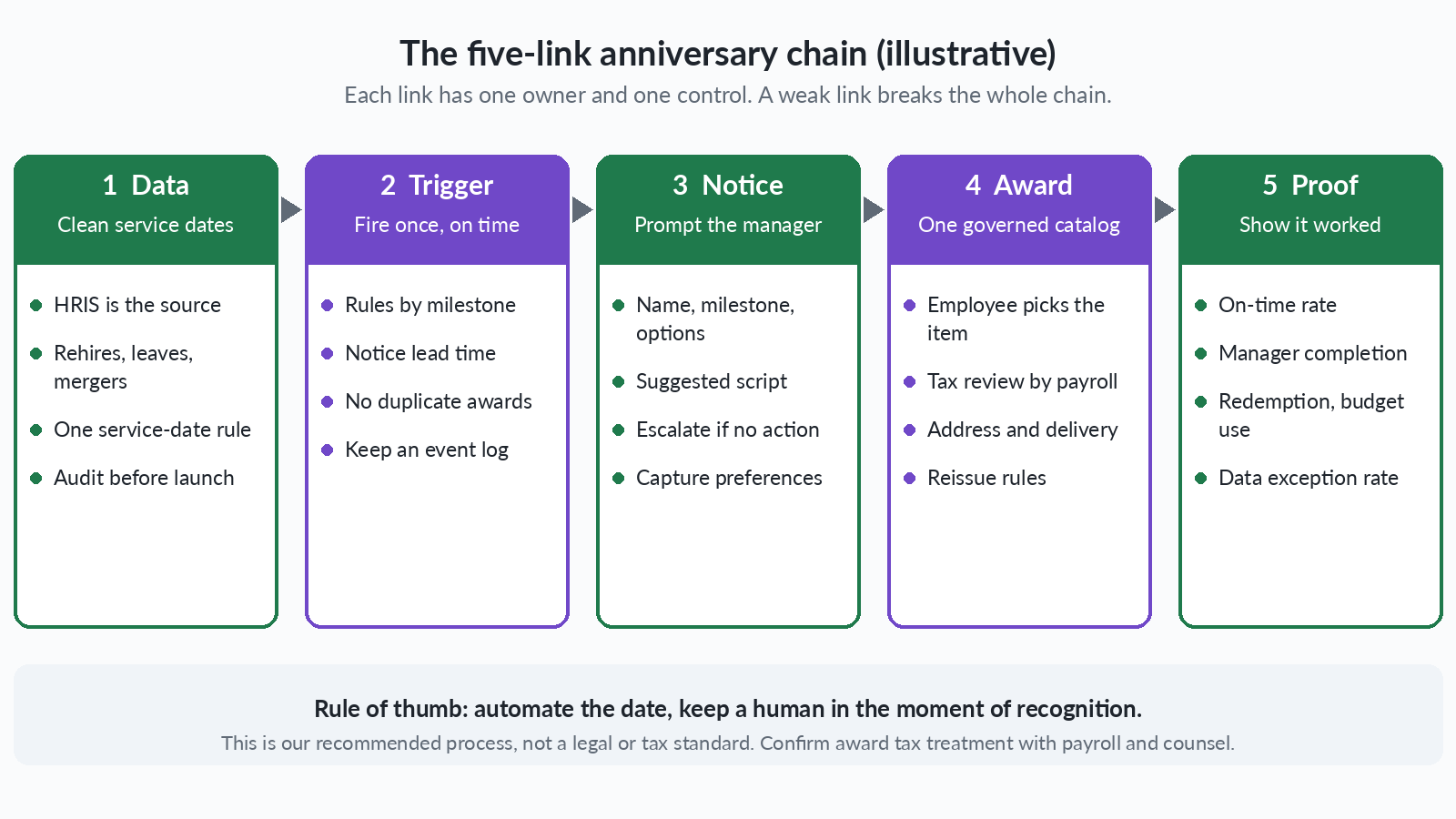
Link 1, Data: How Do You Get Clean Hire-Date Data?
Treat your HR system of record as the single source of truth. A work anniversary recognition program fails quietly when payroll, the HR system and a local spreadsheet each hold a different hire date. Pick one owner, one field and one refresh schedule.
Next, separate original hire date from adjusted service date. Rehires, acquisitions, leaves and transfers between legal entities all raise the question of which date counts. We recommend deciding that rule once and writing it into your plan.
Audit before launch, not after the first missed anniversary. Look for blank, future and duplicate dates. Give people a simple way to flag a disputed date, routed to a named HR owner. Pilot the rules with one business unit first, and tell employees how milestones are recognized.
Then connect the systems rather than moving files by hand. Level 6 describes its platform as integrating directly with your HRIS, performance management, payroll and collaboration systems, with employee data syncing automatically without manual imports or CSV uploads.
Link 2, Trigger: How Should Milestones Fire?
In a work anniversary recognition program, milestones should fire from rules, not from a person reading a list. A rules engine compares each verified service date to your schedule and creates an award event a few weeks before the date, so managers have time to act. Level 6 describes syncing hire dates, anniversaries and tenure milestones to trigger service award recognition automatically.
Each event should be issued exactly once, using a unique key per employee and milestone so a data refresh cannot create a second award. Log every event with its date and outcome so any dispute can be resolved from a record.
Given the tenure figures above, we recommend a first-year milestone and a clear early ladder. Our service award program guide suggests starting before year 5 and connecting the HRIS so milestones trigger automatically and flag whether someone received a qualifying award in the prior four years.
Link 3, Notice: How Do Managers Get Notified Without a Burden?
Send the manager a short prompt that makes the right action the easy one: the employee’s name, the milestone, the award options and a suggested script they can edit. A good work anniversary recognition program never asks managers to look anything up.
Build in escalation. If the manager has not acted by a set point, the prompt goes to an HR partner or skip-level leader, so a busy manager is never the reason someone is overlooked. Remote employees need the same notice and standard.
Capture how people like to be recognized. Gallup’s generational recognition article reports that only 10% of employees have been asked by someone at work how they like to be recognized. A simple preference field, such as public, private or a team moment, makes it more personal.
Gallup’s analysis of recognition equity found that only 26% of employees strongly agree they receive similar amounts of recognition as teammates with similar performance, based on more than 7,500 US employees. In our inference, a scheduled, rules-based anniversary baseline is one way to make recognition more consistent across teams and sites.

Link 4, Award: How Do You Handle Gift Choice and Delivery Across Locations?
Offer one governed catalog rather than letting each site buy its own gifts, which is the core of anniversary recognition at scale. In a work anniversary recognition program at scale, that gives you consistent value, predictable cost and one place to apply policy. For contents, see our long service employee anniversaries and custom reward options posts.
Tax treatment shapes the catalog design of any work anniversary recognition program. IRS Publication 15-B says any fringe benefit is taxable unless the law specifically excludes it. The achievement award exclusion covers tangible personal property given for length of service, but it does not apply to cash, cash equivalents, gift cards, gift coupons or gift certificates, other than arrangements that only let the employee select tangible property from a limited assortment preselected or preapproved by the employer.
The award must also be given as part of a meaningful presentation and not create a significant likelihood of disguised pay. The excludable annual amount is $1,600, or $400 for awards that are not qualified plan awards, which come from an established written plan that does not favor highly compensated employees. Confirm treatment with payroll and tax counsel, and see our service award program guide for timing rules.
Verify addresses at notice time, track every shipment, and set a reissue rule for lost items. Level 6 lists global fulfillment among the services it combines, but rules differ by country, so check each location locally.
Link 5, Proof: What Do You Measure?
Measure whether your work anniversary recognition program actually ran, not only whether people liked it. We recommend six metrics, each defined in writing:
- On-time recognition rate: the share of milestones recognized by the milestone date.
- Manager completion rate: the share of manager prompts acted on without escalation.
- Redemption rate: the share of awards selected and delivered.
- Data exception rate: the share of records flagged for missing, disputed or conflicting dates.
- Budget utilization: spend against the approved budget by cost center.
- Recognition frequency: how often people are recognized across the year, not only on anniversaries.
Level 6 describes reporting that tracks participation rates, reward redemption, department engagement, budget utilization and recognition frequency. We offer no benchmarks here, because targets depend on your workforce. Add a short pulse question after delivery asking whether the recognition felt timely and personal.
Be careful with turnover comparisons. If recognized people stay longer, that is a correlation, not proof of cause. For the difference between rewards and recognition, see our rewards versus recognition post.
How Do You Govern Budget and Exceptions?
Assign budget ownership by cost center, with a named approver for anything off schedule. Every work anniversary recognition program needs a clear answer to who pays, who approves and who can override, or local leaders create side programs.
Track each employee’s annual award total against the IRS limits above. Our employee service award program post covers the prior-four-year check and the written plan.
Define exception types up front and log each one:
- Date disputes and service-date corrections.
- Employees on leave or leaving before delivery.
- Replacement awards for lost or damaged items.
- Manual overrides requested by a leader.
Give each exception an owner, a decision and an audit log entry, and review the log quarterly.
Should You Build, Buy or Use a Managed Service?
Choose based on four criteria: how many HR systems and entities you have, how many countries you ship to, how much HR capacity you can dedicate, and how much governance you must prove. For a work anniversary recognition program, building in-house gives you control but leaves integrations, catalog sourcing, delivery, tax forms and maintenance with your team, while buying a platform or using a managed service moves more of that work to a provider.
Level 6 describes managed services that include program design and strategy, online rewards platform development, points tracking, reward sourcing and fulfillment, recipient management, reporting and analytics, and tax form processing. See our employee recognition and rewards solution page or our wider solutions.
Frequently Asked Questions
How do you automate work anniversary recognition?
You automate it by syncing hire dates from your HR system of record to a rules engine that fires each milestone once, notifies the manager, and logs the result. Level 6 describes awards triggered automatically based on verified employee milestones and tenure anniversaries. Clean service dates are the prerequisite, so audit them first.
Which anniversaries should a program recognize?
A program should recognize early anniversaries as well as the long ones. The U.S. Bureau of Labor Statistics reports median tenure of 4.1 years for U.S. wage and salary workers, so a program that starts at year 5 would not yet reach at least half of them. We recommend a first-year milestone and a clear ladder after it.
Who should deliver the recognition, HR or the manager?
The manager should deliver it, with HR running the process behind the scenes. Managers know the work, and HR cannot know every team. We recommend HR owns the data, triggers, catalog and reporting, while managers get a prompt with a suggested script and an escalation path.
How do you handle remote and multi-location employees?
Multi-location programs work best with one governed catalog and one process, varying only delivery. Verify shipping addresses early, track every shipment, and set a reissue rule for lost packages. Remote employees should get the same manager prompt as office staff. International rules for awards differ, so check each location locally.
What is the difference between a work anniversary recognition program and a service award program?
In our usage, a service award program is the tiered structure of milestones, budgets and written plan, while a work anniversary recognition program is the operating process that delivers those milestones on time. The first sets the rules and the second runs them.
Can you give gift cards for work anniversaries?
You can, but gift cards fall outside the achievement award exclusion. IRS Publication 15-B says the achievement award exclusion does not apply to cash, cash equivalents, gift cards, gift coupons or gift certificates, with a narrow exception for arrangements limited to a preapproved assortment of tangible items. Confirm treatment with payroll and tax counsel.
What data do you need to run anniversary recognition automatically?
You need a unique employee ID, original hire date, adjusted service date, legal entity, location, manager, employment status and delivery address, plus a record of prior awards so nobody is rewarded twice. We recommend writing the service-date rule into your plan so rehires and leaves are handled consistently.
How do you measure whether it works?
Measure the process first: on-time recognition rate, manager completion rate, redemption rate, data exception rate and budget utilization. Define each metric in writing before launch. Turnover comparisons show correlation, not proof that recognition caused retention, so treat them as a directional signal only.
Final Takeaways
- A work anniversary recognition program breaks at scale on consistency, timing and data, not intent, so design operations before gifts.
- Fix the service-date rule and audit hire dates before you automate any trigger.
- Start recognition early, fire each milestone once, and prompt managers with a script and an escalation path.
- Use one governed catalog for your work anniversary recognition program, and confirm tax treatment with payroll and tax counsel.
- Measure on-time recognition, manager completion and data exceptions, and review exceptions every quarter.
If you are weighing build, buy or managed service for a work anniversary recognition program, talk with our team about your milestones, systems and locations.