
By Claudine Raschi, MS · Last updated: June 2026
Quick Answer: What Are Co-Op Fund Clawback Rules?
Co-op fund clawback rules let manufacturers recover co-op or MDF dollars when a partner misses claim deadlines, submits inflated invoices, double-bills, or violates brand guidelines. Enforcement requires these recovery rights to be written into the partner agreement before payment is made.
Every dollar of co-op funding you accrue to a partner is a dollar you are trusting them to spend correctly. When that trust breaks down, recovery is rarely simple. The mechanism that makes recovery possible is the co-op fund clawback: a contractual and operational process for reclaiming funds that were paid out — or committed — against activity that turned out to be non-compliant.
In our 25+ years building channel incentive programs, we have learned that co-op fund clawback enforcement is won or lost long before a disputed claim ever arrives. It is won in the partner agreement and in the system of record. This guide covers the triggers that should be written into every co-op program, the contractual provisions that make recovery enforceable, and the audit trail that turns a disputed claim into a documented recovery.
Scope note: this article covers manufacturer and channel partner marketing co-op and MDF reimbursement recovery — not housing co-op operating revenue, private equity GP clawbacks, or employment compensation clawbacks. Those are different legal and operational frameworks.
Why Manufacturers Need a Co-Op Fund Clawback Policy
A co-op fund clawback policy gives manufacturers a practical way to recover money when partner-funded marketing fails basic program rules. It turns reimbursement from an informal favor into a controlled, auditable transaction.
That matters because co-op programs already sit inside a regulated commercial structure. The Federal Trade Commission requires that manufacturers and wholesalers provide advertising and promotional allowances on “proportionally equal terms” — which means policy language and administrative discipline are not optional. When the policy is vague, the manufacturer ends up arguing over gray areas after the money is gone.
Operationally, co-op dollars accrue from prior partner purchases at a typical rate of 1–5% of purchase volume, with reimbursement covering 40–100% of eligible spend depending on the program structure. Partners need documented pre-approval before spending, which is exactly why reimbursement decisions must tie back to a paper trail. Our overviews of co-op vs. MDF channel funds and MDF vs. co-op differences explain how each pool is structured — but the enforcement principle is the same for both.
When the policy is explicit, a co-op fund clawback becomes a contract enforcement step, not a negotiation.
What Should Trigger an Automatic Co-Op Fund Clawback
An automatic co-op fund clawback should start when a claim fails a non-negotiable rule that was written into the program before funds were committed. The cleanest triggers are objective, binary, and easy to prove.
We recommend listing the full trigger set directly in the partner agreement and again in the program guide:
- Non-compliant or missing proof of performance
- Missed claim deadlines (the most common reason MDF goes unreimbursed)
- Inflated or fabricated invoices
- Unapproved activities or budget shifts after pre-approval
- Double-billing the same activity under both MDF and co-op
- Brand guideline violations
- Paid search campaigns bidding on restricted manufacturer brand terms
Those triggers are not theoretical. Ernst & Young identifies marketing development funds and partner incentives as a key compliance risk in channel ecosystems — requiring justification and red-flag monitoring at each stage of the partner lifecycle. We see the same abuse patterns repeat across channel programs: bogus invoices, recycled proof of performance, duplicate claims, and phantom vendors. Our deeper look at channel incentive fraud risks maps these patterns to the events that should trigger a co-op fund clawback review.
The goal is not to catch partners on technicalities. The goal is to make sure reimbursement only happens when the activity was approved, executed as planned, and supported by evidence a third party could independently verify.
The Four Abuse Patterns Behind Most Co-Op Fund Clawback Cases
Understanding what actually goes wrong is the foundation of any co-op fund clawback framework. Four patterns account for the vast majority of fund misuse in channel programs.
Inflated or Fabricated Invoices
A partner submits an invoice marked up above actual spend, or recycles old proof of performance from a prior period to support a new claim. This is the most direct path to overpayment, and it is why self-certification is never sufficient. Acceptable proof must be third-party verifiable: vendor invoices, media platform screenshots showing impressions and dates, event registration exports, or CRM lead lists matching the approved activity.
Double-Dipping
Double-dipping means claiming the same activity under both MDF and co-op, or billing two manufacturers for one shared event. Because co-op and MDF pools often run simultaneously, the line between them gets blurry fast. A single MDF ledger per activity — with an explicit attestation that costs are not claimed elsewhere — is the control that closes this gap.
Brand Bidding
Brand bidding uses co-op or MDF funds to run paid search campaigns that bid on the manufacturer’s own brand terms and display those trademarks in ad copy. Google’s trademark advertising policies restrict partners from using a brand’s trademarks in ad text without authorization. When a partner siphons brand-term traffic you would have captured organically, the co-op fund clawback right should be explicit in your agreement.
Entitlement Spending
Entitlement spending happens when a partner depletes their accrual balance before expiration with activities that have no real demand-generation intent. The activity may be technically eligible but generates no measurable return. These claims are harder to claw back retroactively — which is exactly why pre-approval gates and proof-of-outcome requirements matter more than post-hoc recovery.
How to Write Co-Op Fund Clawback Language Into Partner Agreements
Partner agreements must include an express right of recovery, a defined look-back period, and a cure-period window before a co-op fund clawback is enforceable. Without those provisions in writing, manufacturers have goodwill but not legal standing.
This is where most programs quietly lose money. A manufacturer cannot claw back what the agreement never gave it the right to reclaim. The strongest co-op fund clawback programs are built on explicit contractual provisions, not goodwill.
Core Provisions to Include
At minimum, your partner agreement must grant an express right of recovery for funds paid against non-compliant claims, define what constitutes a compliance breach, and reserve the right to offset recovered amounts against future accruals. Offset rights are often more enforceable in practice than demanding a cash payment, because the funds remain within your control. The agreement should also state the activities requiring pre-approval, the documentation required for reimbursement, and the method for calculating the recovery amount.
Look-Back Periods
The look-back period defines how far back you can audit and initiate a co-op fund clawback. Windows of 12–24 months are typical and generally defensible — they balance recovery rights against a partner’s reasonable need for finality. State the period explicitly; an open-ended right to reach back indefinitely invites dispute and is harder to enforce. Deloitte and AGMA research on channel incentives stresses that consistent, clearly documented program terms are what make non-compliance actionable.
Cure Periods
A cure period gives the partner a defined window — typically 15 to 30 days — to remedy a fixable deficiency before the co-op fund clawback is enforced. This protects the manufacturer two ways: it demonstrates good faith if the dispute escalates, and it converts many recoverable situations into corrected claims while preserving the relationship. Cure-period language should specify exactly what constitutes a valid cure and what happens when the window lapses without one.
Repayment Schedules and Security Mechanisms
Define how recovered funds are returned: lump-sum repayment, installment schedule, or accrual offset. Spelling out the mechanism in advance removes the ambiguity that partners exploit when a co-op fund clawback is triggered. For large recoveries, an installment structure tied to future accrual credits is often more enforceable than demanding an immediate cash payment.
For higher-risk programs, consider adding a holdback reserve: a small percentage of each reimbursement held in escrow for 90 days until the claim is confirmed clean. This gives manufacturers a funded recovery position if a claim is later found to have inflated invoices or duplicate billing, without having to pursue the partner for a cash repayment. Alternatively, a contractual right to suspend future approvals pending resolution of an open dispute keeps leverage in the manufacturer’s hands throughout the process.
The Audit Trail Is Your Co-Op Fund Clawback Enforcement Backbone
A complete, immutable audit trail — logging decision, actor, and amount at every governance gate — is what separates an enforceable co-op fund clawback from an unresolvable dispute.
Contract language is only enforceable if you can prove what happened. Each transaction must log the decision, the actor, and the amount — and that record must be immutable.
The trail spans four record types: pre-authorization records, claim submissions, proof-of-performance files, and validation decisions. Ernst & Young‘s lifecycle approach to channel compliance emphasizes monitoring incentives for sufficient justification and red flags at every stage — an expectation you can only meet with a continuous, queryable record. Research from Deloitte and AGMA on channel program governance likewise highlights that complete, documented approval chains are the difference between a defensible recovery and a stalled dispute.
The Five Governance Gates
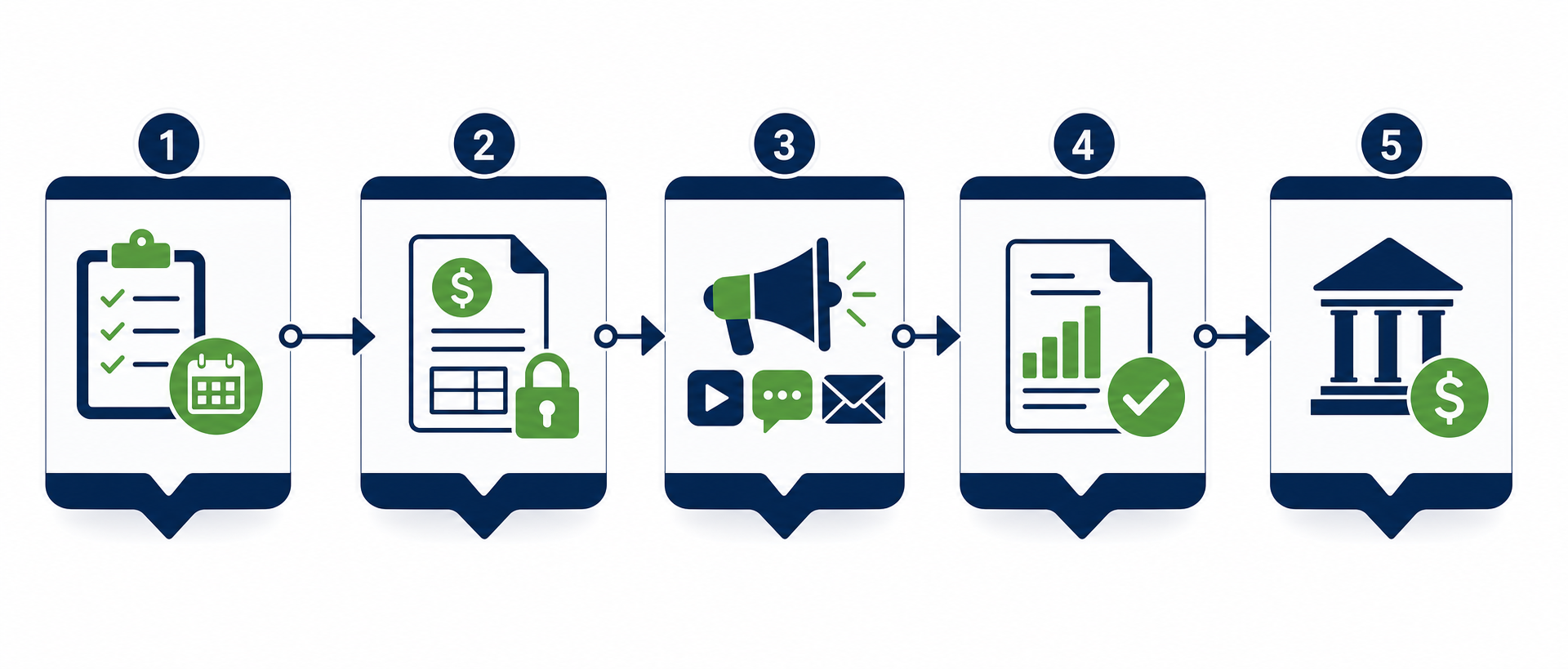
We structure every program around five governance gates, and each one produces a record that supports later recovery:
- Request & plan — the partner declares intended activity, target audience, budget requested, and expected outcome.
- Pre-approval & budget hold — funds are reserved against the plan, preventing double-spend across partners. No pre-approval means no reimbursement, with no exceptions.
- Execution with shared attribution capture — activity is tracked against the approved plan with verifiable lead or impression data.
- Claim + proof of performance — third-party verifiable evidence is submitted within the claim window, typically 60–90 days after activity completion.
- Validation & reimbursement — a documented decision releases or denies funds, with the reviewer, rationale, and amount logged.
When a claim fails at gate four or five, the records from gates one through three are what make the recovery defensible rather than disputable.
Interim Compliance Review Checkpoints
Clawback risk does not only appear when a claim is submitted — it accumulates across the entire program cycle. We recommend three interim checkpoints beyond the five gates:
- Mid-campaign check — at the 50% spend mark, verify the partner’s execution aligns with the approved plan. A deviation here is far cheaper to address than after full reimbursement.
- Quarterly audit sample — pull a random 10–15% of paid claims each quarter and re-validate proof against original pre-approvals. This deters abuse and catches patterns that single-claim review misses.
- Program-end reconciliation — at the close of each program year, compare total accruals, total approved claims, total paid, and total recovered to identify structural leakage before the next cycle opens.
Why Automation Beats Spreadsheets for Co-Op Fund Clawback Enforcement
Platform-based programs enforce pre-approval as a hard gate, place automatic budget holds, and write immutable records — giving manufacturers the evidence needed to execute a successful co-op fund clawback that a spreadsheet program simply cannot produce.
Spreadsheet-based programs fail at enforcement because they produce no immutable record of who approved what, when, and against which budget. A spreadsheet can be overwritten; an overwritten record is not evidence. Manual programs also struggle to place reliable budget holds, which means the same pool dollar can be promised to two different partners simultaneously.
Platform-based programs change the equation. They enforce pre-approval as a hard gate before any spend is authorized, place automatic budget holds, capture proof of performance against the originating request, and write an immutable log of every decision, actor, and amount. Deloitte says compliance teams often face thousands of isolated data silos and need a centralized dashboard to connect disparate data, detect suspicious patterns early, and demonstrate that controls are working. In channel incentives, that means spotting duplicate claims, suspicious invoice patterns, overspending against approvals, or reimbursement requests submitted outside allowed windows.
That is the real advantage of automation: clawback enforcement is no longer an improvised collections exercise. It becomes the output of rule-based approvals, evidence validation, and logged decisions. Our channel incentives platform is designed to translate the legal language in your agreements into automated workflow that produces the evidence a recovery requires.
How to Handle a Disputed Co-Op Fund Clawback
Even a well-documented clawback can draw pushback. A defined escalation path keeps disputes from becoming relationship-ending events without sacrificing your recovery position.
We recommend a five-step dispute path that mirrors the contract language:
- Issue a written notice identifying the exact violated rule and the amount subject to recovery.
- Attach the pre-authorization record, claim file, proof of performance, and validation notes.
- Offer the cure period for fixable defects such as a missing invoice page or incomplete campaign report.
- Escalate unresolved disputes to channel finance or legal review with the full documentation package.
- Recover through repayment or offset against future approved claims per the agreement terms.
In one anonymized engagement, a leading truck manufacturer faced pushback after denying a six-figure claim built on recycled proof of performance. Because every pre-authorization, submission, and validation decision was logged on a centralized platform, the manufacturer presented a complete record and resolved the dispute through its contractual cure-and-offset process without litigation. Documentation, not negotiation, carried the outcome.
In a separate case, a national consumer electronics distributor ran its quarterly audit sample and discovered that roughly 18% of paid co-op claims in one region contained invoices that exceeded the pre-approved budget by 12–40%. The audit trail made the overpayment amount calculable to the dollar, and the manufacturer recovered the full balance through accrual offsets over two subsequent quarters — with no partner terminations and no legal action required.
Equal program administration also matters here. The Federal Trade Commission frames co-op and promotional allowances around proportionally equal treatment across competing resellers — selective enforcement creates both relationship risk and regulatory exposure.
Prevention Beats Chasing a Co-Op Fund Clawback After Payment
Recovery is expensive and adversarial. The most mature programs treat a co-op fund clawback as a last resort, backed by proactive controls that stop most misuse before funds ever leave the pool.
Prevention starts with program design: pre-approval gates, budget holds, third-party proof requirements, and continuous monitoring that catches problems at the front end rather than months later during a manual cleanup. It also starts with partner education — communicating deadlines, eligibility rules, and proof standards upfront reduces the avoidable errors that derail legitimate claims before anyone reaches a dispute stage.
If your current process still runs across spreadsheets, inboxes, and one-off exceptions, fix the governance system before tightening the policy. Manufacturers that want to build a systematic co-op and MDF compliance framework can review how we approach channel incentive management, or reach out to our team to map a cleaner approval, claim, and recovery workflow.
Frequently Asked Questions
What is a co-op fund clawback?
A co-op fund clawback is the contractual and operational process a manufacturer uses to reclaim co-op or MDF dollars that were reimbursed or committed against non-compliant partner activity. Common triggers include inflated invoices, missed claim deadlines, unapproved activities, and brand guideline violations.
What triggers a clawback of co-op funds?
Common triggers include non-compliant proof of performance, missed claim deadlines, inflated or fabricated invoices, unapproved activities, and double-billing the same activity across both MDF and co-op pools. Brand guideline violations — especially unauthorized paid-search bidding on manufacturer brand terms — also constitute enforceable clawback triggers when the partner agreement expressly lists them as compliance breaches.
What look-back period should a partner agreement use?
Look-back periods of 12–24 months are typical and generally enforceable for co-op and MDF programs. The window must be stated explicitly in the agreement — an open-ended right to reclaim with no defined boundary is harder to defend if a partner disputes the recovery. Longer windows give manufacturers more time to uncover invoice inflation or double-dipping during routine finance and compliance reviews.
What is a cure period in a co-op agreement?
A cure period is a defined window — typically 15 to 30 days — during which a partner can remedy a claim deficiency before a co-op fund clawback is enforced. It demonstrates good faith and often converts a recoverable situation into a corrected claim while preserving the partner relationship.
Is self-certification enough to support a co-op claim?
No. Self-certification is never sufficient to support a co-op or MDF reimbursement claim. Reimbursement requires third-party verifiable proof of performance — evidence an independent reviewer can audit. Acceptable formats include vendor invoices, media platform screenshots with dates and delivery metrics, event attendance exports, and CRM lead data that reconciles directly to the approved activity and budget.
Why can’t a spreadsheet program enforce co-op fund clawback?
Spreadsheets have no immutable audit trail, so they cannot prove who approved what or when, and they cannot place reliable budget holds. Without that evidence, the recovery becomes a disputed claim rather than a documented case. Deloitte notes that compliance teams struggle with isolated data silos and need a centralized dashboard to connect data and detect anomalies.
How do you handle a partner that disputes a clawback?
Follow the escalation path written into the agreement: written notice identifying the exact breach, the cure window, internal review with the full documentation package, and a final escalation tier such as mediation. A complete audit trail of pre-authorizations, submissions, and validation decisions is what resolves most disputes without litigation.
Does brand bidding justify a co-op fund clawback?
Yes. Using co-op or MDF funds to bid on the manufacturer’s brand terms and display those trademarks in paid search ads can violate Google’s trademark advertising policies and partner brand guidelines, making it a valid trigger for a co-op fund clawback.
What happens to unused co-op funds?
Unused co-op funds typically expire at the end of the program period — most programs run on an annual or semi-annual accrual calendar. Funds not claimed within the specified window are forfeited and return to the manufacturer’s pool. This expiry structure discourages entitlement spending, since partners who miss legitimate activities lose the accrual entirely rather than receiving an automatic extension.
When do co-op funds need to be claimed?
Most co-op and MDF programs require partners to submit a completed claim — with all proof of performance attached — within 60 to 90 days after the funded activity ends. The clock starts on the day the activity concludes, not the day the invoice was paid. Missing that window is the most common reason a valid marketing activity goes unreimbursed, even when the execution itself was fully compliant.

Final Takeaways
- A co-op fund clawback is only as strong as the contractual right behind it — draft express recovery, offset, look-back, and cure-period provisions into every partner agreement before funds are committed.
- The strongest trigger set covers missed deadlines, invalid proof, inflated invoices, unapproved activities, double-billing, and brand misuse — all defined in writing, not negotiated case by case.
- The audit trail — logging decision, actor, and amount at each of the five governance gates — is the evidence that turns a disputed claim into a defensible recovery.
- Automation beats spreadsheet administration because it enforces pre-approval as a hard gate, places budget holds, and produces the immutable records that make recovery possible.
- Prevention beats recovery: proactive controls stop most misuse before funds leave the pool — and cost far less than chasing reimbursements after the fact.
If you want to make clawback enforcement systematic rather than reactive, reach out to our channel incentives team to map a cleaner approval, claim, and recovery workflow.