
SPIFF Program Compliance: Staying Legal When Paying Dealer Reps Directly
A SPIFF — a Sales Performance Incentive Fund — is a short-term cash incentive paid directly to an individual dealer rep for selling a specific product. Unlike a commission (paid by the rep’s employer) or a rebate (paid to the partner company), a manufacturer-paid SPIFF goes directly to a third-party employee.
That distinction matters enormously for compliance. When a manufacturer pays a dealer employee directly, it is not just funding a promotion — it is putting money into a relationship that already belongs to someone else’s employer. That creates overlapping tax, wage-and-hour, anti-bribery, and state employment-law obligations that standard channel incentive programs never face.
One loose process can turn a routine payout into a missing W-9 problem, a backup withholding penalty, or a wage dispute. That is why SPIFF compliance must be designed into the program before launch — not patched in after the first payout triggers a complaint.
This guide covers manufacturer-paid dealer-rep SPIFFs, which use 1099-MISC treatment. Employer-paid SPIFFs — where the dealer company pays its own sales staff — generally route through payroll and W-2 treatment instead, which is a separate compliance path entirely.
Why SPIFF Compliance Is Different From Other Channel Incentive Compliance
Most channel incentives flow company to company: a manufacturer pays a distributor, a distributor credits a dealership, and the funds stay inside corporate accounting. A SPIFF breaks that pattern entirely. The payment goes to an individual employee of a partner company — not to the partner company itself. That single difference is what separates SPIFF compliance from ordinary channel incentive compliance.
Because of this, SPIFF compliance must account for a three-party legal relationship: the manufacturer who funds the incentive, the dealer rep who earns it, and the dealer employer who employs that rep. Standard channel incentive compliance never has to reconcile a third party’s employment agreement, but SPIFF compliance always does.
It layers individual tax and employment obligations on top of the company-to-company rules every channel program already follows. For a contrast with how internal programs are governed, see our coverage of internal incentive compliance.
That distinction is not theoretical. In 2012, a major big-box home-improvement retailer terminated all vendor-sponsored SPIFF programs for its salespeople — demonstrating that a partner employer can decide these incentives conflict with its compensation model or governance standards altogether. For manufacturers, that means SPIFF compliance starts with employer alignment, not just rep enthusiasm.
The 5 Compliance Checkboxes Every SPIFF Program Needs
Strong SPIFF compliance comes down to five non-negotiable controls. Treat each as a gate that must be cleared before launch and before every payout cycle.
-
Get written partner company consent before launch
Some partner companies flatly prohibit their employees from accepting vendor-funded incentives. Without written employer consent, a manufacturer that pays a dealer’s reps directly risks tortious interference with the dealer’s own employment agreements. The consent that matters here comes from the partner company itself — not merely from the rep who wants the payout. Get it signed, keep it on file, and require re-confirmation annually. Without that documentation, even a well-intentioned SPIFF compliance program has a structural gap at its foundation.
-
Collect W-9s from every participating dealer rep before the first payout
Because the manufacturer is paying an individual rather than a business entity, it needs a completed Form W-9 to support IRS Form 1099-MISC reporting. Per IRS W-9 requester instructions, if a payee does not furnish a taxpayer identification number, the payer must apply backup withholding at 24% of reportable payments.
That penalty falls on the manufacturer, not the rep. Best practice for SPIFF compliance is enrollment gating: a rep cannot participate, and cannot be paid, until a valid W-9 is on file and verified.
-
Apply 1099-MISC — not 1099-NEC — reporting at the new $2,000 threshold
SPIFF payments to dealer reps are “other income,” not nonemployee compensation. Per IRS income treatment scenarios, using 1099-NEC instead of 1099-MISC for other income incorrectly creates self-employment tax exposure the rep does not owe — an error that can sour the program fast.
The threshold has also changed significantly. Avalara explains that the One Big Beautiful Bill Act of 2025 (OBBBA) raised the Form 1099-MISC reporting threshold from $600 to $2,000 for payments made on or after January 1, 2026, with inflation indexing in subsequent years. For smaller programs, that shifts the administrative math — payments under $2,000 per rep per year no longer require a federal 1099 filing starting in 2026.
Most existing content on this topic still cites the old $600 threshold; that figure is outdated for 2026 programs. For the broader tax backdrop, see our SPIFF incentives guide.
-
Audit state wage-payment laws in every state where reps work
The biggest hidden risk in SPIFF compliance is wage classification. Fisher Phillips LLP explains that the DOL concluded manufacturer SPIFF payments can constitute “wages” under the FLSA when the employer has incorporated them into the employee’s compensation arrangement. If a SPIFF is a “wage,” then an unpaid SPIFF becomes an unpaid-wage claim under both federal and state law.
Boardman Clark emphasizes that the result turns on the employment agreement and the employer’s role in communicating and facilitating the payments. State wage-payment laws vary significantly — many states define “wages” far more strictly than federal FLSA. Best practice: require each rep to confirm in writing that their employer does not include manufacturer SPIFF payments in their compensation agreement.
-
Hard-exclude government sales reps and healthcare purchasing reps
INDEAL states flatly that SPIFFs are illegal for government sales — the Department of Justice has labeled them kickbacks in that context. In healthcare, the Federal Anti-Kickback Statute, enforced by the HHS Office of Inspector General, prohibits remuneration that induces purchasing decisions for federally reimbursable items — and violations are felonies.
ACCA HVAC Blog warns that written SPIFF policies are essential to avoid legal entanglements when incentive pay intersects with these restrictions. Program terms must expressly prohibit participation by any rep who sells to government agencies or healthcare entities — there is no safe gray area here for SPIFF compliance.
FLSA Wage Classification Risk — The Most Overlooked SPIFF Compliance Trap
Yes, manufacturer-paid SPIFFs can become wages under the FLSA when a dealer folds them into compensation — and that makes unpaid SPIFFs a wage-claim risk, not just a promotional accounting issue. Many manufacturers assume a direct-to-rep incentive sits completely outside the employment relationship because the dealer is the employer.
The DOL FLSA guidance cited by Fisher Phillips LLP and Boardman Clark says that assumption can fail once the dealer communicates the offer, builds it into compensation expectations, or helps administer the program.
This dual status creates liability on both ends. The dealer may rely on SPIFFs to meet minimum wage; the manufacturer may be tied to a payment that has become part of an employee’s pay. Fisher Phillips notes that manufacturer payments may be implicitly part of the employment agreement even when not listed in a written pay plan.
The defensive move is clear: program terms must state explicitly that the SPIFF is a manufacturer-sponsored promotion, not an employment benefit. Require dealer employers to confirm in writing that they are not folding those payments into the rep’s wage arrangement. That single clarification dramatically reduces dual-status exposure for both parties.
This wage-risk review should also run alongside fraud controls. Ambiguous eligibility rules, weak approval trails, and informal payout exceptions can convert a wage classification issue into a documentation problem — especially in multi-state programs. Review common channel incentive fraud risks alongside wage-law exposure rather than treating them as separate workstreams.

Global Programs — FCPA and UK Bribery Act Considerations
Manufacturers with international dealer networks face an additional layer of SPIFF compliance obligations. Under the Foreign Corrupt Practices Act, SPIFF payments to employees of foreign companies can implicate the FCPA whenever the company has any nexus with a foreign government entity — a state-owned distributor or government-adjacent reseller can pull an ordinary incentive into anti-corruption territory.
The UK Bribery Act sets an even stricter test: it applies in both public and private sectors, and paying a third-party employee without the employer’s knowledge can constitute private-sector bribery regardless of intent.
The practical fix is consistent across both regimes. Require explicit employer acknowledgment in every non-US SPIFF enrollment so that no foreign rep can participate without their employer’s documented awareness. That single control neutralizes the most common cross-border exposure and keeps global SPIFF compliance on solid footing.
Building a SPIFF Compliance Framework Into Your Program Design
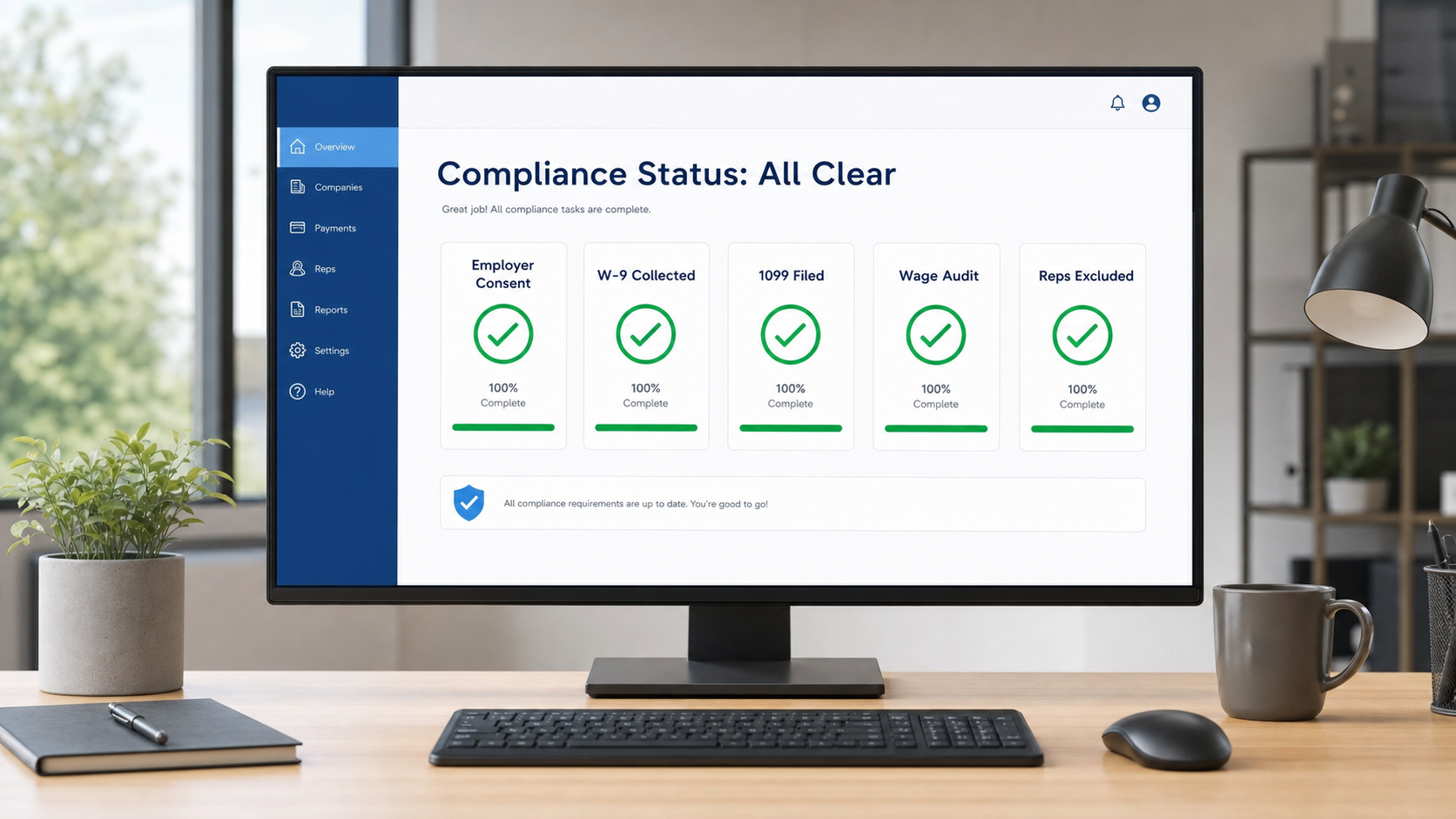
The safest approach builds SPIFF compliance around four operational pillars: W-9 gating at enrollment, explicit employment-status disclaimers in program terms, automated 1099 threshold tracking, and partner company consent on file before any payout. When those four controls are built in from day one, compliance is an operational property of the system rather than a manual review step added after launch.
- Centralized enrollment with W-9 gating. No rep can join, and no payout can be issued, until a valid W-9 is captured and verified. This single control prevents the most common IRS exposure in dealer-rep SPIFF programs.
- Program terms that explicitly disclaim employment status. Every participant agrees up front that the SPIFF is a manufacturer promotion, not an employment benefit, and that participation is subject to employer approval and category restrictions.
- Automated 1099 tracking against the $2,000 threshold. The system tracks cumulative payments per rep and flags 1099-MISC obligations automatically as reps approach the 2026 reporting threshold described by Avalara. Manual spreadsheets cannot do this reliably at scale.
- Partner company consent on file before any payout. No funds move until signed employer consent is recorded against the program — protecting both the manufacturer and the partner relationship.
The following table shows how each control maps to a specific compliance risk and the documentation it produces:
| Control | Risk It Closes | Required Documentation |
|---|---|---|
| Employer consent on file | Tortious interference, partner relationship damage | Signed consent form from partner company principal |
| W-9 gating before enrollment | IRS backup withholding (24%), penalty exposure | Completed IRS Form W-9 per rep |
| 1099-MISC at $2,000 threshold | Tax misreporting, self-employment tax error | Annual 1099-MISC per rep exceeding threshold |
| State wage-law audit | Unpaid wage claims under FLSA and state law | Rep certification re: compensation agreement |
| Government/healthcare exclusion | DOJ kickback claim, Anti-Kickback Statute felony | Enrollment screening + program terms exclusion clause |
When these controls are built in from the start, SPIFF compliance stops being a quarterly fire drill and becomes the default state of the program. A purpose-built incentive program management platform enforces all four principles automatically, removing the manual gaps where most compliance failures begin.
Implementation in Practice
A mid-market building materials manufacturer operating a dealer-rep SPIFF program across 12 states discovered during a compliance review that fewer than 40% of enrolled reps had valid W-9s on file — yet payouts had been processed regardless. After implementing enrollment gating and automated 1099 threshold monitoring, the program reached 100% W-9 coverage within one enrollment cycle.
The compliance upgrade eliminated the backup withholding exposure entirely. Enrollment completion rates held steady at prior levels — the added compliance layer created no measurable friction for participating dealer reps.
Frequently Asked Questions
Below are direct answers to the most common SPIFF compliance questions manufacturers ask before launching a dealer-rep incentive program.
Are SPIFFs legal in the USA?
Yes, manufacturer-paid SPIFFs are legal in the United States when properly structured. They require written employer consent, pre-enrollment W-9 collection, correct 1099-MISC reporting at the $2,000 threshold (effective 2026), and hard exclusions for government and healthcare purchasing reps. SPIFFs paid to government purchasing agents or healthcare procurement staff cross into illegal kickback territory under federal law regardless of intent.
What is the 1099 threshold for SPIFF payments in 2026?
The One Big Beautiful Bill Act of 2025 raised the 1099 reporting threshold from $600 to $2,000 for payments made on or after January 1, 2026. Manufacturers running SPIFF programs must file a 1099-MISC — not 1099-NEC — for any dealer rep who receives $2,000 or more in SPIFF payments during the calendar year. Payments below $2,000 no longer require federal reporting as of 2026.
Can a dealer employer prohibit SPIFF payments to their employees?
Yes. Partner companies retain the right to prohibit their employees from accepting third-party SPIFFs. Manufacturers must obtain written consent from the partner company before launching a SPIFF program. Without consent, paying a dealer rep directly may constitute tortious interference with the dealer’s employment agreements — creating liability for the manufacturer independent of tax issues.
Are SPIFF payments subject to self-employment tax?
No. SPIFF payments to dealer employees are reported on Form 1099-MISC as “other income” and treated as supplemental income on the recipient’s personal return. They are not treated as self-employment income and do not trigger self-employment tax. The key distinction is that the rep is an employee of the dealer, not an independent contractor running their own business.
What happens if a manufacturer fails to collect W-9s from dealer reps?
The IRS requires payers to obtain a completed Form W-9 before issuing payments subject to 1099 reporting. Failure to collect a W-9 exposes the manufacturer to backup withholding requirements — the payer must withhold 24% of the payment and remit it to the IRS. Best practice is to gate SPIFF enrollment so reps cannot receive payouts until a valid W-9 is on file.
Can SPIFF payments constitute wages under the FLSA?
Yes, under certain circumstances. A DOL opinion letter confirmed that manufacturer SPIFF payments can count toward a dealer employee’s minimum wage obligation if the employer incorporates them into the employment agreement. If those SPIFFs go unpaid, the dealer — and potentially the manufacturer — may face wage claims. Program terms should explicitly state that SPIFFs are a manufacturer promotion, not an employment benefit.
Do employers have to include SPIFFs in overtime calculations?
For manufacturer-paid SPIFFs routed as 1099-MISC other income, the payment does not pass through the dealer’s payroll and is generally not included in the dealer’s overtime base for the rep. However, if the dealer incorporates manufacturer SPIFFs into the employment agreement as wages, those amounts may need to be factored into the regular-rate calculation under FLSA overtime rules. Consult labor counsel for state-specific analysis.
Are SPIFFs legal in healthcare and government sales?
No. SPIFF payments to healthcare purchasing staff may violate the Federal Anti-Kickback Statute, a federal felony. Payments to government purchasing agents may constitute kickbacks under DOJ guidance. Manufacturers must hard-exclude participants who sell to government agencies or healthcare entities in their program terms and enrollment screening.
Conclusion
Durable SPIFF compliance rests on five practical controls: secure written partner company consent before launch, collect W-9s from every participating rep before the first payout, apply 1099-MISC reporting at the new $2,000 threshold, audit state wage-payment laws wherever your reps work, and hard-exclude government and healthcare purchasing reps entirely. Each control closes a distinct legal exposure, and together they convert a high-risk direct-payment program into a defensible one.
The manufacturers who manage this best treat SPIFF compliance as a design requirement — not an afterthought. That is exactly where Level 6’s platform earns its place, enforcing W-9 gating, employer-consent capture, automated 1099 tracking, and employment-status disclaimers as built-in defaults. Ready to build a compliant SPIFF program? Contact our team to see how Level 6 handles the compliance layer end-to-end.