
By Claudine Raschi, MS · Last updated: November 2026
Quick Answer: What Is Consumer Rebate First Party Data?
Consumer rebate first party data is information shoppers give you directly when they file a claim. Collect only what you need to validate and pay it, ask for marketing permission separately, and keep every record clean and traceable.
Why Build First Party Data at the Rebate Claim?
A claim is a permissioned data event: the shopper chose to hand over details in exchange for a payout. For manufacturers that sell through retailers or distributors, consumer rebate first party data can be a direct record of who bought when an upfront discount or instant rebate gives you none. Our digital rebate program guide notes that a digital claim can yield serial number, purchase date, retailer, ZIP code, contact details, payout preference and marketing consent.
The contrast with discounting is stark. On its rebate programs page, Level 6 describes upfront discounting as “Zero data; you don’t know who bought the product,” while strategic rebate programs offer “High-value; captures 1st-party customer data and receipts.” For a wider look at the topic, see our rebate versus discount post.
Why does this matter? Not because third-party cookies were switched off by default in Chrome. In April 2025, Google’s Privacy Sandbox update said it would maintain its current approach to offering users third-party cookie choice in Chrome, with no new standalone prompt. In our view, consumer rebate first party data matters because you control its consent and quality.
McKinsey & Company’s privacy-first marketing article from 2021 puts it this way: “Any sustainable first-party data strategy must have the customer relationship at its core.” A consumer rebate first party data program should therefore treat the claimant as a customer, not a lead to be harvested.
This post covers strategy and governance. For claim formats, see our guide to digital rebate formats; for program privacy, see our data privacy post.
How Do First-Party, Zero-Party and Third-Party Data Differ?
First-party data is what you collect directly from your own customers, such as the purchase details on a claim. Zero-party data is information a customer chooses to volunteer, such as an optional ownership answer. Third-party data is collected by someone else and sold or shared, such as a bought contact list. These are our working definitions.
A rebate claim can produce the first two. That is why consumer rebate first party data tends to be easier to trace than a purchased list: you know where it came from and what the shopper agreed to.
What Should a Rebate Claim Form Collect?
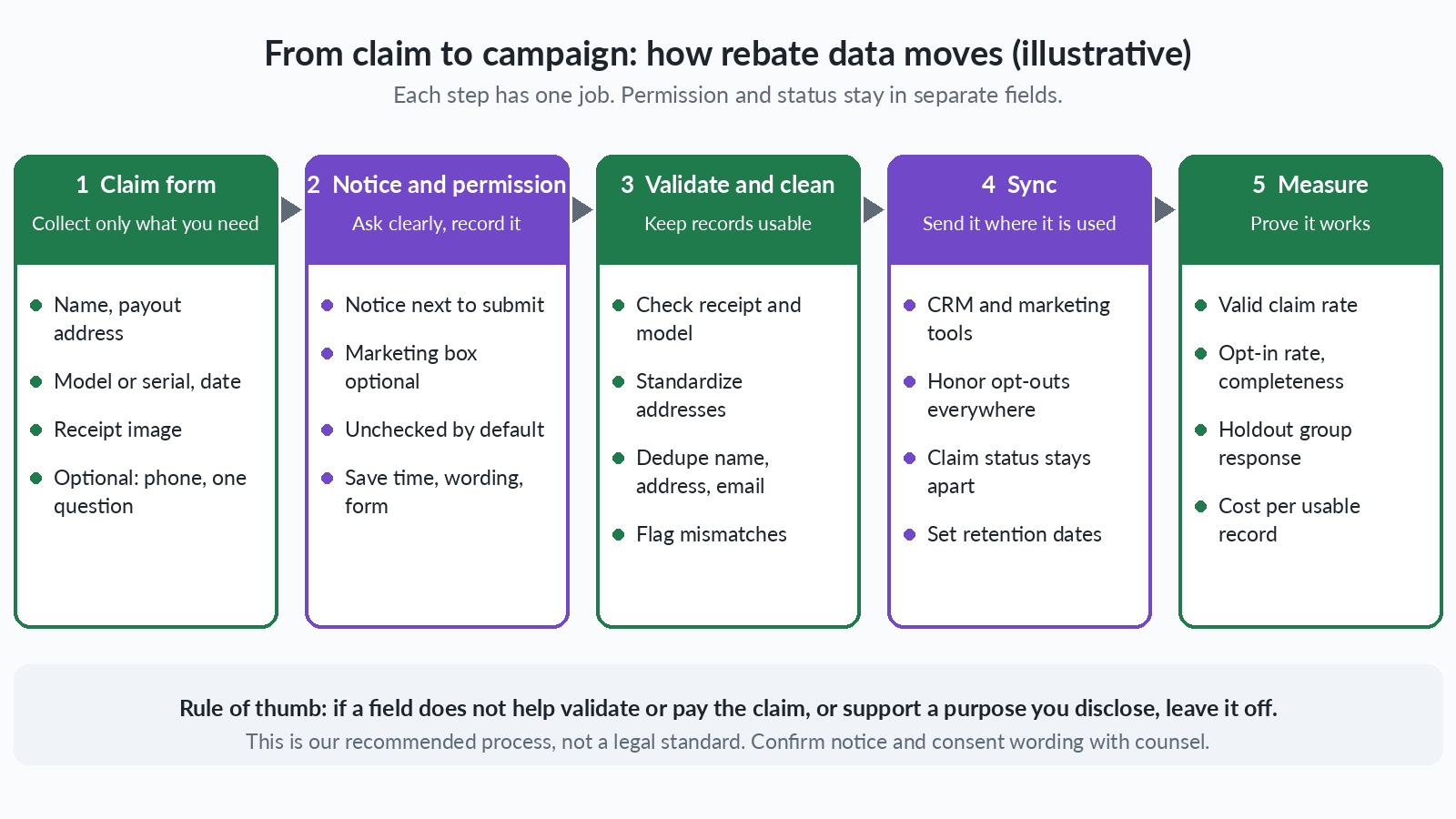
A consumer rebate first party data claim form should collect what you need to validate and pay the claim, plus a small number of optional fields you can justify. The 12 fields below are our recommendation, not a sourced standard. Adjust them to your product category and confirm them with counsel.
| Field | Why you need it | Required or optional | Handling note |
|---|---|---|---|
| Name | Identifies the claimant | Required | Match to the name on the receipt where shown |
| Payout address | Delivers the payout | Required | Standardize the address at entry |
| Sends claim status updates | Required for status | Marketing permission is a separate question | |
| Phone | Resolves claim problems | Optional | Text marketing needs its own permission; ask counsel |
| Product model or serial | Validates eligibility | Required | Check against eligible models |
| Purchase date | Validates the promotion window | Required | Check against the promotion dates |
| Retailer | Validates the purchase and enables channel analysis | Required, or inferred from the receipt | Use a controlled list, not free text |
| Receipt image | Proves the purchase | Required | Store securely and set a retention date |
| ZIP code | Supports regional analysis | Optional, or taken from the address | Do not ask twice |
| Ownership or purchase-intent question | Informs follow-up offers | Optional | Keep to one question |
| Marketing permission checkbox | Records consent to marketing | Optional | Unchecked by default, separate from the claim |
| Payout preference | Routes the reward correctly | Required | Offer only the methods you support |
Why Collect Only What You Need?
Every extra field adds friction, risk and cleanup to your consumer rebate first party data. The California Privacy Protection Agency’s CCPA regulations say that collection, use, retention and sharing of personal information “shall be reasonably necessary and proportionate to achieve” the purpose for which it was collected or another disclosed compatible purpose.
Our own data privacy guidance points the same way. We apply a simple test: if a field does not help validate the claim, pay it, or support a purpose you disclose, leave it off the form.
How Do You Ask for Marketing Permission Properly?
If the CCPA applies to your business, give a notice at collection at or before the point of collection, then ask for marketing permission as a separate, optional choice. In our view, that is the core of good consumer rebate first party data practice.
The California Attorney General’s CCPA FAQ says the notice must list the categories of personal information collected and their purposes, link to the privacy policy, and include a Do Not Sell or Share link if the business sells personal information. It applies only to businesses the CCPA covers, so check your coverage and any other state laws with counsel.
Placement matters. For webforms, the regulations say a business “may post a conspicuous link to the notice in close proximity to the fields in which the consumer inputs their personal information, or in close proximity to the button by which the consumer submits their personal information.”
We use a simple pay first, permission second test: the claim must be payable without any optional field, and marketing permission is asked only after the shopper sees what they are agreeing to. We recommend these practices for a consumer rebate first party data form:
- Use a separate, unchecked marketing permission box, written in plain language.
- Keep a consent audit trail: the timestamp, exact wording and source form for every permission record.
- Keep marketing permission optional, and never tie the payout to it.
- Place the notice link beside the submit button.
On that third point, McKinsey’s article states it is against CCPA regulations to directly exclude customers from discounts or services because they opted out of data collection. Confirm with counsel how this applies to a rebate.
What Are the Basic Email and Text Rules?
If you send marketing email built on consumer rebate first party data, CAN-SPAM may apply. The FTC’s CAN-SPAM guide says the law covers all commercial email and “makes no exception for business-to-business email.” It requires non-deceptive headers and subject lines, identification of the message as an ad, a valid physical postal address and a clear way to opt out.
Penalties can reach $53,088 for each separate violating email, according to the same guide. Ask counsel which of your rebate messages count as marketing. Text marketing has separate consent rules, so check those with counsel before you add a phone question.
How Do You Keep Rebate Data Clean?
Clean consumer rebate first party data starts at intake and continues through the program. Validate receipts before approval by matching the model, serial number and date to the receipt and checking for a reused one. Standardize addresses, and dedupe on name, address and email. Flag mismatches for review instead of silently overwriting them. Also review duplicate claims: the same receipt, serial number or address on more than one claim deserves a second look.
Keep claim status separate from marketing status. A claim can be approved, denied or pending without changing whether the person agreed to marketing. In our view, mixing the two makes it easy to send marketing to someone who never agreed to it.
Connect the data to the systems that use it. Level 6 describes an integration-first platform architecture that connects directly with marketing automation, e-commerce, POS and CRM systems. Whatever you use, honor opt-outs everywhere and offer a preference center.

How Can You Use Consumer Rebate Data After the Claim?
Use consumer rebate first party data to build segments and send relevant, permitted follow-ups. Our recommended segments are product line, retailer and purchase timing. Retailer-level analysis can show where buyers purchased, which an instant rebate often cannot show unless the retailer shares data.
Common downstream uses include:
- Post-purchase onboarding and how-to content.
- Accessory and replacement offers timed to the purchase date.
- Warranty registration reminders.
- Suppression lists so opted-out records never receive marketing.
Use holdout groups to test incrementality, meaning whether your messaging changes behavior. Leave a random set of opted-in records out of a campaign and compare their response with the group that received it. For redemption context, see our redemption rate post, and for program design, see our rebate program design guide.
What Should You Measure?
Measure the quality of your consumer rebate first party data and downstream response, not only redemption. We suggest these definitions, and we recommend setting your own baselines:
- Valid claim rate: approved claims divided by submitted claims.
- Marketing opt-in rate: claimants who granted permission divided by approved claimants.
- Record completeness: the share of records with every field you need.
- Bounce rate: the share of emails that fail to deliver.
- Downstream response versus holdout: the lift your messaging produces.
- Cost per usable record: program data costs divided by records that are valid, complete and permitted.
Level 6 describes reporting dashboards that track redemption rates, breakage, participation levels, program ROI, reward distribution and claim approval timelines. We suggest tracking the data quality metrics above in addition to those program measures.
Who Owns the Data and How Long Do You Keep It?
Settle ownership, retention and access before launch. If an agency or platform runs your program, the contract should say who owns the consumer rebate first party data, what the vendor may do with it, and what happens when the contract ends. Also settle who ends up with the record when a buyer claims through a retailer program, because brand-held and retailer-held data are not the same thing. For vendor selection, see our rebate management RFP guide.
Plan for deletion. Our privacy guidance recommends deleting information when it is no longer useful. Restrict internal access by role, and review who can see receipts and contact details. For a structured review process, see our channel incentive program audit guide.
What Does Level 6 Offer?
For consumer rebate first party data programs, Level 6 describes building branded rebate portals where participants submit claims, upload receipts and track redemption status, with every claim verified against eligibility criteria. See our full rebate programs approach or our wider incentive solutions.
Frequently Asked Questions
What is consumer rebate first party data?
Consumer rebate first party data is information a shopper gives you directly when filing a rebate claim, such as purchase details, contact information and marketing permission. Because the shopper supplied it to you, you control how it is collected, consented and kept clean. We recommend separating what is needed to pay the claim from what is optional.
What should a rebate claim form collect?
A claim form should collect what you need to validate and pay the claim: name, payout address, email for status updates, product model or serial, purchase date, retailer, receipt image and payout preference. Everything else, such as phone, ownership questions and marketing permission, should be optional. In our view, every extra field needs a reason you can state in plain language.
Should marketing permission be required to get a rebate?
No, and we recommend against it. Use an optional, unchecked marketing checkbox that is separate from the claim. McKinsey’s 2021 article states it is against CCPA regulations to directly exclude customers from discounts or services because they opted out of data collection. Confirm with counsel how that applies to your rebate and your state footprint.
Where should the privacy notice appear on a claim form?
The notice must be given at or before the point of collection if the CCPA applies to your business. The CCPA regulations say a business collecting through a webform may post a conspicuous link near the fields or near the submit button. We recommend placing it next to the submit button and confirming the wording with counsel.
Do email marketing rules apply to rebate follow-ups?
Yes, CAN-SPAM can apply to marketing email sent to rebate claimants. The FTC says CAN-SPAM covers all commercial email and makes no exception for business-to-business messages. It requires accurate headers and subject lines, identification as an ad, a valid postal address and a clear opt-out. Ask counsel which of your rebate messages count as marketing and which are status updates.
How do you keep rebate claim data clean?
Validate receipts and product models at intake, standardize addresses, and dedupe on name, address and email. Flag mismatches for review rather than deleting them. Keep claim status and marketing status in separate fields so an opt-out never changes whether a claim is paid, and sync opt-outs to every system that sends messages.
How do you know if rebate data is working?
A holdout group is the clearest way to test whether rebate data follow-ups work. Hold back a small, randomly selected set of opted-in records from a campaign and compare their response with the group that received it. Alongside that, track valid claim rate, marketing opt-in rate, record completeness, email bounce rate and cost per usable record. We recommend setting your own baselines first.
What is the difference between first-party, zero-party and third-party data?
First-party data is what you collect directly from your own customers, such as claim details. Zero-party data is information a customer chooses to volunteer, such as an optional ownership answer. Third-party data is collected by others and sold or shared. These are our working definitions, and a rebate claim can produce the first two.
Final Takeaways
- Treat every claim as a permissioned source of consumer rebate first party data, and collect only what you need to validate and pay it.
- Place the notice at collection near the submit button, and keep marketing permission optional, unchecked and separate.
- Measure data quality and use holdout groups to prove that follow-up messaging works.
If you want help designing a claim form and data plan that your counsel can review, talk with the Level 6 team about your rebate program.