
Quick Answer: What Is Co-Op Marketing Claims Fraud?
Co-op marketing claims fraud is any reimbursement request a channel partner submits for advertising that was inflated, duplicated, never run, ineligible, backdated, or padded. Automated pre-payout validation catches each vector while the money is still yours.
Co-op advertising is one of the largest discretionary line items manufacturers hand to their channel, and one of the least verified. Most programs review claims for completeness rather than truthfulness, so a complete packet clears even when the activity never ran.
That gap is where co-op marketing claims fraud lives. It is rarely a single dramatic theft, but a steady leak of marked-up invoices, duplicate submissions, and rounded-up amounts that pass because nobody had time to check the evidence.
Below are the six co-op marketing claims fraud vectors we see most often, paired with the validation automation check that catches each one before payment clears.
How Does a Co-Op Advertising Claim Work?
Co-op advertising is a cost-sharing arrangement in which a manufacturer reimburses a channel partner — a retailer, dealer, or distributor — for a portion of qualifying marketing spend that promotes the manufacturer’s products. A partner spending $8,000 on approved advertising at a 50% co-op rate, for example, submits a claim and receives a $4,000 reimbursement.
Every co-op marketing claims lifecycle follows five stages: fund accrual, pre-approval, campaign execution, proof submission, and validation with reimbursement. Manufacturers running channel incentive programs at scale rely on automated validation at the final stage to catch fraud before it clears — not after. Co-op marketing claims fraud can enter the process at any of those stages — inflating amounts at the accrual stage, fabricating campaigns at execution, or falsifying proof at submission. A validation layer applied before payment clears is the only control that catches fraud consistently across all five stages.
The five stages in sequence:
- Fund accrual. The partner earns a co-op balance as a percentage of purchases from the manufacturer — typically 1% to 3% of net sales.
- Pre-approval. The partner submits a campaign plan for brand and eligibility review before running the ad.
- Campaign execution. The partner runs the approved activity — print, digital, broadcast, direct mail, or events.
- Proof submission. The partner files a claim with proof of performance: dated invoices, tearsheets, screenshots, or ad-server reports.
- Validation and reimbursement. The manufacturer reviews the claim against the approved plan, validates the proof, and issues payment for eligible spend.
How Much Do Manufacturers Lose to Co-Op Fraud Each Year?
Channel incentive program abuse costs manufacturers up to $1.4 billion in lost profits each year, according to a Deloitte & Touche and AGMA study reported by CRN. Co-op and market development funds carry a large share of that exposure, because they are reimbursed on partner-supplied paperwork.
The affected share of business is larger than most finance teams assume. Respondents in the same Deloitte & Touche and AGMA research estimated that incentive abuse may touch up to 25 percent of all channel sales, and two-thirds of surveyed vendors work with more than 5,000 partners.
Exposure to co-op marketing claims fraud scales with partner count. Volume turns manual review into rubber-stamping, because a reviewer with 400 claims and four days checks arithmetic, not authenticity.
The pool at risk is enormous. U.S. manufacturers make available an estimated $36 billion to $70 billion in co-op advertising funds annually, and MediaPost, reporting Local Search Association research, found that up to $35 billion of those funds go unclaimed each year.
Unclaimed funds and claims abuse share one root cause: weak program mechanics. Practitioners commonly estimate abuse consumes Co-op fraud is a documented, material risk at every scale of manufacturer-to-channel program.
What Are the Six Co-Op Claims Fraud Vectors?
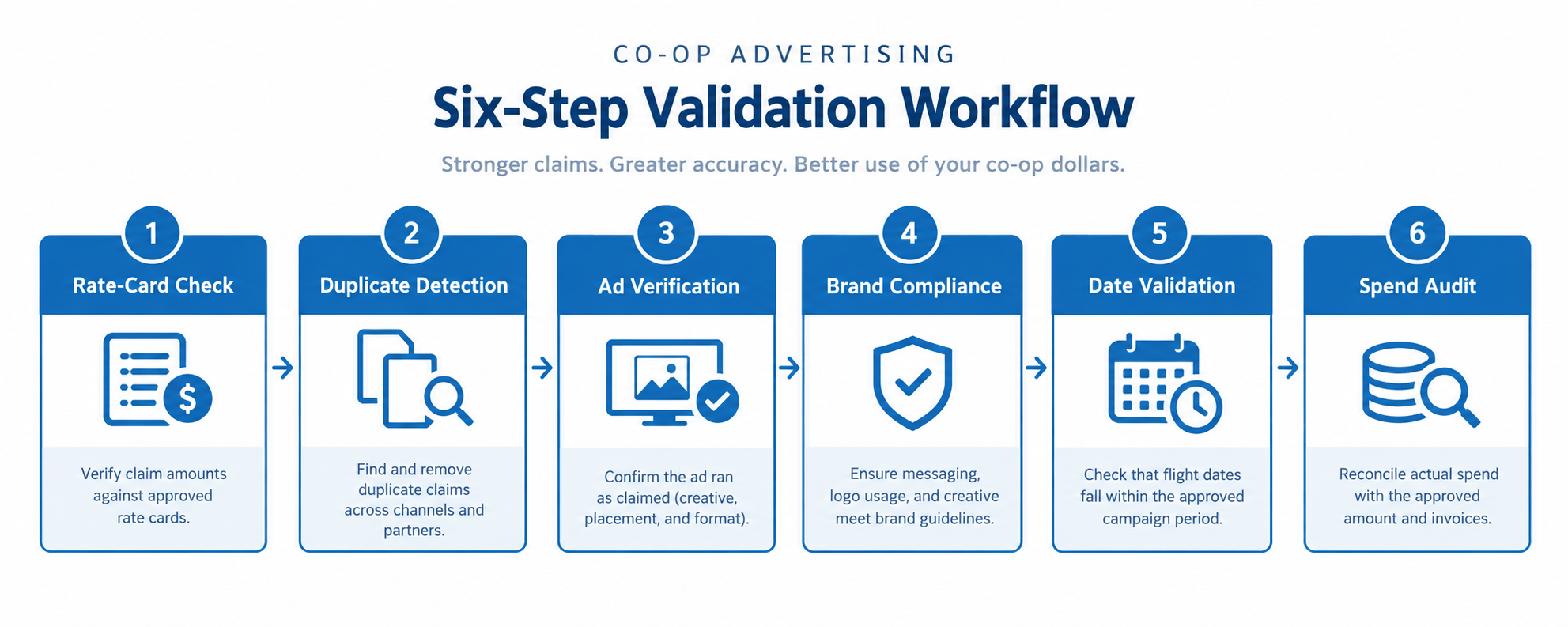
Six vectors account for nearly all co-op marketing claims fraud we encounter: inflated media invoices, double-billing, fictitious campaigns, off-brand activity, fund period manipulation, and claim amount padding. Each needs its own automated control, because no single document review catches them all.
1. Inflated Media Invoices
Inflated invoicing is the submission of media costs above the price the outlet actually charged. It concentrates in print and broadcast, where a manufacturer cannot easily confirm an invoice with the publisher directly, so the marked-up difference stays with the partner.
This co-op marketing claims fraud vector hides inside legitimate activity: the campaign ran and only the number is wrong.
Validation check: automated rate-card comparison. The platform benchmarks each invoice against published rates for that outlet, format, and market. Any claim exceeding the rate card by more than 10 percent is held for review rather than rejected, since negotiated packages can explain a legitimate variance.
2. Double-Billing and Duplicate Claims
Double-billing is the submission of the same campaign or invoice twice, either to one manufacturer across two claim cycles or split across co-op programs from two brands. Multi-vendor partners representing competing manufacturers are the highest-risk population.
Exact matches are only the starting point for this co-op marketing claims fraud vector, because a partner may repunctuate an invoice number or rename identical creative.
Validation check: cross-claim deduplication. The system normalizes invoice numbers and vendor names, then matches claim IDs, invoice numbers, dates, amounts, media vendors, and creative fingerprints across every open, approved, and recently paid claim. A match on three or more fields blocks payment and routes both records to a reviewer queue.
3. Fictitious Campaigns That Never Ran
Fictitious campaign claims use manufactured proof to seek reimbursement for advertising that never ran. In digital, that means screenshots of creative never trafficked, sometimes mocked up in an image editor. In print, it means tearsheets for placements never booked.
Detecting this co-op marketing claims fraud vector requires evidence of delivery, not of design: a screenshot proves the creative exists, not that an impression was served.
Validation check: third-party ad verification. Digital claims must carry served-impression data, campaign IDs, run dates, and an ad server report. Print claims are cross-referenced against publication tearsheet records or require a publisher signature, while broadcast claims need station logs tied to the approved schedule.
4. Off-Brand or Ineligible Activity
Off-brand claims use manufacturer co-op dollars to promote the partner’s own brand, or to fund activity the program never covered: internal training, operations costs, or unrelated trade show attendance. These expenses are often masked inside vague marketing invoices.
This co-op marketing claims fraud vector is often negligence rather than intent, which does nothing to make the reimbursement appropriate.
Validation check: automated brand compliance scan. Submitted creative is reviewed against brand guidelines for logo usage, required taglines, and product imagery. A separate eligibility engine confirms the activity type appears in the current program guide, and creative failing a mandatory rule is returned for correction before payment.
5. Fund Period Manipulation and Timing Fraud
Timing fraud is the submission of claims for activity outside the eligible program period, usually by backdating invoices or proof-of-performance documents into a fund accrual window. It reopens a budget that should have expired.
This co-op marketing claims fraud vector spikes at quarter and year end, when partners race to consume expiring accruals, and a single date inside the window is not sufficient proof.
Validation check: date-anchored validation. The platform cross-references invoice date, media run date, proof date, and submission deadline against the approved program period. Any required date outside the window triggers a hold for human review.
6. Claim Amount Padding
Claim padding is rounding actual spend up to the nearest reimbursement tier, or claiming a full allocation when documented spend was lower. A partner who spent $850 submits $1,000, and the variance is small enough that nobody escalates it.
Padding is the subtlest co-op marketing claims fraud vector and directionally identical to invoice inflation, and across thousands of claims a quarter small roundings compound into a material variance.
Validation check: spend-to-claim ratio audit. The system recalculates the allowed payment from documented eligible spend, subtracting excluded costs before applying the co-op percentage and any cap. If eligible spend is $8,000 and the program reimburses 50 percent, the maximum valid reimbursement is $4,000, not the partner’s fund balance.
What Documentation Is Required for a Co-Op Reimbursement Claim?
A defensible co-op claim requires four artifacts: a paid media invoice, proof of performance showing the advertising ran, evidence the creative was brand compliant, and dates placing the activity inside the eligible program period. Missing any one makes the claim unverifiable.
Proof of performance is the artifact most often fabricated in co-op marketing claims fraud, so requirements should vary by activity type.
Most manufacturers require partners to submit claims through a digital portal that captures each proof element, tracks status in real time, and enforces submission windows. Typical programs require claims within 60 to 90 days of campaign completion — partners who miss the deadline forfeit their reimbursement regardless of how clean the claim is.
The most common reasons co-op claims are rejected: missing or illegible proof of performance, submission outside the program window, ineligible activity that did not receive pre-approval, brand noncompliance in the creative, and an invoice amount that does not match the approved plan. Each of those rejection reasons also doubles as a fraud signal — a claim that fails multiple checks simultaneously warrants escalated review rather than a simple reject-and-resubmit.
How Do Manufacturers Validate Co-Op Advertising Claims?
Manufacturers validate co-op claims by automating verification before payment rather than auditing after it. A claims platform applies rate-card checks, deduplication, date validation, brand scanning, and spend-to-claim audits to every submission, escalating only exceptions to reviewers.

Pre-payout validation is the structural fix for co-op marketing claims fraud. Post-payment auditing recovers some money and damages every partner relationship it touches; pre-payout controls prevent both the payment and the argument.
Seven capabilities define a co-op claims validation layer worth deploying:
- Activity-specific proof of performance: documentation set by activity type, not one generic form.
- Invoice verification: amounts benchmarked against rate-card databases.
- Cross-claim deduplication: multi-field and fuzzy matching across all open claims.
- Brand compliance scan: automated creative review against current brand guidelines.
- Date validation: invoice, run, and proof dates checked against the program period.
- Spend-to-claim ratio audit: reimbursement capped at documented eligible spend.
- Complete audit trail: every decision recorded with reviewer, rule, and rationale.
Platform-level controls produce measurable gains. Working with a national building materials manufacturer (within a single enrollment cycle), we moved partner W-9 compliance from 60 percent to 100 percent by making valid tax documentation a system requirement.
In a state agency incentive program, structured identity and eligibility validation reduced assessed fraud risk by 99 percent, because the controls ran at submission rather than reconciliation.
Validation also changes partner behavior: when partners see that dates, invoices, and creative are checked every time, speculative claims stop arriving. Our analysis of fraud risks in channel incentive programs covers how that deterrent effect extends to rebates and SPIFFs.
Manufacturers that instrument their validation layer track four return-on-investment (ROI) metrics to quantify the program’s value: invalid-claim rate (percentage of submitted claims flagged), dollars prevented before payout (the dollar value of rejected fraudulent claims), exception-review rate (share of flagged claims that escalate to a human reviewer), and per-claim processing cost and time. A mature validation platform typically reduces exception-review rates by 60% to 80% relative to manual review alone, because automated checks resolve the clear-cut cases before a human analyst ever opens the file.
How Does the Robinson-Patman Act Apply to Co-Op Advertising?
The Robinson-Patman Act requires manufacturers to make co-op advertising allowances available to all competing customers on proportionally equal terms. co-op marketing claims fraud controls must therefore apply uniformly, because selective enforcement creates legal exposure of its own.
The obligation is explicit in federal guidance. The Federal Trade Commission states that the Act forbids certain discriminatory allowances or services and, in general, requires a seller to treat all competing customers in a proportionately equal manner.
Sections 2(d) and 2(e) are the operative provisions. As the FTC’s Fred Meyer Guides state, a seller paying resellers for promotional services must offer those payments to all competing customers on proportionally equal terms, and a proven violation is automatic without any showing of competitive injury.
Can Manufacturers Recover Fraudulently Paid Co-Op Funds?
Recovery is possible, but it depends on contract language and documentation. Manufacturers can claw back reimbursements when program terms establish a clawback right, define the audit window, and set the evidence standard for reversing a paid claim.
Recovery rates fall fast. A claim discovered two quarters after payout competes with staff turnover, lost records, and disputed recollections, and pursuit often costs more than the amount at stake.
That is why clawback is a backstop rather than a strategy for co-op marketing claims fraud. Our guide to co-op fund clawback rules details the contract provisions and audit timelines that make recovery enforceable when prevention fails.
Frequently Asked Questions
Below are the questions channel marketing managers and finance teams ask most often about co-op marketing claims fraud and how to prevent it.
What is co-op marketing claims fraud?
Co-op marketing claims fraud is the submission of false or overstated reimbursement requests against a manufacturer’s co-op advertising program. It covers inflated invoices, duplicate submissions, campaigns that never ran, ineligible activity, backdated documents, and padded amounts. Most of it clears payment because manual review confirms whether a claim packet is complete, not whether it is true.
What are the most common types of co-op advertising fraud?
Six vectors account for most losses: inflated media invoices priced above rate card, double-billing the same invoice across cycles or brands, fictitious campaigns supported by fabricated proof of performance, off-brand or ineligible activity, fund period manipulation through backdating, and claim amount padding. Each vector maps to one specific automated check that runs before payment clears.
What is proof of performance in co-op advertising?
Proof of performance is documentation showing that an advertisement actually ran as claimed. Common forms include print tearsheets, broadcast affidavits of performance, ad server logs, and screenshots paired with served-impression data. It is the artifact most often fabricated in co-op claims, which is why publisher-verified proof carries more weight than a partner-supplied screenshot.
How do manufacturers validate co-op advertising claims?
Manufacturers validate claims by automating verification before payout. A claims platform benchmarks invoices against rate cards, deduplicates across open claims, checks dates against program periods, scans creative for brand compliance, and audits spend-to-claim ratios. Human reviewers see only flagged exceptions, and every decision is logged in an audit trail for disputes and compliance review.
Can manufacturers recover fraudulently paid co-op funds?
Recovery is possible when program terms establish a clawback right, define the audit window, and set the evidence standard for a reversal. In practice, recovery rates fall quickly as partner staff turn over and records disappear, and pursuit often costs more than the amount at stake. Clawback is a backstop, never a control strategy.
How much do manufacturers lose to co-op fraud each year?
Deloitte & Touche and AGMA research reported by CRN puts channel incentive abuse at up to $1.4 billion in lost profits annually, with respondents estimating it may affect up to 25 percent of channel sales. Against a U.S. co-op pool estimated at $36 billion to $70 billion, even low single-digit leakage is material.
What is the Robinson-Patman Act and how does it apply to co-op advertising?
The Robinson-Patman Act is a federal price discrimination law. Under Sections 2(d) and 2(e), a manufacturer paying resellers for promotional services must offer those payments to all competing customers on proportionally equal terms. The FTC also requires sellers to inform every competing customer that allowances exist, so validation rules must apply uniformly across partner tiers.
What is co-op advertising?
Co-op advertising is a marketing cost-sharing program in which a manufacturer reimburses channel partners — retailers, dealers, or distributors — for a portion of qualifying advertising spend that promotes the manufacturer’s brand or products. Partners earn a co-op balance as a percentage of their purchases, then submit claims with proof of performance to receive reimbursement after a campaign runs. Co-op programs transfer marketing execution to local partners while keeping brand standards enforced at the manufacturer level.
Can you give an example of co-op advertising?
A national HVAC manufacturer allocates a 2% co-op fund on all distributor purchases. A regional distributor with $500,000 in annual purchases earns a $10,000 co-op balance. The distributor runs a local digital ad campaign promoting the manufacturer’s equipment line, spends $8,000, and submits a reimbursement claim with invoices and ad-placement screenshots. At a 50% reimbursement rate, the manufacturer pays $4,000 after the claim clears validation — confirming the campaign ran, the spend matches the invoice, and the creative meets brand guidelines.
Final Takeaways
Here is what every manufacturer managing a co-op or MDF program should keep front of mind when evaluating their claims validation process.
- The loss is documented, not theoretical. Channel incentive abuse costs up to $1.4 billion in annual profit and may touch a quarter of channel sales.
- Six vectors cover nearly every case. Inflated invoices, double-billing, fictitious campaigns, off-brand activity, timing manipulation, and amount padding drive the losses.
- Every vector has a matching automated check. Rate-card comparison, deduplication, ad verification, brand compliance scanning, date-anchored validation, and spend-to-claim audits each close one co-op marketing claims fraud gap.
- Pre-payout validation beats clawback. Holding a suspect claim costs a review cycle; recovering a paid one costs money, time, and partner trust.
- Uniform enforcement is a legal requirement. Robinson-Patman obligations mean controls must apply to every competing partner on proportionally equal terms.
If you are sizing the exposure in your own program, we can map claim volume against your current controls and show which co-op marketing claims fraud vectors your process would miss today, so review our channel program solutions or talk with our team about a pre-payment validation review.