Quick Answer: What Makes a Channel Partner Tier Program Work?
A tier program works when most active partners can realistically advance, benefits stack meaningfully at each level, and status can be lost as well as earned. Strong channel partner tier program design targets the mid-tier majority with reachable thresholds and a fixed review cadence.
Why Most Channel Partner Tier Programs Fail to Motivate the Middle
Most tier programs are built to celebrate partners who would have succeeded anyway. Effective channel partner tier program design targets the middle of the partner base, where incremental behavior change is still available and the biggest unrealized growth opportunity sits.
In a typical channel ecosystem, according to channel program benchmarking reported by Unifyr Channel Atlas research, revenue concentration in partner programs is typical, with top-performing partners often generating a disproportionate share of channel revenue — industry-observed data consistently shows the top 10% to 20% of partners generating 70% to 80% of channel revenue, while the 60% to 70% in the middle represent the largest untapped growth pool. When tiers are built only around top-end volume, those middle partners learn that advancement is unrealistic, and they stop trying.
Forrester frames the goal plainly: a program should offer multiple tiers awarded according to each partner’s relative value and commitment, not simply purchase history (Forrester). Tiers are a behavior-shaping instrument, not a leaderboard. We see this problem often when manufacturers add tiers but do not change field coverage, margins, MDF access, or training support — a decorative structure does not change partner math or partner attention.
If you are still defining the building blocks, our overview of what tiered incentives are is a useful starting point.
What Criteria Actually Drive Partner Tier Advancement?
The right criteria combine revenue proof with capability proof. Strong channel partner tier program design measures what a partner sold, how they sold it, and whether they are building capacity to sell more next quarter.
We recommend five production-based qualification criteria that a partner can deliberately influence: partner-sourced revenue, certified reps, joint business plan participation, co-marketing engagement, and service SLA compliance.
1. Partner-Sourced Revenue
Partner-sourced revenue — not merely partner-fulfilled volume — is the cleanest signal of genuine demand creation. This requires deal-registration mechanics that timestamp who sourced the opportunity and protect that partner’s margin through close. Without registration, “sourced” becomes unverifiable and the criterion collapses into total volume.
2. Certified Reps
A minimum number of certified individuals proves a partner has invested in the capability to sell and support your product, not just resell it. Certification counts should escalate by tier — a handful at entry level, many multiples at the top — and they predict retention and service quality in ways that revenue alone cannot replicate.
3. Joint Business Plan Participation
A signed, jointly owned business plan converts a transactional reseller into a co-invested partner with shared targets. One published manufacturer scorecard weights the joint business plan and the quarterly business review at roughly 10% each, signaling that planning behavior earns real points in channel partner tier program design (a major manufacturer’s publicly available channel distribution program guide — industry practice).
4. Co-Marketing Engagement
Co-marketing participation measures whether a partner will invest its own brand and budget alongside yours to create demand. Qualification can be defined as completed campaigns, MDF utilization against plan, or a minimum number of joint demand-generation activities per period. Co-marketing requires partner skin in the game, which filters for genuine growth commitment.
5. Service SLA Compliance
Service-level compliance protects the end customer and your brand, ensuring advancement never rewards partners who sell well but support poorly. Typical measures include response-time adherence, customer-satisfaction thresholds, and accurate reporting of sell-through and inventory data. For more on which signals to track, see our guide to channel partner metrics that matter.
6. Specialization Pathways
Some manufacturers reward partners for developing vertical or product specializations — a formal process where a partner demonstrates expertise in, say, HVAC controls or industrial automation, and earns a “specialization badge” that counts toward tier advancement. Specialization criteria are especially useful when you want to reward capability depth over pure volume, and when you need partners who can represent complex SKUs without heavy manufacturer support. According to Forrester Research, partners with active product specializations show meaningfully higher complex-deal close rates than unspecialized partners at the same revenue tier.
Specialization pathways also give mid-tier partners a clear, non-revenue route to advancement during slow sales cycles — they can invest in training and certification when pipeline is thin and earn credit toward their next tier before their revenue recovers.
This broader model aligns with Deloitte Insights, which argues that partner programs should track financial KPIs alongside customer and enablement measures rather than relying on revenue alone. Thoughtful channel partner tier program design recognizes leading indicators — certified reps, registered pipeline, SLA scores — before they show up as lagging revenue. For manufacturers building broader incentive architecture around these measures, our guide on how to build a channel incentive program is a useful companion.
How to Set Tier Thresholds the Right Way
The right thresholds feel demanding but believable — what we call the “Goldilocks threshold.” Good channel partner tier program design makes the next level visible to the partners you most want to activate, especially your committed mid-tier group.
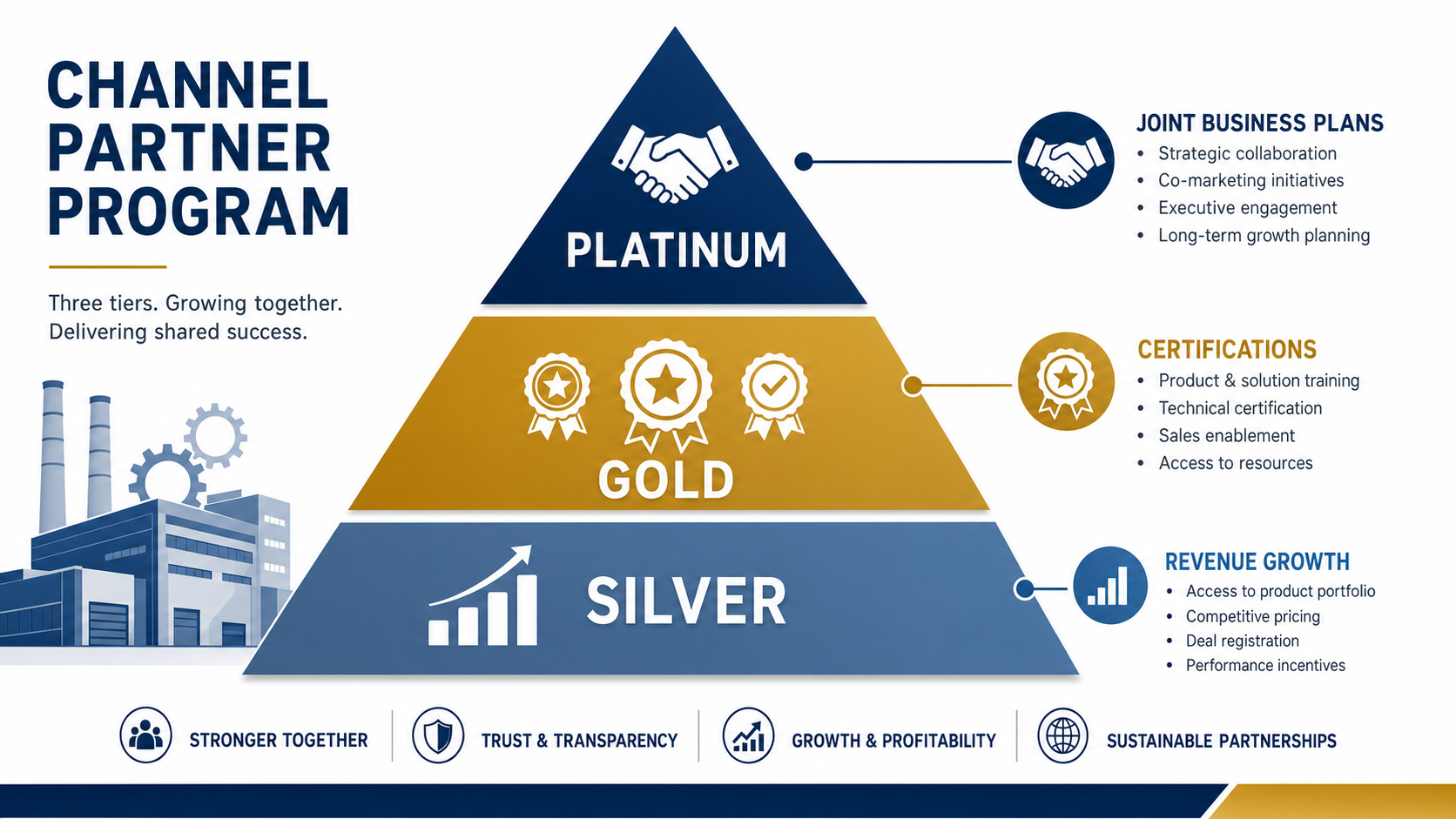
We recommend three tiers for most programs; four is the practical maximum. Three levels are easy for partners to understand, simple for channel teams to manage, and distinct enough for benefits to feel meaningful. Five or six-tier systems create distinctions too fine to administer and too small to motivate.
Start by segmenting only active partners, not every contracted account. Then plot active partners against each criterion, find where the broad middle of the distribution sits, and place the mid-tier threshold just above that point so roughly 60% to 70% can realistically reach it within a planning cycle. If a partner cannot advance within an 18-month window with focused effort, the threshold is too high.
Strong channel partner tier program design also avoids all-or-nothing revenue cliffs. Use weighted attainment, score ranges, or partial credit for certifications, registered pipeline, product mix, and reporting compliance. That logic mirrors guidance from McKinsey & Company, which notes that traditional KPIs often miss value created across the wider funnel and that companies should choose metrics capturing the full value-generation path.
What Benefits Should Each Tier Deliver?
| Benefit | Silver | Gold | Platinum |
|---|---|---|---|
| MDF access | Standard pool | Enhanced allocation | Priority + dedicated budget |
| Deal registration | Standard queue | Priority queue | Exclusive protection window |
| Partner manager time | Self-serve portal | Shared CAM | Dedicated CAM |
| Margin/rebates | Base rate | +2–4 pts | +5–8 pts |
| Product access | Standard | Early access | Roadmap input + beta access |
Benefits should change behavior, not just decorate status. The best channel partner tier program design makes each tier visibly better in ways that improve the partner’s economics, speed, and access — every level must answer: “What becomes easier or more profitable at the next tier?”
Silver: The Foundation Tier
Silver partners earn the baseline of a credible program: standard margins and rebates, deal-registration access, partner portal and standard enablement, and shared marketing assets. This tier should be reachable by any partner that fully complies with the program agreement, establishing a floor of professional treatment. Most active partners should clear it without heroics.
Gold: The Mid-Tier Engine
Gold is the tier your channel partner tier program design should be engineered around, because it is where the mid-tier majority converts latent capacity into active demand creation. Gold partners receive enhanced margins and rebates, priority deal registration, a defined MDF allocation, co-branded campaigns, and meaningful partner-manager time. The benefit jump from Silver to Gold must feel like a genuine upgrade in attention, economics, and co-selling support.
Platinum: The Strategic Tier
Platinum partners get the best margins, the largest MDF pools, earliest roadmap and product access, dedicated channel account management, and exclusive named opportunities. These benefits are reserved for partners delivering the broadest capabilities and the highest validated value. Platinum should feel scarce; if too many partners reach it, the benefits dilute and the economics break.
We advise manufacturers to publish benefits in four columns: financial rewards, sales access, marketing access, and support access. That format helps partners compare tiers quickly and helps your internal team defend why each benefit exists. Benefits also need compliance guardrails; our article on SPIFF program compliance covers the operational side.
For a concrete benchmark, see how a leading manufacturer’s Specialty Additives Channel Partner Program ties qualification to rebate eligibility, reporting discipline, planning tasks, and quarterly reviews. And our breakdown of how dealer incentive programs work shows where payouts actually influence behavior.

The Single Worst Mistake: Tiers That Can’t Be Lost
The most damaging error in channel partner tier program design is building tiers that can only be gained, never lost. Once status is permanent, partners who reached Gold or Platinum during a strong year keep premium margins, MDF, and access indefinitely — even as production declines. The program’s costs rise while its motivational power evaporates.
Permanent tiers also corrupt the distribution math. Over time, top tiers fill with legacy partners, benefits dilute, and you can no longer afford to make Gold genuinely attractive to the mid-tier base you most want to activate. The fix is structural: every tier is provisional, recomputed on the review cadence, and defended by clear downward-mobility rules. Sound channel partner tier program design makes status something partners must continually re-earn.
If no partner has dropped a tier in the last twelve months, the system has become a ratchet that only goes up. McKinsey’s work on B2B growth underscores that the highest performers govern their commercial systems deliberately rather than letting them run on autopilot (McKinsey & Company). Our guide to SPIFF program compliance outlines the documentation and audit habits that make tier recomputation defensible.
Watch for Cliff Effects and Gaming
Two secondary risks undermine otherwise well-designed tier systems. The first is the cliff effect: when the reward jump between tiers is very large at a specific threshold, partners who are close to the cutoff may sandbag — holding deals to the next quarter to secure their tier status before a review date. Smooth the incentive curve by ensuring that tier benefits increase proportionally across the range, not just at the threshold crossing.
The second risk is tier compression: over time, as your partner base matures, more partners accumulate certifications and JBPs, pushing an uncomfortable share of the program into Gold or Platinum. Build annual threshold reviews into your governance calendar — the same review cycle that reassesses tier placements should also reassess whether the thresholds themselves still reflect your top 15% target for Platinum.
Should Every Partner Climb the Same Tier Ladder?
Not always. Channel partner tier program design works best when you account for how different partners go to market — resellers, referral partners, OEM integrators, and service-led partners have fundamentally different production profiles. Applying a single revenue-and-certifications ladder to all of them creates structural unfairness that top consultants at McKinsey & Company call “motion mismatch” — you measure resellers on pipeline volume when your SI partners generate value through services attach and renewals.
For most manufacturers with 50–200 active partners, a single three-tier ladder with weighted criteria is sufficient if the scorecard balances revenue contribution, capability signals, and engagement behaviors. Larger programs with genuinely distinct partner types — for example a reseller track and a services track — benefit from separate advancement criteria for each motion, even if the tier names remain the same. The rule of thumb: separate tracks when the production metrics for two partner types are so different that one group structurally cannot win on the other’s criteria.
At minimum, review whether your single ladder inadvertently excludes a high-value partner segment. A regional dealer network will never accumulate the certified-rep count of a national VAR — but may be your highest-margin partner in three territories. Weighted scorecards that include engagement and customer-success metrics, not just revenue, help the ladder stay fair across partner types.
A Real-World Channel Partner Tier Program Design Scorecard
A weighted scorecard is often the best way to balance revenue with strategic behaviors. Public examples of channel partner tier program design show why: they create advancement paths that do not depend on one number alone.
a leading manufacturer’s published Specialty Additives guide uses three levels — Silver at scores from 1.5 to less than 3, Gold at 3 to less than 4, and Platinum at 4 to 5 — weighting revenue target achievement at 35%, volume at 15%, past dues at 5%, sell-out and inventory data at 5%, joint business planning at 10%, quarterly business reviews at 10%, opportunity pipeline at 10%, and product-focus priorities at 10% (a major manufacturer’s publicly available channel distribution program guide — industry practice).
A balanced 5-category scorecard for a manufacturer with distributor and dealer channels looks like this:
- Business Performance (50%): Revenue growth, product mix, and registered pipeline conversion.
- Capability & Development (20%): Certified reps, vertical specialization, and service coverage.
- Joint Planning (15%): Quarterly business reviews, campaign participation, and documented account plans.
- Operating Discipline (10%): Reporting accuracy, inventory visibility, and compliance.
- Business Behavior (5%): Financial health, including on-time payments and minimal past dues.
Leading manufacturers are increasingly adding a sixth category: customer-success and retention signals — renewal rates, gross revenue retention (GRR), Net Promoter Score (NPS) from end customers, and post-sale support SLA compliance. This reflects a fundamental shift in channel partner tier program design: partners are no longer evaluated only on what they sell, but on whether the customers they bring stay.
A partner who sources deals that churn within 12 months costs more than they generate. Weighting retention at even 10–15% of the scorecard creates a powerful behavioral signal: tier status depends on partner quality, not just partner volume.
This mix ensures partners cannot buy their way into a top tier through a single mega-deal. When OEMs collaborate with partners on clear goals for sales, service capabilities, and inventory commitments, end customers receive more consistent service, per McKinsey & Company.
According to McKinsey & Company, manufacturers that align partner investment with actual contribution metrics rather than partner size see 20–30% higher channel revenue yield.
In one anonymized manufacturer example, a national HVAC brand moved from a four-tier, revenue-only model to a three-tier scorecard built around those weights. Within two semiannual review cycles, more mid-tier distributors entered the middle band and top-tier benefits were reserved for partners who were both productive and operationally dependable.
Scorecard integrity depends on data hygiene and audit trails. Before running the first formal tier review, validate that your PRM or incentive platform can source each criterion from a reliable, tamper-resistant record: partner-sourced revenue from closed-won CRM data, certified rep counts from your LMS, JBP completion from signed documents, co-marketing participation from campaign execution logs. Disputed tier placements — which will happen — are resolved in minutes when every input is traceable. Without an audit trail, tier disputes become executive escalations.
We have also seen behavior-focused incentive layers produce strong engagement outside formal tiering. In work with a Fortune 500 Tier 1 auto parts supplier, quarterly contests paired with fixed review cycles increased salesperson activity and program website access by nearly 50%.
The lesson is durable: when the next tier is reachable and the benefits are real, the mid-tier majority moves. If you need help mapping that structure to your own mix of rebates, contests, and partner portals, talk with our team about designing the right partner tier framework for your channel.
How to Pilot Your Tier Design Before Full Launch
The most common implementation mistake is launching a new channel partner tier program design across your full partner base simultaneously. Instead, select a first cohort of 15–25 partners who represent the distribution you expect at scale — a mix of your top performers, a bloc of mid-tier partners, and a handful of underperformers — and run the new scorecard against their last 12 months of data before going live.
This “shadow scoring” exercise reveals two things immediately: whether your tier thresholds land where you intended (you want roughly 10–15% Platinum, 40–50% Gold, and the rest Silver or Registered), and whether any data inputs you assumed would be available — certified rep counts, JBP completion records, co-marketing participation logs — are actually tracked and accessible in your PRM or CRM. Gaps discovered in shadow scoring take weeks to fix; gaps discovered on launch day take quarters.
After validating thresholds, communicate the new criteria to partners 60–90 days before the first formal tier review. Partners need a transition runway — especially mid-tier partners who may need to complete certifications or sign a JBP before they qualify. Transparency in the transition period is what separates channel incentive platforms that drive advancement from programs that partners dismiss as arbitrary.
One often-overlooked pilot element is testing for channel conflict — cases where the tier system creates tension between direct sales teams and partner-managed accounts. Before launch, align your Channel Account Manager (CAM) compensation with tier performance: CAMs should be credited for helping partners advance tiers, not just for direct deal closure. Programs that resolve this alignment early see far smoother tier launches and better partner trust in the system.
How Often Should You Review Partner Tier Status?
Most manufacturers should review tier status on a fixed quarterly or semiannual cadence. Consistent channel partner tier program design depends on review windows that are predictable enough to drive planning but frequent enough to keep momentum alive.
Between formal reviews, partners should have real-time visibility into their tier progress through a partner portal or dashboard. Showing each partner their current score against each criterion — sourced revenue YTD, certified rep count, JBP completion status, co-marketing participation — creates a continuous feedback loop that drives behavior between review cycles. Partners who can see they are 15 points from the next tier threshold are far more likely to take action than partners who receive a tier notification once a year with no context. A well-designed channel incentive platform makes this visibility automatic and eliminates the trust deficit that paper-based scorecards create.
Quarterly reviews work best when partner behavior can change quickly — certifications, reporting compliance, campaign participation, or strategic product push. Semiannual reviews work better when sales cycles are longer. Annual-only reviews tend to let status drift away from actual contribution. Forrester recommends evaluating partner profiles, metrics, and segments every six to twelve months to ensure the program remains optimized (Forrester).
a leading manufacturer’s published guide expects monthly sell-out and inventory reporting, annual joint business planning, and quarterly business reviews — giving partners enough visibility to self-correct before year-end (a major manufacturer’s publicly available channel distribution program guide — industry practice). Strong channel partner tier program design also includes progress reporting between reviews, so partners can see exactly which thresholds or certifications still stand between them and advancement. Our channel incentive solutions page explains how we structure the technology layer behind that process.
Frequently Asked Questions
What criteria should be used for partner tier advancement?
The most effective advancement criteria are production-based and within a partner’s control: partner-sourced revenue, certified reps, joint business plan participation, co-marketing engagement, and service SLA compliance. Combining a revenue signal with capability and behavioral signals prevents tiers from simply sorting partners by size and rewards the behaviors that create durable channel growth.
How many tier levels should a channel partner program have?
Three tiers are usually sufficient and four is the practical maximum. Five- or six-level systems create distinctions too fine to administer and too small to motivate partners, while a tight structure keeps thresholds easy to model and advancement easy to understand. Most programs land on a Silver, Gold, and Platinum structure, sometimes with an entry-level registered tier beneath it.
What benefits should be offered at each partner tier level?
Benefits should stack so each level delivers clearly more value. Silver typically offers standard margins, deal registration, and enablement; Gold adds enhanced margins, priority registration, MDF, and partner-manager time; Platinum delivers the best margins, largest MDF, earliest roadmap access, dedicated account management, and exclusive opportunities. Each jump must feel like a genuine upgrade, or the tier becomes decoration rather than motivation.
How do you set realistic partner tier thresholds?
Use a distribution analysis of your active partner base. Plot every partner against each criterion, locate the broad middle of the distribution, and set the mid-tier threshold just above it so roughly 60–70% of active partners can realistically advance within a planning cycle. If a mid-tier partner cannot achieve the next level within an 18-month window with focused effort, the threshold is set too high.
What is the most common mistake in channel partner tier design?
The most common and damaging mistake is building tiers that can only be gained, never lost. When status is permanent, top tiers fill with legacy partners whose production has declined, benefits dilute, and the program loses both budget discipline and motivational power. Every tier should be provisional and recomputed on a fixed review cadence with clear downward-mobility rules.
How often should partner tier status be reviewed?
A quarterly or semi-annual cadence works best for most programs. Reviewing status on a fixed schedule keeps benefits attached to current performance, gives partners a predictable window to advance, and creates a natural forum — often the quarterly business review — to discuss both upward and downward movement. Annual-only reviews tend to let status drift away from actual contribution.
Should partners be able to drop down a tier?
Yes. Downward mobility is essential to a credible program. If no partner has dropped a tier in the past year, the system is a one-way ratchet whose standards erode while its costs climb. Recomputing status each cycle — with advance notice and a defined grace window — keeps the program honest and ensures premium benefits flow to partners who are currently earning them.
What metrics determine partner tier qualification?
Qualification metrics blend performance, capability, and behavior. Common measures include validated partner-sourced revenue and volume, certified-rep counts, joint business plan and quarterly business review participation, MDF or co-marketing utilization, and service-level compliance such as response times and customer satisfaction. Weighting these so no single metric dominates produces a balanced scorecard that rewards well-rounded, growth-oriented partners.
Final Takeaways
The bottom line is that channel partner tier program design works when it changes partner behavior and channel investment decisions — not when it memorializes last year’s leaderboard.
- Design for the mid-tier majority: set your second tier so 60–70% of active partners can realistically reach it, rather than over-rewarding the top 10–20% who already perform.
- Qualify on five behaviors partners control — partner-sourced revenue, certified reps, joint business plans, co-marketing engagement, and service SLAs — so tiers drive new activity instead of sorting by size.
- Use a 5-category weighted scorecard: 50% business performance, 20% capability, 15% joint planning, 10% operating discipline, and 5% business behavior.
- Stack benefits so each level is a distinct, defensible value proposition with a gap large enough to justify the work required to climb.
- Govern with a quarterly or semi-annual review and real downward mobility; tiers that can only be gained and never lost become permanent discount structures within two years.
If you want to turn your tiers into a measurable growth engine, schedule a conversation with our team about your channel partner tier strategy and threshold modeling.