
By Claudine Raschi, MS · Last updated: November 2026
Quick Answer: What Is a Fair Process for Sales Commission Dispute Resolution?
Strong sales commission dispute resolution is a written five-step process: rep submission, manager review, comp team audit, escalation, and a documented final decision. Each step needs an owner, required evidence and a time target.
Why Do Commission Disputes Happen?
Our guide to the sales commission reconciliation process covers reconciliation before payouts are finalized. This post covers what happens when a rep still disagrees. Good sales commission dispute resolution begins with knowing where disputes come from.
In our view, four main causes drive them:
- Data mismatches: the CRM, finance records and the commission calculation disagree about a deal’s amount, date or status.
- Crediting and split ambiguity: two people believe they own the same deal. Our posts on sales crediting rules for teams and split credit rules for team sales go deeper.
- Adjustments after close: reversals, cancellations and clawbacks change a number the rep already counted on.
- Timing and the meaning of “earned”: the plan does not say clearly when a commission becomes payable.
Without a formal path, reps may keep private records, a symptom we cover in shadow accounting in sales compensation.
Why Does a Formal Dispute Process Matter?
A formal process matters because people judge fairness by how a decision is made as well as by the result, and sales commission dispute resolution is a decision process. The Colquitt and colleagues’ 2001 meta-analysis reviewed 183 justice studies and found that distributive, procedural, interpersonal and informational justice each contribute to fairness perceptions.
The Colquitt and colleagues’ 2013 meta-analysis of 493 independent samples says procedural justice reflects the perceived fairness of decision-making processes and the degree to which they are “consistent, accurate, unbiased, and open to voice and input.” Distributive justice reflects the perceived fairness of decision outcomes.
What Do State Laws Say About Written Commission Terms?
This post is general information, not legal advice. State laws vary, and the two examples below are not general U.S. law, so confirm your obligations with employment counsel.
California Labor Code section 2751 says that when an employer contracts with an employee for services rendered in California and the method of payment involves commissions, the contract shall be in writing and shall set forth how commissions are computed and paid. The employer must also give each employee a signed copy and obtain a signed receipt.
New York Labor Law section 191, paragraph 1(c), covers commission salespersons as New York law defines them. The employer must furnish, upon written request, a statement of earnings paid or due and unpaid, and must keep signed written terms describing how commissions are calculated for not less than three years.
The New York State Department of Labor’s commissions FAQ says earned commissions are legally considered wages and must be paid even if employment has ended. If they are not yet earned, the written employment agreement controls. A clear, written definition of “earned” therefore matters.
What Is the Five-Step Commission Dispute Process?
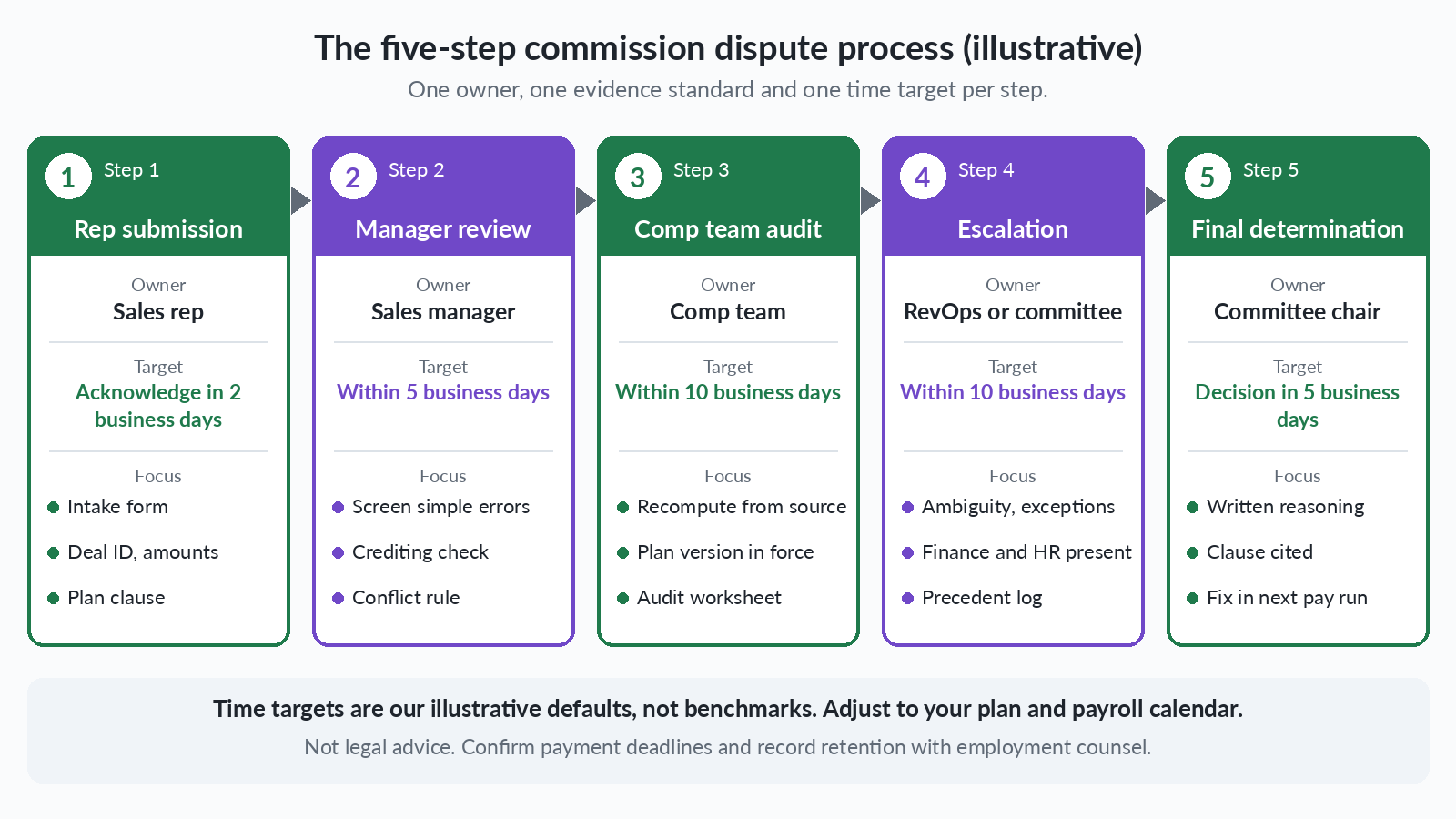
The five-step commission dispute process moves a disagreement from the rep’s first claim to a documented final decision, with one owner and one evidence standard per step.
The time targets below are illustrative defaults for a service level agreement (SLA), not benchmarks or averages. Adjust them to your plan, your payroll calendar and your counsel’s advice.
| Step | Owner | What happens | Illustrative target time | Evidence required |
|---|---|---|---|---|
| 1. Rep submission | Sales rep | Rep files one intake form or ticket; comp team acknowledges | Acknowledge within 2 business days | Pay period, deal or transaction ID, expected vs paid amount, plan clause relied on |
| 2. Manager review | Direct sales manager | Manager screens for simple errors and crediting questions | Within 5 business days | Manager notes, deal record, crediting assignment |
| 3. Comp team audit | Sales compensation team | Team recomputes the payout from source records under the plan version in force | Within 10 business days | Source records, plan document version, calculation worksheet or audit trail |
| 4. Escalation | RevOps or a comp committee, with finance and HR present | Group decides ambiguity, exceptions, high-value cases and precedent | At the next scheduled meeting, or within 10 business days | Audit findings, plan language, exception request, precedent log |
| 5. Final determination | Comp committee chair or designated approver | Written decision is issued, correction is queued and the file is closed | Decision within 5 business days; correction in the next pay run | Written decision, clause cited, reasoning, corrected payout record |
Step 1: How Should a Rep Submit a Dispute?
Use a single intake form or ticket, so every dispute enters the same way. Require the pay period, deal or transaction ID, expected and paid amounts, and the plan clause the rep relies on. A quick written acknowledgment matters, because, in our view, silence can push reps back to private spreadsheets.
A free-text box and room for records keep sales commission dispute resolution open to the rep’s voice.
Step 2: What Does Manager Review Involve?
The manager screens for simple errors, such as a wrong deal date or a crediting question, and resolves what can be resolved. This early screen settles simple errors before they reach the comp team, which keeps sales commission dispute resolution efficient.
A manager should not decide alone when the dispute touches the manager’s own credit or override. Forward that claim to the comp team and record why, to avoid a conflict of interest.
Step 3: What Does the Comp Team Audit?
The comp team recomputes the payout from source records, not from the rep’s version or the manager’s summary. We recommend a three-way match, and our reconciliation guide explains it.
Check which plan document version was in force for the deal. Level 6 describes full audit trails and version history. Record what the audit found, whether or not it supports the rep, because a thorough audit is the backbone of sales commission dispute resolution.
Step 4: When Should a Dispute Go to RevOps or a Committee?
Escalate when the audit shows plan ambiguity, when the rep requests an exception, when the amount exceeds a threshold you set, or when the decision would set a precedent. Finance and HR should both be present.
Plan changes can create ambiguity, so see our post on sales commission plan change management. This step is about resolving commission disputes that the first three steps cannot settle.
Step 5: What Belongs in the Final Determination?
A commission dispute process ends with a written decision that states the reasoning and cites the plan clause. If the rep is right, queue the correction in the next pay run. If the plan language was unclear, fix it so the dispute does not return. Share the decision, the plan clause and the calculation with the rep, because explaining the math is part of fair sales commission dispute resolution, whether or not the rep was right.
Add the case to a precedent log, so similar claims get similar answers. We also recommend limiting appeals to one, with a stated deadline. Final documentation completes sales commission dispute resolution for each case.
What Are Sample Timelines for Each Step?
These are illustrative defaults to adjust to your plan and payroll calendar. As a sketch for sales commission dispute resolution: acknowledge within 2 business days, manager review within 5, audit within 10, committee decision within 10, and the written decision within 5, with the correction in the next pay run.
We recommend paying the undisputed portion on schedule while the rest is under review. In our view, you should not assume that a dispute process pauses legal payment deadlines. For one example, New York Labor Law section 191 says commission salespersons must be paid at least once each month, and not later than the last day of the month following the month in which commissions are earned. Confirm your own deadlines with counsel, because they vary by state.
What Should You Document and Keep?
In our view, each dispute file should hold the intake form, the rep’s evidence, manager notes, the audit worksheet, the plan version applied, any committee reasoning, the written decision, and proof of correction. A complete file makes sales commission dispute resolution defensible.
The U.S. Department of Labor Fact Sheet #21 says employers must preserve payroll records, collective bargaining agreements, and sales and purchase records for at least three years. Records on which wage computations are based, such as wage rate tables and records of additions to or deductions from wages, must be kept for two years.
New York Labor Law section 191 separately requires written commission terms on file for not less than three years. We recommend keeping dispute files and calculation evidence at least as long as the longest applicable rule. State rules can be longer, so confirm retention periods with counsel.

How Do You Prevent Disputes Before They Start?
Prevention is part of sales commission dispute resolution, because clear terms and visible numbers remove confusion.
- Write plan language clearly. Define “earned,” crediting, splits and adjustments in plain terms, and show each payout line by line. See our posts on clawback provisions and holdback periods.
- Show earnings between pay dates. Level 6’s ICM page describes dashboards that show earnings, goal progress, leaderboards and forecasted payouts, and says reps can “track commissions daily.”
- Related reading: our quota attainment distribution analysis post.
What Should You Measure?
Set targets from your own baseline, not an outside benchmark. These are the measures we would start with for sales commission dispute resolution:
- Dispute rate per pay cycle
- Time to resolution, by step
- Overturn rate, meaning how often a decision changes the original payout
- Root-cause mix: data error, plan ambiguity or crediting
- Repeat disputes by plan rule
- Rep trust, measured by a short pulse question after each case
Where Does ICM Software Fit?
A process on paper still depends on people finding records, and incentive compensation management (ICM) software can, in our view, help with that search for sales commission dispute resolution. Level 6 describes automated calculations and clear dashboards that eliminate confusion around how payouts are earned, along with adjustments and dispute management, approval workflows and compensation policy documentation.
The same page says finance and sales ops teams can audit payouts, review exceptions and approve payments before release. It does not describe a step-by-step dispute process, so the five steps remain your policy to write. See our ICM system implementation checklist, or browse Level 6 solutions.
Frequently Asked Questions
What is sales commission dispute resolution?
Sales commission dispute resolution is the written process a company uses to review, decide and document a rep’s claim that a payout is wrong. We recommend five steps: rep submission, manager review, comp team audit, escalation to RevOps or a comp committee, and a documented final determination, each with an owner, evidence requirements and a time target.
How long should a commission dispute take to resolve?
The right duration depends on your plan and payroll calendar, so set your own. As an illustrative default, we suggest acknowledging within 2 business days, then roughly 5, 10, 10 and 5 business days across the later steps. Adjust these to your plan, your payroll calendar and your counsel’s advice. Simple errors should close at Step 2.
Who should decide a commission dispute?
Decision authority should rise with complexity. Managers and the comp team can settle simple errors, while RevOps or a comp committee, with finance and HR present, should decide ambiguity, exceptions and precedent. A manager should not decide alone when the manager’s own credit or override is affected.
What should a rep include in a commission dispute?
A rep should include the pay period, the deal or transaction ID, the expected and paid amounts, and the plan clause the rep relies on. We also recommend a short written explanation and any supporting records. A structured form makes the claim faster to audit.
Do commissions have to be in writing?
It depends on the state. California Labor Code section 2751 requires a written contract setting forth how commissions are computed and paid, and New York Labor Law section 191 requires signed written terms for commission salespersons. State laws vary, so confirm your obligations with employment counsel. This is general information, not legal advice.
Do I have to pay disputed commissions while a dispute is open?
Our recommendation is to pay the undisputed portion on schedule and hold only the contested amount. Legal requirements vary by state, and we would not assume a dispute process pauses legal payment deadlines. New York Labor Law section 191, for example, requires commission salespersons to be paid at least once each month, and not later than the last day of the month after the commissions are earned. Confirm the rules that apply to you with counsel.
How long should you keep commission dispute records?
Keep them at least as long as the longest applicable rule. The U.S. Department of Labor says payroll and sales records must be preserved for at least three years, and wage computation records for two years. New York requires written commission terms on file for not less than three years. State rules can be longer, so confirm with counsel.
Final Takeaways
- Use a written five-step sales commission dispute resolution process, with an owner, evidence standard and time target at each step.
- Judge your sales commission dispute resolution by fairness of procedure as well as the outcome: consistent, accurate, unbiased and open to the rep’s voice.
- Pay the undisputed portion on schedule, and confirm legal deadlines with counsel.
- Keep a full dispute file for every case.
To discuss how incentive compensation management can support your sales commission dispute resolution process, talk with the Level 6 team.