
By Claudine Raschi, MS · Last updated: November 2026
Quick Answer: What Makes a Strong HVAC Channel Incentive Program?
A strong HVAC channel incentive program pays three groups differently: distributors for sell-through, contractor firms for loyalty and certification, and installers for short SPIFFs on named models. Time each layer to the season.
Why Is the HVAC and Building Materials Channel Different?
An HVAC channel incentive program has to work around three facts. The distributor takes the order, but in our view the contractor who installs the system often decides the brand. Demand also swings with the calendar, and the rules for what you can sell keep changing.
AHRI’s January 2026 shipment release reports that U.S. shipments of central air conditioners and air-source heat pumps totaled 440,819 units in January 2026. AHRI’s May 2026 shipment release reports 919,685 units in May, more than twice the January figure. AHRI’s July 2026 shipment release shows 916,830 units, and AHRI’s September 2026 shipment release shows 673,286 units, up 27.3 percent from 528,980 in September 2025.
AHRI defines a shipment as the point when a unit transfers ownership, and a consignment is not a transfer of ownership. In our reading, that makes a shipment a sell-in event, not a finished installation. Any HVAC channel incentive program that pays only on sell-in rewards the distributor’s order, not the contractor’s decision.
Rules and credits move too. EPA’s HFC phasedown FAQ says any new split system installed after January 1, 2026, must use refrigerant with a GWP less than 700. The IRS energy efficient home improvement credit page shows the credit was available for improvements made through December 31, 2025. Expect consumer-side demand drivers to change, and do not hard-wire incentive logic to them.
What Is the Three-Layer HVAC Incentive Stack?
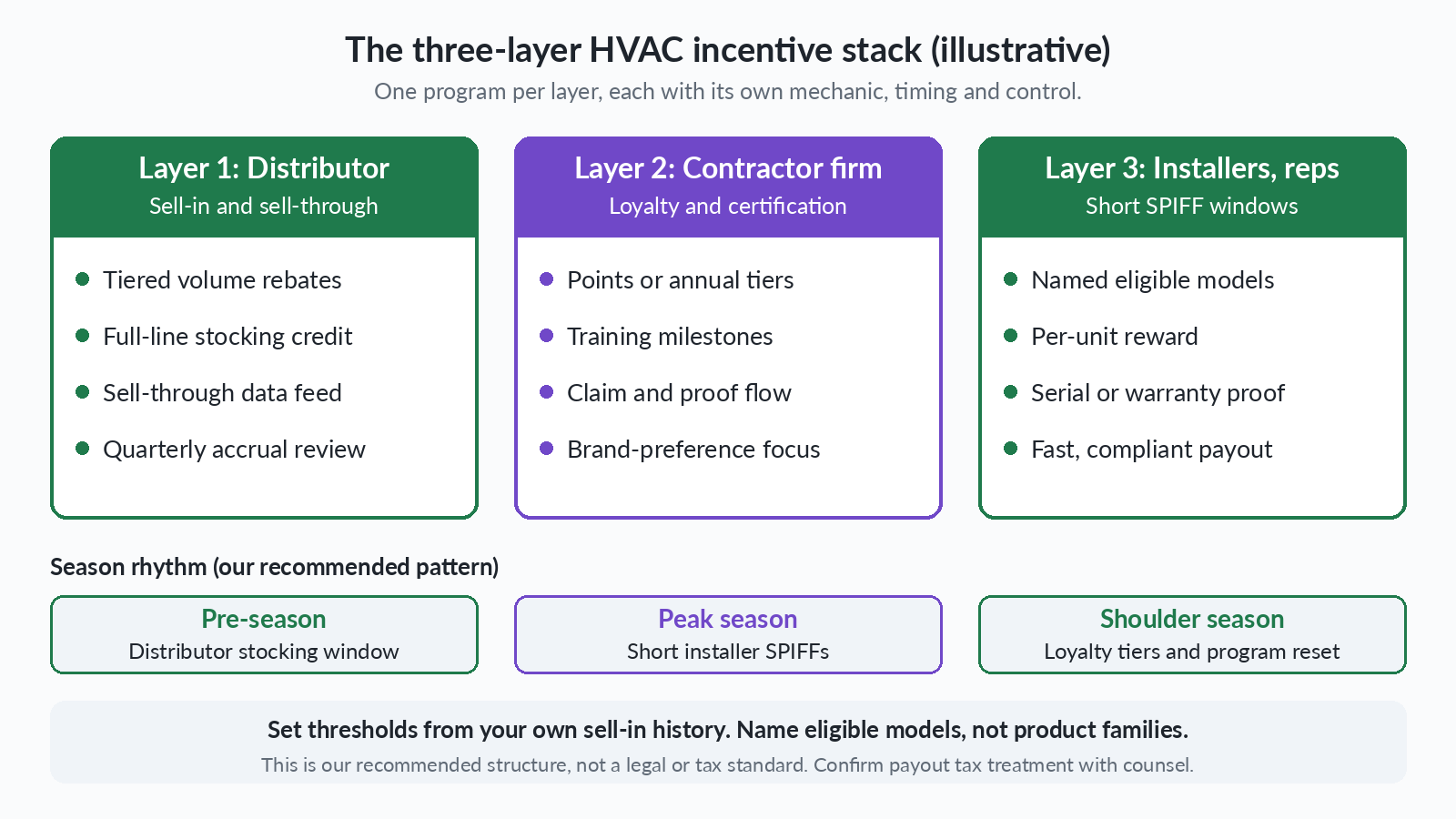
The three-layer HVAC incentive stack assigns one mechanic to each person who influences a sale. Distributors get tiers tied to sell-through, contractor firms get loyalty and certification rewards, and individual installers and reps get short SPIFFs.
| Layer | Who it targets | Best-fit mechanic | Timing | Main control |
|---|---|---|---|---|
| Layer 1: Distributor | Distributor branches and buying groups that stock and resell your line | Tiers that reward sell-through and full-line stocking, not only sell-in | Accrues across the year, with a push before the season | Sell-through data feed reconciled to sell-in |
| Layer 2: Contractor firm | Contractor companies that recommend and install your brand | Points or annual tiers on qualifying equipment bought through the distributor, plus certification milestones | Annual cycle, with a reset in the shoulder season | Claim proof and a versioned eligible-model list |
| Layer 3: Installers and sales reps | Individual technicians, comfort advisors and counter reps | Short, per-unit SPIFFs on named models | Brief in-season windows | Serial number or warranty registration proof, plus a W-9 on file |
This post does not cover the basics or the math. For fundamentals, read our guides on building a channel incentive program and how dealer incentive programs work.
Layer 1: How Should a Distributor Tier Program Work?
Design the distributor layer of your HVAC channel incentive program around sell-through, not only sell-in. Because a shipment records a transfer of ownership, a distributor can fill its shelves and still leave your units unsold. We recommend tiers that credit units sold onward to contractors and credit stocking of the full line.
Set tier thresholds from your own sell-in history, not from a generic benchmark. We recommend placing most distributors in the middle tiers at launch so the top tier stays earned, and reviewing thresholds on a schedule you publish. For more on the difference, see our post on sell-through vs sell-in incentives for distributors, and for upgrade rules see partner tier upgrade criteria.
Decide accrual and payout timing up front. In our view, accrue as sell-through data arrives and pay after a reconciliation step, so a late correction does not force a clawback. The data feed matters most here: Level 6’s sales incentive page describes an API-first architecture with bi-directional data flow between your core business systems and its incentive engine, with pre-built low-code connectors, a RESTful API and webhooks.
Layer 2: How Do You Build Contractor Loyalty?
The contractor layer is where an HVAC channel incentive program earns brand preference. We recommend points or annual tiers on qualifying equipment the contractor buys through the distributor, plus milestones for certification and training. The contractor then has a reason to specify your brand on the next job.
The contractor submits a claim with proof, tracks its status, and sees which tier is next. Level 6’s rebate program page describes online claim submission with receipt upload and status tracking, verification that every claim meets eligibility criteria, and tiered rebates with progressive reward levels.
Recognition matters alongside cash in any HVAC channel incentive program. Our post on channel partner recognition beyond SPIFFs and rebates covers options that keep a contractor engaged between purchases, and certification status is a natural fit for that kind of recognition.
Layer 3: When Do SPIFFs Work for Installers and Reps?
SPIFFs work best when they are short, specific and easy to verify. Level 6 describes SPIFFs as rewarding a defined sale or activity during a specific promotion, and says clear earning rules and a defined promotion window help participants understand what qualifies and what they can earn.
For an HVAC channel incentive program, we recommend a per-unit reward on named models inside a fixed window. Require proof that ties the payout to an actual installation, such as a serial number or a warranty registration.
Level 6 also says cash programs are particularly effective for short-term promotions or SPIFF campaigns, with payout options of reloadable, prepaid and virtual debit cards. If you pay installers directly, read our guide to SPIFF compliance when paying dealer reps directly. To judge results, use our SPIFF ROI metrics post.
How Do You Time Programs Around the Season?
Because AHRI’s monthly figures swing widely through the year, one calendar cannot serve every layer. In our view, an HVAC channel incentive program needs three windows. Each one targets a different layer and a different behavior.
- Pre-season stocking (Layer 1): start a few weeks before demand builds, and reward distributors for stocking the full line and for sell-through that follows.
- In-season SPIFFs (Layer 3): run short windows on named models while installers are busiest, and end them cleanly.
- Shoulder-season loyalty and reset (Layer 2): close annual tiers, recognize certifications, update the eligible-model list and set the next cycle.
Our post on seasonal spring and fall offers goes further on offer timing. No two layers should reward the same unit for the same behavior.

How Do You Handle Refrigerant and Product Changeovers?
Name models, not product families, in every eligibility rule. EPA says manufacture and import compliance dates vary by subsector, from January 1, 2025, to January 1, 2028, and that GWP limits do not apply to systems installed before January 1, 2026. EPA also says the 2023 Technology Transitions Rule does not limit the use of existing products or systems, so owners can keep using and repairing legacy systems.
In practice, an HVAC channel incentive program should version its eligible-model list, give each version an effective date and an end date, and pay nothing on ineligible installs. We recommend a review point whenever product rules change, with the new list published before the old one expires. The IRS credit ending after December 31, 2025, is another reason to keep incentive logic independent of consumer-side programs.
How Do You Stay Compliant on Payouts?
Payouts in an HVAC channel incentive program to contractor firms and individuals can trigger tax reporting, so plan for it from the start. The IRS Form 1099 instructions say that for payments made after 2025 the minimum reporting threshold increased to $2,000, and it may be inflation-adjusted beginning in calendar year 2027. Reporting applies to payments made in the course of your trade or business.
The same instructions describe Form 1099-NEC as covering at least $2,000 for services performed by someone who is not your employee, and Form 1099-MISC as covering at least $2,000 in prizes and awards and other income. Form 1099-NEC is due January 31, and Form 1099-MISC is due February 28 on paper or March 31 electronically.
We cannot tell you which form applies to a given SPIFF payment, so confirm treatment with tax counsel. As our recommendation, collect a Form W-9, the IRS form for a payee’s taxpayer ID, before the first payout, and keep a payment record for every award. Our SPIFF compliance guide covers the process side.
Does This Work for Building Materials?
Yes, an HVAC channel incentive program built on the same three layers works for building materials, with different counters and a different rhythm. Distributors and yards take the orders, builders and remodelers play the contractor role, and estimators and counter reps take the place of installers.
The calendar follows the construction season rather than the cooling season. Pre-season stocking, short in-season SPIFFs and an off-season reset still map cleanly.
What Should You Measure in an HVAC Channel Incentive Program?
Measure behavior at each layer, and set targets from your own baseline, not an outside benchmark. These are the measures we would start with for your HVAC channel incentive program:
- Sell-through to sell-in gap, per distributor
- Claim approval time
- Tier movement among contractor firms
- Contractor activation, meaning firms that earn after enrolling
- SPIFF lift against a baseline window
- Breakage, meaning earned rewards that go unclaimed
Level 6 describes dashboards that track revenue influenced, participation, reward earnings, goal attainment and channel engagement. Its rebate reporting covers redemption rates, breakage, participation levels, program ROI and claim approval timelines. To test an existing program against these measures, use our program audit scorecard.
Should You Build, Buy or Use a Managed Service?
Build only if you have the data engineering and claim operations to run an HVAC channel incentive program at scale. Buy if you want a platform but plan to staff the operation yourself. Level 6 describes managed services covering program design, technology deployment, claim processing, validation, customer service, reward fulfillment, reporting and analytics, and its solutions overview describes channel incentives for OEMs since 2005.
How Do You Govern the Program and Handle Conflict?
Write the rules of your HVAC channel incentive program before launch and name one owner. We recommend a single eligible-model list, a documented dispute path and a stated rule for when a distributor claim and a contractor claim touch the same unit. Our channel conflict policy post covers how to escalate disagreements.
Frequently Asked Questions
What is an HVAC channel incentive program?
An HVAC channel incentive program is a structured set of rewards a manufacturer offers to the partners who sell and install its equipment. We organize it in three layers: distributors, contractor firms, and individual installers and reps. Each layer gets a mechanic that matches its role, such as tiers, loyalty points or short SPIFFs, with its own timing and controls.
How do HVAC manufacturers incentivize distributors?
We recommend tiers that reward both sell-in and sell-through, with credit for full-line stocking as well. Set thresholds from your own sell-in history. Because a shipment is a transfer of ownership, not an installation, a sell-through data feed is what shows whether units actually moved on to contractors.
What is the difference between a rebate and a SPIFF for HVAC contractors?
In our view, a rebate rewards purchases over a longer period, often through tiers, while Level 6 describes a SPIFF as rewarding a defined sale or activity during a specific promotion. We find rebates and loyalty tiers build contractor preference over the year. SPIFFs steer individual installers toward named models in a short window.
When should HVAC manufacturers run SPIFFs?
Run SPIFFs in short windows during the busy season, when installers and reps are actively choosing between brands. We recommend ending each window cleanly and naming eligible models in advance. Use the shoulder season for loyalty tier closes and resets, and pre-season for distributor stocking, so the layers do not overlap.
How do you prove an HVAC installation for a SPIFF payout?
We recommend requiring proof that ties the reward to an actual installation, such as a serial number or a warranty registration. Check each claim against the eligible-model list and the promotion dates. Level 6 describes automated flagging of duplicate submissions and ineligible transactions, which can catch problems before payment.
How do refrigerant changes affect incentive programs?
Refrigerant changes alter which products are eligible, so the model list must change with them. EPA says any new split system installed after January 1, 2026, must use refrigerant with a GWP less than 700. We recommend naming models, not product families, versioning the list with effective and end dates, and paying nothing on ineligible installs.
Do contractor incentive payments need tax forms?
Yes, they may trigger tax reporting. The IRS Form 1099 instructions say that for payments made after 2025 the minimum reporting threshold increased to $2,000 for Forms 1099-MISC and 1099-NEC. Which form applies to a given payment is a question for tax counsel. We recommend collecting a Form W-9 before the first payout.
Final Takeaways
- Pay each person for the behavior they control: distributors for sell-through, contractor firms for loyalty, installers for named-model sales.
- Build your HVAC channel incentive program on sell-through, and treat shipments as sell-in.
- Run three seasonal windows, and keep layers from rewarding the same unit twice.
- Name models, version the eligible list and review it when product rules change.
- Collect a W-9 first and confirm tax treatment with counsel.
If you want to map the three-layer HVAC incentive stack to your own channel, talk with the Level 6 team about your HVAC channel incentive program.