
Quick Answer: What Does a Successful ICM System Implementation Look Like?
A successful incentive compensation management implementation at a manufacturer takes roughly 90 days across three phases: pre-migration data audit (Days 1–30), commission rule configuration (Days 31–60), and parallel-run validation with rep communication (Days 61–90). Manufacturers that follow this sequence go live on a real commission cycle without a missed or restated payment; those that skip the data audit usually pay for it twice.
Why the Rollout — Not the Software — Decides the Outcome
Once you have selected a platform, the remaining risk in your incentive compensation management implementation is operational. What determines whether reps trust their first statement is data hygiene, rule fidelity, and communication discipline — not features.
That risk is not hypothetical. Per Deloitte’s compensation management market primer, 56 percent of surveyed organizations redesigned their compensation strategy in the last three years, yet only 9 percent report being “very ready” for that change. That readiness gap is where rollouts stall.
There is also a moving-target problem. Almost 80% of U.S. firms revise their compensation structure every two years or less, according to Chung’s 2020 sales compensation review at Harvard Business School, so your ICM system implementation must be configured for change — not just for the plan you are running this year.
Define the finish line before Day 1. A completed rollout means every rule reconciles against history, integrations run unattended, reps self-serve their statements, and the legacy process has a shutdown date. Anything less is a pilot.
Why Manufacturers Face Unique ICM Challenges
Navigating Complex Dealer Networks
Manufacturers face ICM challenges that generic rollout guides ignore: decentralized dealer networks, territory splits, and margin-based compensation that requires real-time ERP cost data. Paying across dealer networks is the first hurdle, because channel partners rarely use the same CRM as internal teams. Dealer incentives also involve volume rebates, co-op funds, and retroactive tier adjustments. Your incentive compensation management implementation needs automated pipelines feeding the central engine plus, as in our manufacturer ICM solutions, separate tracking per component.
Managing Geographic Territory Splits
Territory split errors are the leading cause of rep disputes in manufacturing ICM rollouts. Manufacturing deals frequently span regions, pulling in regional managers, inside sales, and field engineers. Assigning fractional credit by postal code or ownership hierarchy is a notorious error source, so define split logic during configuration rather than at payout time. Historical split disputes are your cheapest inventory of edge cases.
Accounting for Multi-Tier Products and OEMs
OEMs sell products whose components yield very different margins, so reps are often paid on gross margin rather than revenue, which requires ingesting ERP cost data. Executive tiers add a layer: 82 percent of private companies offer long-term incentive plans (Deloitte), so your ICM implementation must hold commissions and multi-year metrics in one data model.
Define Success Before Day 1
Define success as measurable accuracy, control, usability, and readiness. A scorecard prevents the team from declaring the rollout complete merely because calculations run.
- Calculation accuracy: sampled transactions reproduce approved plan outcomes within tolerance.
- Reconciliation: 100% of material legacy-versus-new differences have a documented disposition.
- Data quality: required fields meet completeness, uniqueness, validity, and timeliness thresholds.
- Control readiness: access, approvals, change logs, exception handling, and payroll sign-off are tested.
- User readiness: managers, administrators, and reps complete role-based training and know the support path.
Keep the bar explicit. Only 9% of surveyed organizations reported being “very ready” to address compensation redesign (Deloitte), so your incentive compensation management implementation should close that gap with evidence, not optimism.
Days 1–30: Pre-Migration Data Audit
Week 1: Build the Data Map
Map every input the calculation consumes at field level. For manufacturers and OEMs, that spans CRM opportunities, ERP invoices and credit memos, HRIS rosters, territory tables, dealer records, quota tables, and payroll files — each with a documented owner, transformation rule, and refresh cadence. Expect to find logic depending on a field nobody maintains.
Week 2: Profile and Clean the Legacy Data
Clean data in the source system, not the migration file, or you re-import the same errors next quarter. Profile for the defects that break commission math:
- Missing or unstable IDs for employees, dealers, customers, products, and adjustments.
- Duplicate customer and rep records, unmatched sellers, unmapped product families.
- Invalid dates and conflicts among booking, shipment, invoice, and payment dates.
- Late credits, negative or orphaned transactions, and currency gaps.
- Effective-dating failures for hires, transfers, leaves, terminations, and quota changes.
Then set an explicit history window. We recommend migrating 24 months of transaction detail — enough to validate seasonality and annual accelerators, without inheriting data debt from three platforms ago. Freeze the map afterward, because late-arriving fields are the second most common cause of slip in an ICM implementation.
Week 3: Stakeholder Alignment and RACI
An ICM rollout is a three-function project, and unclear ownership turns a 90-day plan into a nine-month one. Sales Operations owns plan logic; IT owns integrations, security roles, and pipelines; HR and Finance own eligibility, payroll timing, and the audit trail.
Write a one-page RACI covering six decisions: who approves rule logic, who signs off on migrated data, who authorizes exception payments, who communicates to reps, who declares go-live, and who owns the system after Day 90.
Week 4: Rule Inventory and Baseline Validation Period
Inventory every earning rule in plain language, then select a closed quarter with known-correct payouts as your baseline validation period. Cover base rates, tier and accelerator schedules, splits, draws, clawbacks, SPIFF overlays, and dealer or rebate-linked earnings.
Day-30 gate: proceed only when data meets agreed thresholds, totals reconcile back to each source, ownership is assigned, and critical defects have no open-ended workaround. Effective-dated roster history matters here, given the 27% annual sales force attrition rate documented in the HBS sales compensation research — rep movement must not create data gaps that break mid-year calculations.
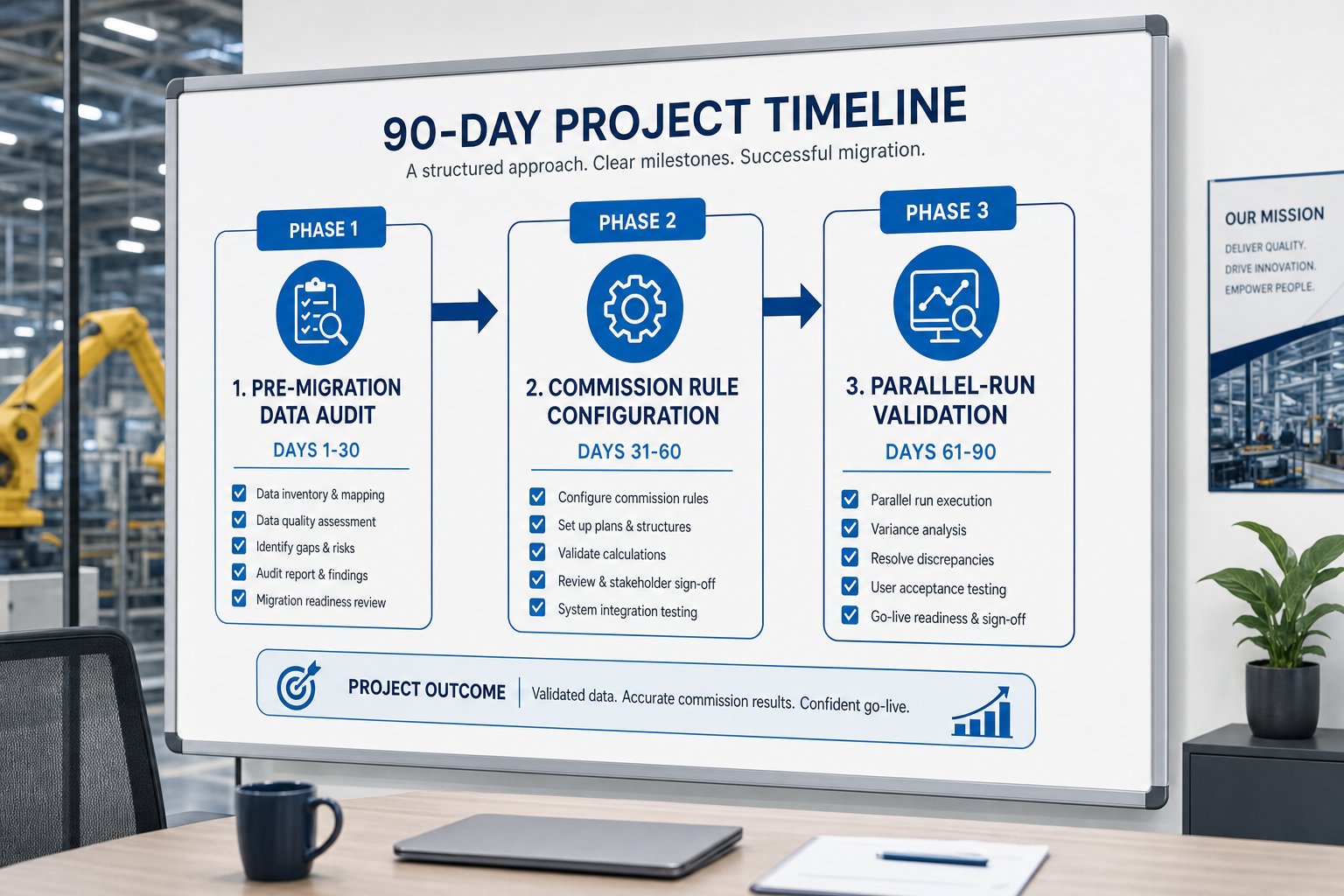
Days 31–60: Commission Rule Configuration & System Setup
Weeks 5–6: Build Rules in Dependency Order
Configure in layers: hierarchies first, then crediting and attribution, then rate and tier logic, then adjustments such as splits, clawbacks, and overlays. Each layer depends on the one below it, so building out of order guarantees rework in any commission system implementation. Document rule intent as you go, since undocumented logic is how systems drift out of compliance with the written plan.
Specify each rule with eligibility, crediting event, measurement period, rate or formula, tiers, thresholds, caps, floors, accelerators, proration, splits, clawbacks, and rounding. Every entry needs worked examples and a named approver — if a plan says “revenue,” state whether that means booked, shipped, invoiced, or collected.
Because 56% of surveyed organizations changed compensation strategy within three years (Deloitte), we build modular, effective-dated rules. Modularity is where flexibility earns its keep in an incentive compensation management implementation: adding a commission variant should not require a vendor change order.
Weeks 7–8: Integration and Structured UAT
Stand up integrations to ERP, CRM, and payroll in test mode, then run user acceptance testing with real historical data and named testers. UAT is not a demo — it is written test cases, each with an expected result and a pass/fail record approved by the business owner:
- Threshold boundaries, rate transitions, caps, floors, and rounding.
- Returns, cancellations, backorders, partial shipments, credit memos, delayed collections.
- Mid-period hires, leaves, transfers, terminations, quota changes, and territory splits.
- Manual adjustments, approvals, reruns, locked periods, payroll exports, audit retrieval.
- Volume and runtime testing at production scale with realistic integration timing.
Exit Criteria for Phase Two
Do not enter the parallel run until every rule is configured and documented, UAT passes at 100 percent on the baseline period, and integrations have run one unattended cycle, including posting to payroll and the general ledger in the correct period. Entering with known defects turns validation into debugging, the most common way a 90-day ICM system implementation slips.
Day-60 gate: critical rules pass, access matches role design, integrations fail visibly and recover, and outputs are understandable to people who did not build them.
Days 61–90: Parallel-Run Validation & Rep Communication
Phase three proves correctness in production. Parallel-run validation means calculating the same live commission cycle in the legacy process and the new system, then reconciling every variance to root cause before shutting the old process down.
Weeks 9–10: Run the Parallel Cycle
Run at least one — ideally two — full payout cycles in parallel, comparing at three levels: total payout by plan, payout by individual rep, and line-item earnings for a sample of complex transactions. Aggregate agreement can mask offsetting individual errors, which is why rep-level comparison is non-negotiable.
Log every variance in one tracker with an owner and a root cause: legacy error, configuration error, data-migration gap, or plan interpretation change. That last category matters, because the old process was sometimes quietly wrong for years.
Target zero unexplained variance — nothing damages confidence in an incentive compensation management implementation faster than a rep who finds an error first.
What Good Looks Like: A Mid-Market Furniture Manufacturer
A mid-market furniture manufacturer was locked into an expensive SaaS commission model with canned reports, inflexible payroll processes, and no way to add commission variants, while its team still ran manual calculations and mailed 1099s.
After moving to a more flexible platform, it achieved $150,000 per year in savings (Level 6) from eliminated license overhead, reclaimed administrative hours, and no manual tax-form handling. Plan changes stopped requiring a vendor project.

Weeks 10–11: The Four-Touch Rep Communication Cadence
Communicate on a fixed cadence rather than in one announcement, because the goal is confidence in the numbers, not awareness of a new login. We use a four-touch rep communication cadence: a what-and-why announcement, a live walkthrough of the new statement, a side-by-side preview of each rep’s own parallel-run results, and a go-live note with the dispute process spelled out.
Showing each rep their own parallel-run numbers is the highest-leverage step in any incentive compensation management implementation: it converts skeptics into validators and surfaces edge cases from the people who know their own book best.
That matters commercially, since a botched pay experience adds turnover to an already high 27% attrition baseline. See our guide to sales compensation plan change management for the people side.
Week 12: Go-Live, Sign-Off, and Legacy Shutdown
Day-90 gate: the executive sponsor approves production, Payroll accepts the output, IT accepts integration and security controls, HR accepts plan and roster treatment, and Sales Operations owns steady-state administration. That shared sign-off is how an incentive compensation management implementation becomes an operating capability rather than a software project.
Then decommission the legacy process with a dated shutdown notice, and close with a 30-day hypercare window: a named owner, a weekly variance review, a documented dispute SLA, and written change control. Leaving the old spreadsheet “available just in case” means running two systems indefinitely.
Common Pitfalls to Avoid
Treating the Rollout as an IT Project
An ICM rollout fails when IT drives it in a vacuum and delivers a system that calculates correctly but serves nobody. Compensation is only one part of strategic sales performance management; without a link to the bigger plan, even the best compensation plans won’t pay off (Harvard Business Review). Sales Operations must co-own the incentive compensation management implementation.
Redesigning Plans Mid-Implementation
Introducing new plan mechanics while deploying new software is a double transformation that compounds risk at every phase. Unproven mechanics lead to endless UAT cycles. We advise a “lift and shift” approach: digitize existing plans first, stabilize the system, then optimize the logic next fiscal year.
Rushing or Skipping the Parallel Run
Compressing the parallel run is the single most common cause of live-payroll errors post-go-live. Stakeholders compress a 30-day window into a single week, or skip the data audit that makes the run interpretable. Both choices convert validation into debugging on live payroll. Protect that window in your ICM rollout schedule, and delay go-live rather than compromise it.
Frequently Asked Questions
How long does an incentive compensation management implementation take?
Most manufacturer rollouts take about 90 days when scoped to existing plans: 30 days for the pre-migration data audit, 30 days for rule configuration and UAT, and 30 days for parallel-run validation and go-live. Timelines extend when legacy data is unmapped or several ERPs feed commission logic.
What is parallel-run validation and why does it matter?
Parallel-run validation means calculating the same live commission cycle in your legacy process and your new system, then reconciling every variance to root cause. It matters because aggregate totals can match while individual rep payouts are wrong, so reconcile at total, rep, and line-item level.
Who should own an ICM rollout — Sales Ops, IT, or HR?
Sales Operations should own the project and the plan logic, with IT owning integrations, data pipelines, and security roles, and HR or Finance owning eligibility, payroll timing, and the audit trail. Document that in a one-page RACI, naming who owns the system after go-live.
How much legacy transaction history should we migrate?
Twenty-four months of transaction detail is a practical default. That window covers seasonality, annual accelerators, and one full plan year for validation, without importing data-quality problems from systems you no longer run. Migrate older summarized history only for a specific audit requirement.
What should we test during UAT?
Test written cases with expected results, covering routine transactions and edge conditions: partial shipments, credit memos reversing prior periods, mid-quarter territory changes, split deals, orders crossing tier boundaries, and terminated reps with unpaid earnings. Verify that results post to payroll correctly.
How do we communicate the change to sales reps?
Use a four-touch cadence rather than one announcement: explain what is changing and why, walk through the new statement live, show each rep a preview of their own parallel-run results, then send a go-live note with the dispute process. Showing reps their own numbers builds trust fastest.
Final Takeaways
A successful incentive compensation management implementation is a sequencing problem, not a software problem. Audit data before you configure, configure in dependency order and test with written cases, then prove correctness with a parallel run before anyone’s paycheck depends on it.
Hold the exit criteria at each phase boundary, and document as you build. Reusable components plus real change control separate a rollout that ages well from one you replace in three years — the principle behind our manufacturer ICM solutions.
Ready to pressure-test your rollout plan? Talk with our incentive team about your data audit, rule inventory, and parallel-run approach before Day 1.