By Claudine Raschi, MS · Last updated: October 2026
Quick Answer: How Do You Build a Channel Partner Recognition Program?
A channel partner recognition program rewards partners with status, visibility, and access, not just cash. Use five mechanics: leaderboards, tier status, advisory council seats, award events, and executive spotlights. Tie each to clear performance standards and run it alongside SPIFFs and rebates.
What Is a Channel Partner Recognition Program?
A channel partner recognition program is a structured way for a manufacturer or OEM to publicly acknowledge the dealers, distributors, resellers, and integrators who perform well. It rewards partners with status, visibility, influence, and access, rather than relying only on cash payouts.
Most channel teams already run SPIFFs and rebates. Those tools work, but they are transactional. When a competitor offers a richer SPIFF, a partner relationship built only on payouts can shift quickly. Recognition gives partners reasons to stay that are harder for a competitor to copy.
This guide shows how to build a channel partner recognition program around five recognition mechanics, how to set fair qualification rules, how recognition fits with your existing channel incentive programs, and how to measure results without guesswork. The goal is a complement to cash, not a replacement for it.
What Does Recognition Do That Cash Cannot?
Recognition adds perceived value and personal connection that a payment alone does not deliver. The strongest evidence comes from employee research, so we label it that way. Channel-specific data is thinner, but it raises a useful question.
The Incentive Research Foundation surveyed 500 full-time employees or channel partners eligible for non-cash rewards programs. In one travel scenario, a trip for the top 5% of performers, channel program participants expected an average reward value of $2,743 versus $2,084 for employee participants, 32% higher.
Here is the telling part. The same IRF paper found satisfaction was generally higher in employee-driven programs than in channel programs, even though channel participants often expected greater reward values. The authors note that “a more personal connection may significantly influence perceived value.” For channel leaders, that points to a gap that bigger rewards alone may not close.
A channel partner recognition program is built to close that gap. It creates the personal connection and public acknowledgment that a purely transactional relationship lacks.
What does the broader evidence say?
Reward programs in general have measurable impact. An Incentive Research Foundation review reports that a meta-analysis found the presence of reward programs resulted in an average 22 percent gain in performance compared with organizations offering no reward program. That finding covers reward programs broadly, not recognition alone and not channel partners specifically.
On recognition itself, the CIPD evidence review reports “strong evidence that employee recognition and non-financial rewards have a moderate to large effect on workplace performance (Level A).” This is employee evidence, and some studies used students, so treat it as directional for channel partner recognition rather than proof.
Recognition is also scarce. Gallup reports in its employee data that only one in three U.S. workers strongly agree they received recognition or praise for doing good work in the past seven days. Gallup also notes that acknowledging best work can be low cost, as small as a personal note or thank-you card. Partners and their reps sit outside your company, so recognition from you has to be deliberate.
What Are the Five Recognition Mechanics That Build Partner Loyalty?
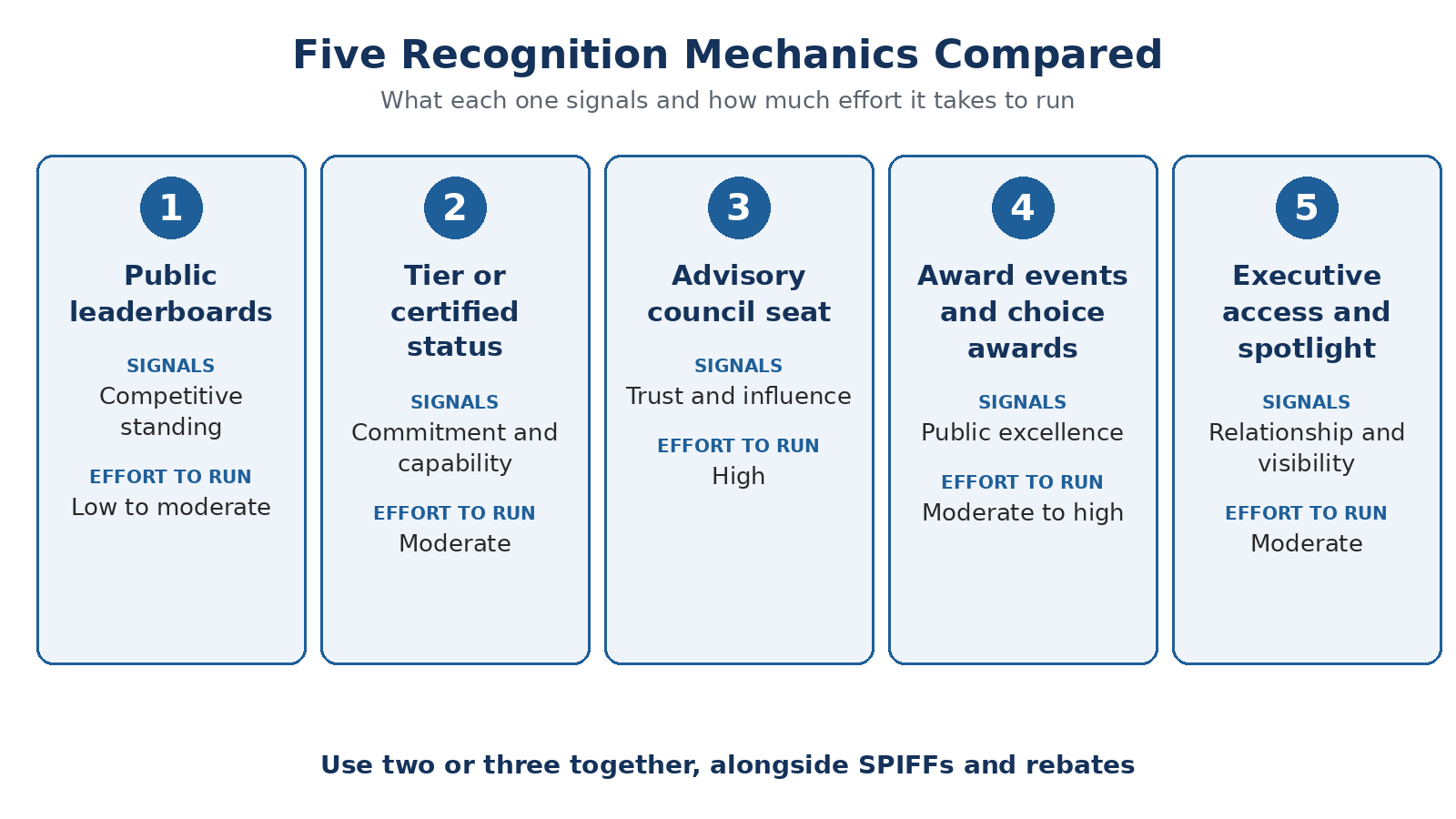
Five mechanics are worth considering: public leaderboards, tier or certified status, advisory council seats, award events with reward choice, and executive access paired with co-marketing spotlights. Each signals something different, and most partner recognition program designs can start with two or three of them.
1. Public leaderboards and performance rankings
A leaderboard shows partners where they stand against peers on the metrics you care about. It turns quiet performance into visible status, and it gives mid-pack partners a clear target to chase.
Segment leaderboards by region, partner type, or size so a small regional dealer is not ranked against a national distributor. Rank on more than revenue: certifications earned, deal registrations, or customer satisfaction scores all work. Refresh the board often enough that movement feels possible.
2. Tier or certified status
Tier status, such as a good, better, best structure, gives partners a durable designation they can show customers. Certified or specialist badges do the same for technical skill. Both answer a partner’s question: what do I gain by investing more in this brand?
Status works best when it carries tangible privileges, such as priority support, early product access, better lead routing, or first access to market development funds (MDF). Our guide to channel partner tier program design covers the structural choices in detail.
3. Partner advisory council seat
An advisory council seat gives your best partners real influence over product roadmaps, program rules, and go-to-market plans. For many partner principals, being asked for their opinion carries more weight than another payout.
Keep councils small, rotate a portion of seats each year, and close the loop by showing members which recommendations you acted on. A council that meets but never changes anything quickly becomes a liability rather than an honor.
4. Award events and choice-based awards
Annual partner awards, presented at a conference or a dedicated event, create a public moment of recognition in front of peers and your leadership. Categories can include top growth, best new partner, technical excellence, and customer impact.
Pair the award with reward choice where possible. Letting winners pick from a range of travel, merchandise, or experiences generates a sense of ownership. This is the channel equivalent of the President’s Club incentive many companies run for internal sales teams.
5. Executive access and co-marketing spotlight
Executive access means a call, a visit, or a dinner with your senior leaders. A co-marketing spotlight features the partner in a case study, newsletter, webinar, or social post. Both deliver the personal connection the IRF research suggests channel programs often lack.
Spotlights also benefit the partner commercially, since the content helps them win business in their own market. Make sure each spotlight is earned against a clear standard, not handed to whoever asks first.
How Do the Five Mechanics Compare?
Each mechanic sends a different signal and requires a different level of effort. Use this comparison to choose the mix that fits your partner base and team capacity.
| Mechanic | What it signals | Effort to run | Best fit |
|---|---|---|---|
| Public leaderboards | Competitive standing among peers | Low to moderate, once data feeds are automated | Large partner networks with comparable sales motions |
| Tier or certified status | Long-term commitment and capability | Moderate, requires clear criteria and annual review | Programs with distinct partner investment levels |
| Advisory council seat | Trust and strategic influence | High, requires executive time and follow-through | Top strategic partners and emerging leaders |
| Award events and choice awards | Public excellence in front of peers | Moderate to high, tied to event planning | Brands with an annual partner conference |
| Executive access and co-marketing spotlight | Personal relationship and market visibility | Moderate, depends on marketing and leadership bandwidth | Partners who value brand association in their market |
How Should You Set Qualification Criteria?
Set qualification criteria that reward clear performance standards across several dimensions, not revenue alone. Criteria tied only to sales volume will keep recognizing the same large partners and miss the ones you most need to grow.

Tiering shows why. Forrester reports that tiers are the primary method used by 98% of the top IT partner programs, averaging three tiers with a good, better, best naming convention. Forrester also names the limitations: revenue attainment is still the main criterion for moving up, and revenue is a lagging indicator.
Forrester adds that revenue-led tiering makes it hard for smaller partners, or partners in small markets, to reach the top level. Prioritizing top performers makes it easy to overlook emerging superstars. It can also exclude partners who refer leads or deliver services rather than resell. A well-built channel partner recognition program designs around each of those gaps.
What criteria should you include?
- Growth rate alongside absolute revenue, so a fast-growing small partner can earn recognition.
- Leading indicators such as certifications, training completion, and deal registrations.
- Non-resale contributions such as referrals, implementation work, and service quality.
- Market-adjusted targets so partners in smaller territories compete on fair terms.
- An emerging partner category with its own awards and at least one rotating council seat.
Publish the criteria before the period starts. Partners trust a partner recognition program they can understand, and they disengage from one that feels political or opaque.
How Does Recognition Fit With SPIFFs and Rebates?
Recognition complements SPIFFs and rebates; it does not replace them. Cash incentives drive specific, short-term behavior. Recognition builds the identity and loyalty that keep partners engaged between promotions.
Think of the stack in three layers. Rebate programs reward volume and sustained purchasing. SPIFFs from your sales incentive programs push a product, a launch, or a quarter-end goal. A channel partner recognition program sits on top, rewarding the partners and reps who show up consistently.
The layers should reinforce each other. SPIFF and rebate performance can feed leaderboard rankings, and tier status can unlock richer rebate terms. If you are already measuring payout efficiency, our guide to SPIFF program ROI metrics shows how to connect those numbers to recognition data.
Recognition also matters at the individual rep level, not just the partner company. Our article on how to build a salesperson recognition program covers rep-level mechanics that work inside a broader channel partner recognition strategy.
Do Recognition Awards Create Tax Reporting Duties?
They can. Awards to channel partners and their reps may carry information reporting obligations. Plan tax treatment into your channel partner recognition program before you announce prizes, not after.
According to the IRS instructions for Forms 1099-MISC and 1099-NEC, for tax years beginning after 2025 the reporting threshold increased to $2,000, with inflation adjustment beginning in 2027. Prizes and awards that are not for services performed go in box 3 of Form 1099-MISC when they total at least $2,000.
Prizes and awards for services performed by nonemployees, such as an award for the top commission salesperson, are reported in box 1a of Form 1099-NEC. We recommend you and your partners confirm treatment of non-cash awards, such as trips and merchandise, with a tax advisor.
How Do You Launch and Communicate the Program?
Launch a channel partner recognition program by publishing the criteria, the calendar, and the benefits before the first performance period begins. Partners should know what earns recognition, when winners are named, and what each status unlocks.
Use the channels partners already visit. Announce the program in your partner portal or partner relationship management (PRM) system, repeat it in partner newsletters, and brief your channel managers so they can explain it in every business review.
Add recognition that is not tied to a single year. Milestone and tenure honors, such as years in the program, give long-standing partners a reason to stay. Digital badges that partners can place on their websites and email signatures extend your recognition into their own markets.
How Do You Measure a Channel Partner Recognition Program?
Measure a channel partner recognition program by tracking engagement first, behavior change second, and business outcomes third. Set your own baseline before launch so every comparison is against your partners, not an industry average.
- Engagement: portal logins, leaderboard views, award nominations, and event attendance.
- Behavior: certifications completed, deal registrations, and marketing fund usage.
- Movement: partners advancing tiers and new partners entering the rankings.
- Retention: partner churn and share of wallet among recognized partners.
- Sentiment: partner satisfaction surveys and advisory council feedback.
Compare recognized partners against similar partners who were not recognized, and look at the mid-tier group separately. Movement there shows whether a partner recognition program is reaching beyond your top partners. A periodic channel incentive program audit is a good moment to review these metrics alongside your cash incentives.
What Mistakes Should You Avoid?
The most damaging mistake is recognizing partners for simply participating rather than for meeting a performance standard. The CIPD review notes that recognition and rewards can have a negative effect on performance when offered for simply doing a task without consideration of any standard of performance. That is employee evidence, but the logic likely carries over to partners.
- Revenue-only criteria that lock out small, specialist, and emerging partners.
- Recognition with no follow-through, such as councils whose feedback is ignored.
- Inconsistent timing that makes awards feel random rather than earned.
- Ignoring individual reps inside partner companies, who drive daily selling.
- Skipping tax planning until after awards are announced.
Each of these weakens trust. A partner recognition program only builds loyalty if partners believe the standards are fair and the honors are real.
What Have We Seen in Level 6 Programs?
Here are three examples from our client work. They come from salesperson and channel sales programs rather than partner-company recognition, but the design lessons apply.
A Fortune 500 Tier 1 auto parts supplier ran quarterly contests, a random drawing of all eligible submissions for a chance to win an all-inclusive trip. Salesperson activity and program website access increased by nearly 50%.
A Fortune 500 pharmaceutical company offered unlimited award choice instead of one-size-fits-all award trips and exceeded its annual goals. Choice generated a sense of ownership, which is the same principle behind choice-based partner awards.
An automotive brand had dealer salespeople complete a monthly short video plus quiz, incentivized at $20 per video. Corporate tracked rep participation as a KPI for area sales managers, whose bonuses were partly tied to participation. A new education each month plus an email reminder kept the brand top-of-mind. These lessons carry into any channel partner recognition effort: consistent rhythm, clear ownership, and visible progress. For more on long-term retention, see our guide to improving channel partner loyalty.
Frequently Asked Questions
What is a channel partner recognition program?
A channel partner recognition program is a structured way for a manufacturer to publicly acknowledge high-performing dealers, distributors, and resellers. It rewards partners with status, visibility, influence, and access, such as leaderboards, tier designations, advisory council seats, awards, and co-marketing spotlights. It works alongside SPIFFs and rebates rather than replacing them, adding loyalty that cash alone does not build.
How is partner recognition different from a SPIFF?
A SPIFF is a cash payment for a specific sale or short-term behavior, while recognition rewards sustained performance with status and access. SPIFFs are transactional and easy for competitors to match. Recognition builds identity and personal connection with your brand, which is harder to copy. The two can work together, with SPIFF results feeding into recognition rankings and awards.
What are examples of non-cash recognition for channel partners?
Common examples include public leaderboards, tier or certified status badges, seats on a partner advisory council, annual partner awards presented at an event, and executive access such as meetings with senior leaders. Co-marketing spotlights, such as case studies or webinar features, also work well. Choice-based awards that let winners select travel, merchandise, or experiences add a sense of ownership.
How do you choose which partners to recognize?
Choose partners using published criteria that combine revenue with growth rate, certifications, deal registrations, service quality, and referrals. Revenue-only criteria tend to reward the same large partners and overlook emerging ones. Adjust targets for market size, create an emerging partner category, and announce criteria before the performance period begins so partners see the process as fair.
Do channel partner awards create tax reporting duties?
Awards to channel partners and their reps can trigger IRS information reporting. For tax years beginning after 2025, the reporting threshold is $2,000. Awards for services performed by nonemployees, such as a top commission salesperson award, are reported in box 1a of Form 1099-NEC. Non-service prizes go in box 3 of Form 1099-MISC. Confirm non-cash award treatment with a tax advisor.
How do you measure the success of partner recognition?
Measure success in three layers: engagement, behavior, and outcomes. Track portal logins, nominations, and event attendance for engagement. Track certifications, deal registrations, and tier movement for behavior. Track partner retention, share of wallet, and satisfaction for outcomes. Set a baseline before launch and compare recognized partners with similar partners who were not recognized.
What is the biggest mistake in partner recognition programs?
The biggest mistake is recognizing partners simply for participating instead of for meeting a clear performance standard. Employee research from the CIPD notes that rewards offered for simply doing a task, without any standard of performance, can hurt performance. Other common mistakes include revenue-only criteria, advisory councils whose feedback is ignored, and leaving tax planning until after awards are announced.
Final Takeaways
- A channel partner recognition program adds status, visibility, and access that cash incentives cannot deliver on their own.
- Combine two or three of the five mechanics: leaderboards, tier status, advisory council seats, award events, and executive or co-marketing spotlights.
- Use multi-dimensional criteria so smaller, service-led, and emerging partners can earn recognition, not just top resellers.
- Layer recognition on top of SPIFFs and rebates, and plan for 1099 reporting before awards are announced.
- Measure engagement, behavior, and outcomes against your own baseline.
Level 6 designs incentive and recognition solutions for manufacturers and OEMs, from recognition and rewards platforms to full channel programs. Ready to add recognition to your partner strategy? Talk with our channel incentives team about building a channel partner recognition program that fits your network.