By Claudine Raschi, MS · Last updated: August 2026
Quick Answer: Is a B2B Rebate Program or a Discount Better for Protecting Margin?
A rebate usually protects margin better. A 10% discount costs 10% of every dollar sold. A 10% rebate redeemed at 40% costs roughly 4%. Run the break-even redemption rate first: below it the rebate wins, above it the discount is cheaper.
Most pricing debates never get to the math. The rebate vs discount B2B decision is arithmetic, not philosophy, and one variable decides it: how much of the offer actually gets claimed.
This post is a decision tool. We build the break-even redemption rate formula, run a worked example at 40% gross margin, and map the pocket-price waterfall. For program structures, see our guide to the types of B2B rebate programs.
Why Discounts Destroy Margin Faster Than They Look
A discount is the most expensive incentive a manufacturer can offer, because it is the only one with a 100% redemption rate. Every dollar conceded on the invoice is conceded on every unit, to every buyer, whether or not behavior changed.
The leverage runs both ways. McKinsey & Company found that a 1% improvement in realized price lifts operating profit by roughly 8% for a typical S&P 500 company. Price is the highest-torque lever on the P&L — and the fastest way to destroy value. That asymmetry is why the rebate vs discount B2B comparison tilts the way it does.
The disproportionate math: a 10% discount isn’t a 10% margin hit
Discounts feel proportional and are not. On a product carrying a 40% gross margin, a 10% price discount removes about 25% of the profit, because the concession comes entirely out of the margin layer rather than out of the full price.
- List price: $1,000 · unit cost: $600 · gross profit: $400 (40% margin)
- After a 10% discount: revenue $900, cost unchanged at $600, gross profit $300
- Profit erased: $100 — 10% of revenue, but 25% of gross profit
Thinner margins are punished harder. At a 25% gross margin, that same $1,000 sale carries $250 of profit; discounting to $900 leaves $150, erasing roughly 40% of it.
The leakage is systemic. In construction and industrial channels, Professional Pricing Society research documents that 30–40% of full list price is routinely lost to discounting — which is why the rebate vs discount B2B question belongs in finance, not just sales ops.
The volume trap: how many more units you must sell to break even
The second failure of the discount is the volume it demands in return, and the hurdle is far higher than the headline percentage suggests. Use this formula: required volume lift = original unit profit ÷ discounted unit profit − 1. On the 40% margin example, $400 ÷ $300 − 1 means selling roughly 33% more units to earn back the same profit dollars.
McKinsey’s pricing benchmark makes the same point at portfolio scale: a 5% price cut requires 18.7% more volume just to break even on operating profit. In any rebate vs discount B2B review, “we’ll make it up in volume” should be treated as a testable assumption, not a strategy.
Governance is the missing control. Bain & Company reports that 85% of B2B teams believe their pricing needs improvement while only 15% have effective governance, and that disciplined pricing transformations sustain margin gains of 2–7 percentage points over three years. That gap is where discount leakage lives.
How a B2B Rebate Program Protects Margin Through Redemption Math
A rebate protects margin for one structural reason: it is conditional and deferred, so its cost is a function of redemption rather than revenue. You publish a 10% offer but pay only partners who earn and claim it.
Redemption is therefore the pricing variable, and its range is wide. Across Level 6 digital B2B rebate programs, redemption lands between roughly 38% and 80% depending on claim friction and payout speed. Our analysis of consumer rebate redemption rates shows the same mechanics at a different scale.
The break-even redemption rate formula
One number resolves the rebate vs discount B2B argument. The effective cost of a rebate is:
Effective rebate cost = Rebate % × Redemption Rate
Set that equal to the discount you would otherwise have granted, and solve for redemption:
Break-even redemption rate = Discount % ÷ Rebate %
If sales wants a 5% off-invoice discount and you counter with a 10% rebate, break-even redemption is 5% ÷ 10% = 50%. Below 50% the rebate is cheaper; above it the discount is. For a 10% discount versus a 15% rebate, break-even is 66.7%, so a forecast of 55% favors the rebate and 75% favors the discount.
Two adjustments make the model honest. Add administration cost as a percentage of revenue, and take no credit for accrued-but-unpaid rebates — under ASC 606 (FASB Topic 606) variable-consideration guidance, that liability should be reserved as earned. Poor tracking is an operational failure, not a windfall; it distorts the effective net price finance reports to leadership.
Finish with net program impact = incremental gross profit − rebate payouts − program costs. That converts a rebate vs discount B2B debate into a forecast finance can defend in a pricing committee.
Running the numbers: rebate vs. discount at 40% gross margin
Assume $1,000,000 of eligible sales at a 40% gross margin, so gross profit starts at $400,000. The table isolates payout economics before adding incremental volume or program cost.
| Offer | Redemption | Effective cost | Incentive cost | Gross profit after incentive |
|---|---|---|---|---|
| 10% upfront discount | 100% at invoice | 10% | $100,000 | $300,000 |
| 10% deferred rebate | 40% | 4% | $40,000 | $360,000 |
| 10% deferred rebate | 60% | 6% | $60,000 | $340,000 |
| 10% deferred rebate | 80% | 8% | $80,000 | $320,000 |
At 40% redemption the rebate preserves $60,000 more gross profit than the identical headline discount. Even at 80% redemption it protects $20,000 more, because the discount pays every buyer regardless of behavior.
Then add the behavioral upside a discount cannot buy: tie the rebate to growth thresholds and even a 5% volume lift improves the rebate case while the discount stays flat. That is the asymmetry in every rebate vs discount B2B model — the discount’s cost is certain and its behavior change is not; the rebate’s cost is contingent and its behavior change is contractual.
Why channel partner rebates behave differently than consumer rebates
Consumer rebates rely partly on breakage — people forget to claim. B2B rebates cannot be designed that way. Distributors have accounting departments and long memories; unclaimed money becomes a dispute, then a lost account.
In a channel program, lower redemption should reflect partners missing growth tiers, not claim friction. So the winning rebate vs discount B2B design targets high redemption on a smaller, tightly conditioned offer rather than low redemption on a generous one.
A national HVAC distributor lifted redemption from 18% to 41% by moving to digital claims. The real gain was trust: partners sold against the program, and finance saw the liability before quarter close.
Rebate vs Discount B2B: When to Use Each Strategy
Use a discount in four situations; use a rebate vs discount B2B analysis to choose a rebate in five. Discounts fit inventory clearance, single competitive deals, cash-constrained buyers, and spot transactions. Rebates fit growth incentives, mix-shift goals, price-integrity protection, verified sell-through, and retention programs.
Four scenarios where discounts make sense
- Inventory you need gone. End-of-life stock where carrying cost exceeds the margin at risk.
- Competitive displacement on one large deal. When a named account decides on the quoted number, deferred value does not clear the bar.
- Cash-flow-constrained buyers. Distributors who cannot wait 60 days for a payout.
- Simple spot transactions. A one-time buyer rarely justifies enrollment, claim validation, and accrual.
Five scenarios where a rebate program wins on margin
- Growth you pay for only if it happens. Tiered thresholds fund the outcome, not the hope.
- Mix shift toward higher-margin SKUs. A rebate can target specific products; a blanket discount cannot.
- Price-integrity protection. Off-invoice rebates keep list price intact, so you have somewhere to go next year.
- Verified sell-through and data capture. Payout tied to end-customer evidence beats loading inventory into the channel.
- Retention and share defense. A Fortune 500 auto parts supplier lifted engagement nearly 50% by restructuring payouts as quarterly contests.
Compounding is the strongest argument in any rebate vs discount B2B review. An automotive OEM ran a structured backend incentive across three years: 1,167 incentivized VINs and 28% share in year one, 4,220 VINs and 31% in year two, 5,379 VINs and 35% in year three. An equivalent discount buys volume once and resets to zero.
The Pocket-Price Waterfall: Where Margin Leaks Before It Gets to the P&L
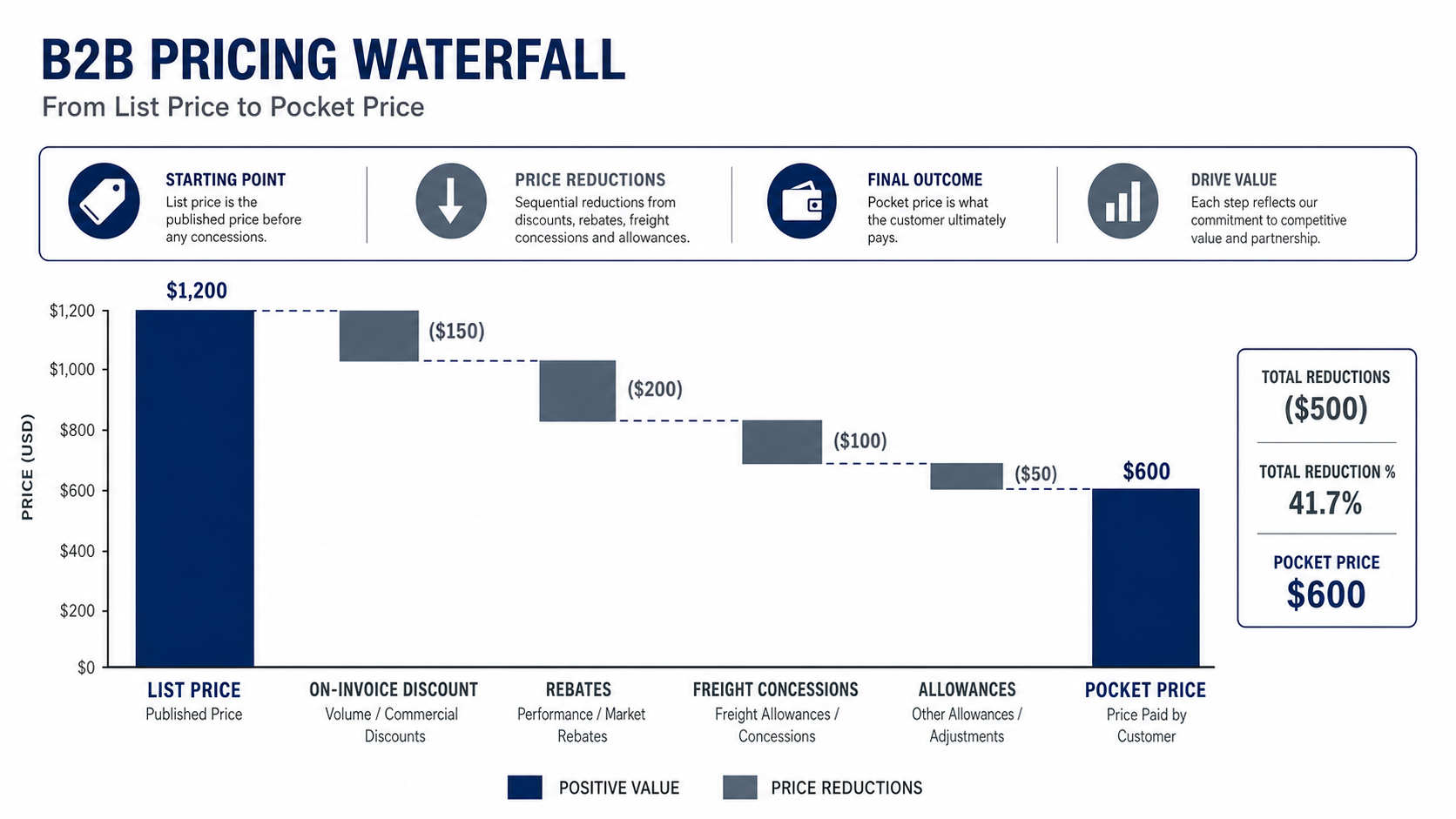
The pocket-price waterfall accounts for everything between list price and the cash you keep. It starts at list, subtracts on-invoice discounts, then every off-invoice item — rebates, co-op funds, freight allowances, payment terms, returns.
Most manufacturers can quote list price from memory but cannot state pocket price by customer, and that blind spot is where the 30–40% of list price disappears. You cannot manage a rebate vs discount B2B tradeoff you cannot measure at the account level.
On-invoice vs. off-invoice pricing — what manufacturers miss
On-invoice concessions are permanent and visible across the channel. Once a customer sees $900 on the invoice, $1,000 stops being a real number.
Off-invoice concessions preserve the reference price. The invoice still says $1,000, the rebate arrives separately against defined performance, and the concession is reversible when performance stops. That reversibility is why a rebate vs discount B2B analysis usually favors the rebate over a multi-year horizon.
The discipline that matters is preventing stacking: a 4% expected rebate layered on an existing 8% discount is another tier of leakage, not a 4% program. A blended strategy — where an on-invoice discount establishes baseline competitiveness and a back-end rebate rewards growth above a threshold — can work, but only when both instruments are modeled together and the combined pocket-price impact is known before the offer goes out. Off-invoice programs also require claim validation, accrual discipline, and audit trails; most manufacturers integrate them with ERP systems such as SAP, Microsoft Dynamics 365, or NetSuite to automate tier tracking and accrual posting. Our rebate program RFP guide covers what to require of a platform vendor, and our analysis of rebate program pros and cons walks through the trade-offs in detail.

How Channel Partners Respond to Rebates vs. Discounts
Partners treat a discount as a permanent new buy price and a rebate as a target to hit. That behavioral difference — not the headline percentage — is the variable most financial models leave out of the rebate vs discount B2B comparison.
Rebates reward behavior over time; discounts reward the transaction
A discount is consumed at purchase and creates no forward obligation. Worse, partners anchor to the lower number and treat it as their new baseline entitlement — the opposite of the behavior you paid for.
A rebate creates a goal, a scoreboard, and a payout date — three conditions that reliably shift effort. Quarterly cadence and visible progress matter more than the headline percentage, which is why we build channel incentive solutions around thresholds and feedback rather than flat rates.
The loyalty and retention advantage
A pending accrual is a switching cost. When a distributor holds a rebate balance that pays at year end, a cheaper competitor must overcome not just price but forfeited earnings — a moat a discount can never build.
Aberdeen Group findings reported by Chief Marketer show 50% of manufacturers and retailers naming customer retention as the top benefit of rebate programs, followed by customer conversion at 46%.
Retention compounds in a way no single-period discount can match. In the rebate vs discount B2B decision, execution quality — claim speed, tier visibility, payout reliability — matters as much as the headline design. A well-run rebate at 60% redemption outperforms a generous discount every quarter.
Rebate vs. Discount: Side-by-Side Comparison
The rebate vs discount B2B decision comes down to seven structural differences. The table below summarizes each dimension so finance and sales leadership can align before the program is designed.
| Attribute | Upfront Discount | B2B Rebate Program |
|---|---|---|
| Cost certainty | 100% of qualifying revenue | Redemption rate × rebate % |
| Price integrity | Lowers visible list price | Off-invoice; list stays intact |
| Behavioral target | Transaction (one-time) | Behavior over time (growth, mix, retention) |
| Cash-flow timing | Immediate margin reduction | Deferred payout; liability accrued over period |
| Revenue recognition | Contra-revenue at point of sale | Variable consideration reserved per ASC 606 / IFRS 15 |
| Partner loyalty effect | Resets to zero each deal | Accruing balance creates switching cost |
| Data and audit trail | None required | Claim validation and redemption reporting |
Types of B2B Rebate Programs vs. Discount Structures
Volume rebates, growth rebates, and mix-shift rebates each solve a different problem — and none behave like an upfront discount. In any rebate vs discount B2B evaluation, the first step is matching the instrument to the behavior you are trying to buy. See our deeper guide to volume incentive rebate programs for tier-setting methodology.
Common rebate program types
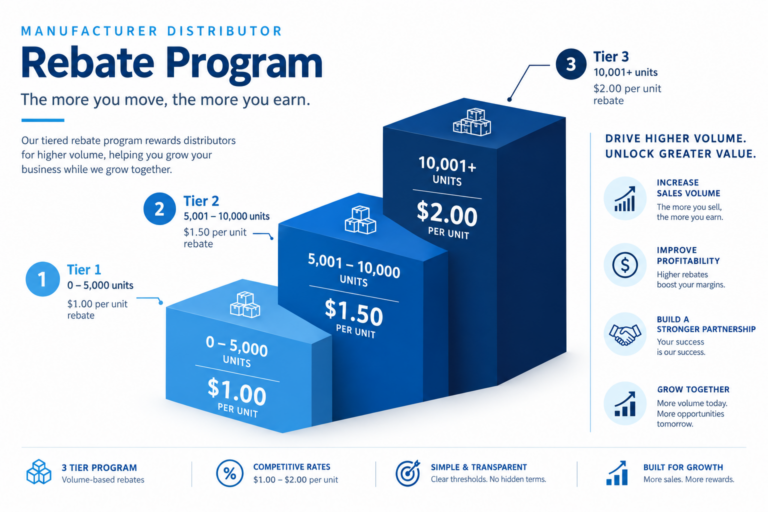
- Volume rebates. Tiered percentages that increase as the partner hits higher purchase thresholds — the most common structure in manufacturing and distribution.
- Growth rebates. Paid only on sales above a prior-period baseline. Zero cost if the partner does not grow; full cost only on the incremental gain.
- Mix-shift rebates. Targeted to specific SKUs or product lines. Designed to steer partners toward higher-margin products that a blanket discount cannot reach.
- Sell-through rebates. Paid on verified end-customer sales rather than distributor purchases, eliminating channel loading. See our guide to types of B2B rebate programs for a full taxonomy.
Common discount structures
- On-invoice discounts. Applied at line-item level, immediately visible in the invoice price. Cannot be recalled once issued.
- Volume discounts. Tiered price breaks applied upfront. Structurally similar to a rebate but paid immediately — the distinction that makes them margin-destructive at 100% take rate.
- Promotional discounts. Time-limited price reductions. Useful for inventory clearance but notorious for training buyers to wait for the next promotion.
Revenue Recognition and Cash-Flow Impact
A discount hits the P&L at the point of sale. A rebate accrues as a liability and pays later. That difference in timing — not just the math — is why the rebate vs discount B2B choice is ultimately a finance decision as much as a sales one.
An upfront discount reduces gross revenue at the point of sale — it flows through as contra-revenue immediately. A rebate is classified as variable consideration under ASC 606 (U.S. GAAP) and IFRS 15. The expected rebate payout must be estimated and reserved against revenue in the period it is earned, not when the claim is filed.
The cash-flow implication is the reverse of what many finance teams expect: a rebate feels cheaper because cash leaves later, but the liability hits the P&L in the same period as the sale. Manufacturers who skip proper accrual reporting overstate gross margin throughout the year and face a correction at settlement — a pattern that distorts pricing committee decisions.
KPIs for Measuring Rebate Program vs. Discount Effectiveness
Five KPIs reveal whether your rebate vs discount B2B strategy is working as designed or quietly destroying the margin it was meant to protect.
- Effective rebate cost rate. Total rebate payouts ÷ rebated revenue. Should stay below the equivalent discount rate at your target redemption assumption.
- Redemption rate by tier. Low redemption on growth tiers signals the threshold is set too high; high redemption on volume tiers may signal under-pricing the offer.
- Gross margin per program participant vs. non-participant. The clearest test of whether the program is generating incremental profit rather than rewarding existing behavior.
- Accrual-to-payout variance. If settlements consistently exceed accruals, your redemption assumption is too low — adjust or tighten claim conditions.
- Share of wallet by partner tier. A retention rebate should increase the percentage of a partner’s category spend directed to your brand over time.
Frequently Asked Questions
What is the difference between a rebate and a discount?
A discount reduces price at the point of sale and applies to every unit sold. A rebate is a conditional payment made after purchase, once the buyer meets defined criteria and files a claim. A discount costs a percentage of all revenue; a rebate costs only what is redeemed.
When should a manufacturer use a rebate instead of a discount?
Use a rebate when you want to pay for a specific behavior — growth over a threshold, mix shift to higher-margin products, or verified sell-through — rather than lowering price. Use a discount when clearing inventory, closing a single competitive deal, or serving cash-constrained buyers who cannot wait for a payout.
Are rebates more profitable than discounts?
Usually, but not automatically. A rebate’s effective cost equals the rebate percentage multiplied by the redemption rate, so a 10% rebate redeemed at 40% costs about 4% of revenue versus 10% for an equivalent discount. If redemption approaches 100% and administration costs are high, the advantage disappears.
How do you calculate the break-even redemption rate for a rebate?
Divide the discount percentage you would otherwise offer by the rebate percentage you plan to offer. A 5% discount versus a 10% rebate gives a break-even redemption rate of 50%; a 10% discount versus a 15% rebate gives 66.7%. Below that level the rebate protects more margin.
Can rebates damage customer relationships?
Yes, when they are hard to claim. Slow payouts, unclear rules, unrealistic targets, and manual submissions create disputes, and partners stop selling against a program they cannot rely on. Designing for high redemption with a smaller, targeted offer protects both margin and the relationship.
What is the pocket-price waterfall?
It is a step-by-step view of everything that reduces list price before revenue reaches your P&L. Starting at list, it subtracts on-invoice discounts, then off-invoice items such as rebates, co-op funds, freight allowances, and returns, arriving at the pocket price you keep. Most manufacturers cannot state it by customer.
How do channel partners respond differently to rebates vs. discounts?
Discounts improve a partner’s buy price immediately, create no forward commitment, and quickly become the expected baseline. Rebates create a target, a scoreboard, and a payout date, shifting selling effort toward the products and volumes you want. Rebate terms can also be differentiated by partner performance.
Does a rebate program require accrual accounting?
Yes. Earned rebate liability should be reserved as it is earned rather than when it is claimed, because forecasting on historical claim rates books margin you may later have to give back. Accrual discipline also gives finance an accurate view of effective net price.
Final Takeaways
- Discounts have a 100% redemption rate. A 10% discount on a 40% margin product removes 25% of gross profit from every unit shipped.
- One formula settles the argument: break-even redemption rate = discount % ÷ rebate %. Forecast redemption against that threshold before approving either.
- Model the fully loaded cost. A credible rebate vs discount B2B comparison uses rebate % × redemption rate plus administration cost, built on accrued liability.
- Off-invoice protects your price reference. Discounts ratchet list price down permanently; rebates are conditional, targeted, and reversible.
- Behavior is the tiebreaker. A discount buys one transaction; a well-structured rebate buys mix, growth, and retention that compound.
If your team wants help building the margin model, setting redemption assumptions, or designing tiers that pay only for incremental performance, you can talk with our team about your program and we will walk the numbers with you. Getting the rebate vs discount B2B decision right once is worth more than a decade of quarter-by-quarter concessions.