By Claudine Raschi, MS · Last updated: April 2026
Quick Answer: What Are Volume Incentive Rebate Programs?
Volume incentive rebate programs are B2B incentive structures where a manufacturer or supplier pays a financial reward back to distributors or channel partners after they hit pre-agreed purchase volume thresholds. Unlike upfront discounts, the rebate is paid retroactively — after performance is verified — protecting the supplier’s margins while motivating higher purchase volumes.
For many industrial distributors, rebate income represents between 40% and 70% of total net profit, according to a survey of 153 manufacturers and distributors published by Industrial Supply Trends. That figure alone explains why manufacturers and suppliers rank volume incentive rebate programs as their most widely deployed channel tool — 62% of manufacturers offer a volume rebate program, making it the most common rebate type in use today.
Yet the same research reveals a critical gap: only 4% of manufacturers say managing their rebate program is easy, and 51% report discrepancies between the rebates they plan to pay and what they actually pay out. The programs that work best are those built on clear tiers, transparent communication, and systematic tracking — the same pillars we have applied at Level 6 since 2005 across consumer rebates, channel incentives, and fully managed rebate programs for manufacturers and suppliers.
Below we cover what volume incentive rebate programs are, the main types with numeric examples, proven benefits, and a step-by-step guide to running one that actually motivates your distributors.
What Are Volume Incentive Rebate Programs?
A volume incentive rebate program is a contractual agreement between a manufacturer or supplier and a distributor, reseller, or channel partner. The supplier sets purchase volume thresholds in advance; the partner earns a financial reward — usually a percentage of total purchases — once those thresholds are met over a defined period (quarterly or annually).
The defining characteristic of a volume incentive rebate is that it is retroactive. The partner pays the full invoice price throughout the period. The rebate is issued only after performance is verified. This structure protects the supplier’s pricing integrity while giving the partner a clear financial incentive to consolidate purchasing and hit higher volume tiers.
This mechanism differs fundamentally from an upfront discount:
- Upfront discounts reduce the invoice price immediately — every unit ships at a lower margin, regardless of final-period volume.
- Volume incentive rebates preserve the full invoice price; the reward is earned, not assumed. If the partner falls short of the threshold, no rebate is paid — protecting the supplier’s margin.
Level 6’s rebate program platform is built on this principle: preserve pricing power, reward verified performance, and use breakage (unredeemed or unclaimed rebates) to keep program economics healthy.
How Do Volume Incentive Rebates Work?
Volume incentive rebates follow a predictable lifecycle. Understanding each step makes it easier to design a program partners will actually engage with — and that your finance team can administer without disputes.
Step 1: Set tiers and rates
The supplier defines volume thresholds and the corresponding rebate rate or dollar amount for each tier. Tiers should be set based on historical partner purchasing data — thresholds that no partner can realistically hit generate no behavior change.
Step 2: Sign the agreement
A written agreement at the start of the period documents the tiers, rebate rates, eligibility criteria, qualifying products, and the payout timeline. Clear terms eliminate the disputes that affect 41% of organizations monthly, according to channel research.
Step 3: Track purchases throughout the period
As the partner places orders, the supplier (or a managed program partner like Level 6) tracks cumulative volume in real time. Partners benefit from visibility into their accruing rebate balance — it is one of the most powerful motivators for pushing volume toward the next tier.
Step 4: Verify and calculate
At period end, the supplier verifies qualifying purchases against contract terms and calculates the earned rebate. Manual spreadsheet-based calculation is where most errors occur — the Enable 2024 State of Volume Rebates study found that 31% of distributors are unsure whether the rebates they receive are accurate.
Step 5: Pay out
Rebate is paid as cash, credit, check, or custom prepaid debit card. Speed of payout matters: delayed rebates erode partner trust and reduce the motivational impact for the next program period.

Types of Volume Incentive Rebate Programs — With Examples
Not all volume incentive rebate programs are structured identically. The right model depends on your sales objectives, partner mix, and margin requirements. Here are the six most common types, each with a concrete numeric example.
1. Single-Tier Volume Rebate
A flat rebate rate kicks in once the partner crosses a single volume threshold. Simple to communicate and administer, making it ideal for new programs or smaller partner networks.
Example: A manufacturer offers a $1-per-unit rebate to any distributor who purchases 10,000 units within the year. A distributor who purchases 12,000 units earns $12,000 back at year end.
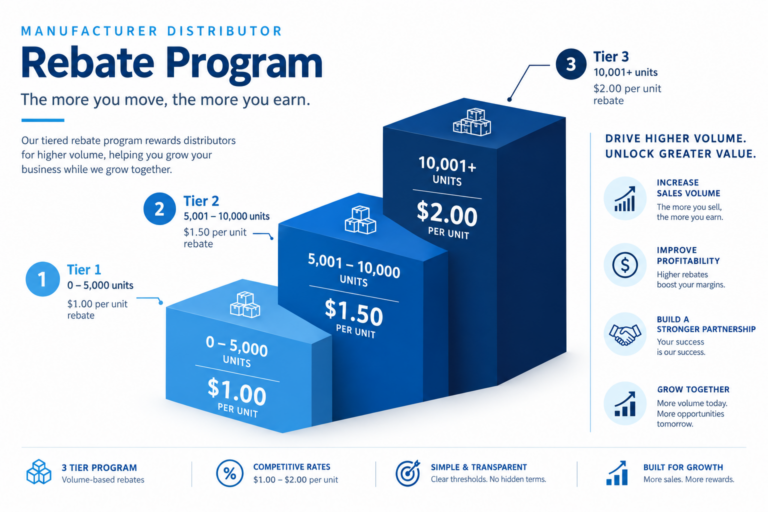
2. Multi-Tier (Tiered) Volume Rebate
Progressively higher rebate rates unlock as the partner hits higher volume thresholds. This is the most widely used volume incentive rebate structure because it continuously motivates partners to push toward the next level.
Example: A component manufacturer offers distributors:
- 1–5,000 units: $1.00 per unit rebate
- 5,001–10,000 units: $1.50 per unit rebate
- 10,000+ units: $2.00 per unit rebate
A distributor purchasing 12,000 units earns: (5,000 × $1.00) + (5,000 × $1.50) + (2,000 × $2.00) = $5,000 + $7,500 + $4,000 = $16,500 total rebate.
3. Retrospective Volume Rebate
Once the partner crosses a threshold, the higher rate applies retroactively to all purchases in the period — not just the incremental volume above the threshold. This creates a powerful incentive to push through each tier because every prior unit gets repriced upward.
Example: A supplier offers a 2% rebate on 0–10,000 units and 4% on 10,001+ (retrospective). A distributor who buys 11,000 units at $100 each earns: 11,000 × $100 × 4% = $44,000 — rather than only 4% on the incremental 1,000 units above the threshold.
4. Growth-Based Volume Rebate
Rewards year-over-year improvement rather than absolute volume. Particularly effective for engaging mid-tier partners who may never reach the highest absolute-volume tiers but represent significant incremental growth potential.
Example: A distributor purchased 10,000 units last year. The supplier offers a 5% rebate on all units purchased above last year’s baseline. If the distributor buys 12,000 units this year, they earn a 5% rebate on the 2,000 incremental units.
5. Product-Mix Rebate
A rebate on core products is contingent on the partner also purchasing a minimum volume from a new or strategic product line. Manufacturers use this structure to gain shelf space and mindshare for priority SKUs.
Example: A manufacturer offers a 3% rebate on product line A, but only if product line B represents at least 20% of the distributor’s total order volume. This approach directly funds adoption of new products through the distributor’s existing purchasing behavior.
6. Time-Based (Promotional) Volume Rebate
Elevated rebate rates activate during a defined window — a quarterly push, product launch period, or seasonal campaign. Time-boxed programs create urgency and concentrate volume in strategically important periods.
Example: A manufacturer offers a 6% rebate (versus the standard 3%) to any distributor who purchases 3,000+ units within a single fiscal quarter. A distributor who purchases 3,200 units at $100 each earns: 3,200 × $100 × 6% = $19,200 back for that quarter.
What Are the Benefits of Volume Incentive Rebate Programs?
Volume incentive rebate programs generate measurable benefits for both the supplier and the channel partner. The structure is designed to align incentives — when the partner earns more by buying more, both parties benefit from the increased volume.
For suppliers and manufacturers
- Protected pricing integrity: Because the rebate is paid retroactively on verified performance, the full invoice price is maintained. There is no public price reduction that trains distributors to wait for discounts.
- Higher order volumes: Partners consolidate purchasing toward threshold tiers, often pulling forward future buys to hit targets. This concentrates volume with fewer, more committed suppliers.
- Margin control through breakage: Programs that pay only on verified, claimed rebates benefit from breakage — the percentage of earned rebates that are never redeemed. Level 6’s rebate program data shows breakage can reach 50% on some consumer-facing programs, directly reducing effective payout costs.
- Channel data and visibility: Volume rebate programs generate rich data on distributor purchasing patterns, growth trajectories, and product preferences — insight that improves demand planning and sales forecasting.
- Partner segmentation: Performance data enables suppliers to identify top-tier earners who deserve enhanced programs, high-growth accounts worth nurturing, and underengaged accounts that may respond to different incentive structures.
For channel partners and distributors
- Lower effective cost per unit: Rebates typically deliver 3–15% savings on purchasing volume, providing a meaningful cost advantage on tight margins.
- Predictable incremental income: For many distributors, rebate income represents a significant share of annual profitability. A well-run volume incentive rebate program is essentially a guaranteed revenue stream tied to achievable purchasing behavior.
- Strengthened supplier relationships: Rebate programs create structured financial ties that build long-term loyalty and reduce the temptation to switch suppliers for marginal price differences.
The Incentive Research Foundation’s landmark study on channel distributor incentive programs found that a well-structured program generated $7.44 million in incremental profit on a $3.5 million investment — a 112.5% ROI — with incremental purchases attributable to the incentive program reaching $37.2 million, according to the IRF’s ROI research.
And McKinsey & Company research on sales incentive design found that smart revisions of compensation and incentive models have a 50% higher impact on sales performance than changes in advertising investments — underscoring the outsized return that well-structured rebate programs can generate.

How to Set Up a Volume Incentive Rebate Program
A well-designed volume incentive rebate program is built in three phases: design, launch, and ongoing management. Skipping any phase is where most programs fail — either by setting tiers no one can hit, under-communicating program mechanics, or losing track of accruals mid-period.
Phase 1: Design
Define your objective first. Every structural decision follows from the business goal. Volume growth calls for tiered volume rebates. Launching a new product line calls for product-mix rebates. Rewarding existing high-value accounts calls for growth-based structures. Trying to accomplish all three objectives with one program usually produces a program too complex for partners to act on.
Analyze historical purchasing data. Set tier thresholds based on what your partner base actually purchases today, not an aspirational wish. A threshold that no current partner can reach creates no behavioral change. A threshold everyone already exceeds generates unnecessary cost without incrementality. The productive range is typically 110–130% of each partner’s prior-year baseline.
Choose your rebate rate range. Rebate rates typically run from 2% to 7.5% of qualifying purchases, depending on industry, margin structure, and competitive pressure. Higher rates are appropriate for new products or strategic growth accounts. Rate-setting requires modeling against your own cost of goods and desired incremental margin contribution.
Define qualifying rules clearly. Which product lines qualify? Which partner types are eligible? What is the measurement period? What happens to partial-period purchases if a partner joins mid-year? Every ambiguity at design time becomes a dispute at payout time.
Phase 2: Launch
Keep program terms simple enough to fit one page. Partners who cannot quickly understand what they need to do to earn the rebate will not change their behavior. Lengthy 15-page program guidelines are the single most common reason high-potential programs underperform.
Communicate proactively to every eligible partner. The 2024 State of Volume Rebates study found that 55% of manufacturers believe better awareness within trading partner organizations would make their programs more effective. Send program details at launch, provide mid-period progress updates, and alert partners when they are within reach of the next tier.
Give partners real-time visibility into their accruing rebate. Partners who can see their progress toward the next tier modify purchasing behavior accordingly. This real-time visibility is the most powerful behavioral driver in a volume incentive rebate program — and the biggest gap in spreadsheet-managed programs.
Phase 3: Ongoing Management
Automate calculation and tracking. Manual rebate management produces errors that damage partner trust. A mid-sized manufacturer running rebate programs for 50+ distributors across multiple product lines cannot reliably track accruals in spreadsheets without errors. Level 6’s managed rebate program platform automates this from contract through payout, with real-time dashboards for both the supplier and the partner.
Pay on time. Slow payout is the fastest way to erode partner confidence in a rebate program. Establish a clear payout timeline at launch and adhere to it. Delayed payments reduce the motivational impact for the next program period and create the perception that rebates are difficult to collect.
Review and refine annually. Use performance data from each program period to improve tier design, identify high-growth accounts, and segment partners for the following year. Volume incentive rebate programs generate valuable channel intelligence — suppliers who use it improve both program effectiveness and distributor relationships over time.
Common Mistakes That Undermine Volume Incentive Rebate Programs
Even well-intentioned volume incentive rebate programs fail when these structural errors appear:
- Tiers that are too aspirational: If no current partner is within range of the first tier, the program creates no behavioral change. Calibrate thresholds to actual purchasing data.
- Overly complex program rules: Multiple product qualifications, minimum-SKU requirements, and stacked eligibility criteria make it impossible for partners to predict their earnings — and they stop trying.
- Infrequent communication: Partners who receive program details once at launch and hear nothing until payout miss the engagement opportunity. Mid-period progress updates are as important as the initial announcement.
- Manual calculation and delayed payouts: Errors and delays are the two fastest routes to partner disengagement. 51% of manufacturers already report payout discrepancies — automation is not optional at scale.
- No connection to strategic goals: Rebate programs that reward whatever partners were already buying produce cost without incrementality. Align tier design to specific growth objectives: new products, new territories, new customer segments.
We have seen these patterns repeatedly across the programs we manage for manufacturers in HVAC, industrial, and B2B distribution. A conversation with our team is typically where suppliers identify which structural issue is suppressing their program’s performance.
Frequently Asked Questions
What is a volume incentive rebate program?
A volume incentive rebate program is a B2B incentive structure where a manufacturer or supplier pays a financial reward to a distributor or channel partner after they hit pre-agreed purchase volume thresholds over a defined period. Unlike upfront discounts, the rebate is paid retroactively — after performance is verified — protecting the supplier’s pricing integrity while motivating higher purchase volumes.
How does a volume rebate differ from an upfront discount?
An upfront discount reduces the invoice price at the time of purchase — the supplier absorbs the cost immediately on every unit, regardless of final-period volume. A volume incentive rebate preserves the full invoice price; the financial reward is earned only after the partner hits a verified threshold. If the partner falls short, no rebate is paid, protecting supplier margins.
What are the most common types of volume incentive rebates?
The most common types are single-tier (flat rebate at one threshold), multi-tier or tiered (progressively higher rates at higher volumes), retrospective (highest rate applies to all volume once the tier is crossed), growth-based (rewards year-over-year improvement), product-mix (rebates contingent on purchasing a defined product mix), and time-based (elevated rates during a defined promotional window).
How do you calculate a volume incentive rebate?
For a simple single-tier structure: multiply total qualifying purchases by the rebate rate. For a multi-tier structure, apply each tier’s rate only to the volume within that tier’s range and sum the amounts. For retrospective rebates, apply the highest earned rate to all qualifying purchases once the threshold is crossed. A concrete example: a distributor buying 12,000 units at $100 each on a 5% tier earns $60,000 back.
What industries use volume incentive rebate programs most?
Manufacturing, industrial distribution, HVAC, automotive parts, consumer packaged goods, electronics distribution, and building materials are the most common industries. Any B2B market where products move through a multi-tier distribution channel — manufacturer to distributor to retailer or end user — is a natural fit for volume incentive rebate programs.
How do you prevent rebate disputes with distributors?
Rebate disputes are almost always caused by unclear contract terms, manual calculation errors, or delayed payouts. Prevent them by writing program terms that define all qualifying conditions unambiguously, automating accrual tracking so both parties see the same data in real time, and establishing a clear payout schedule with defined timelines. Regular mid-period reporting to partners also reduces surprises at period close.
What ROI can manufacturers expect from volume incentive rebate programs?
ROI varies by industry, program design, and partner engagement — but the data is encouraging. The Incentive Research Foundation documented a channel distributor program that generated $7.44 million in incremental profit on a $3.5 million investment, a 112.5% ROI. Well-structured programs typically generate $3–5 in incremental gross margin for every $1 invested.
Should we manage a volume rebate program in-house or outsource it?
Manufacturers supporting fewer than 10 partners with simple single-tier programs can often manage in-house with a spreadsheet or basic ERP module. As programs scale — multiple tiers, 25+ partners, cross-product qualifications, multiple payout schedules — the calculation complexity and administrative burden typically exceed what in-house teams can manage accurately. A managed program partner like Level 6 handles design, tracking, calculation, fulfillment, and partner communication as a complete service.
Final Takeaways
- Volume incentive rebate programs are the most widely deployed channel incentive tool among manufacturers — and among the most profitable for distributors, often representing 40–70% of net profit.
- The key structural choices are tier type (single, multi-tier, retrospective, growth-based), measurement period (quarterly vs. annual), and qualifying product scope — each maps to a different business objective.
- The difference between upfront discounts and volume rebates is fundamental: rebates preserve pricing integrity and pay only on verified performance, protecting supplier margins while motivating incremental volume.
- Most program failures trace to three causes: tiers set too aspirationally, insufficient partner communication, and manual tracking that produces errors and disputes.
- IRF research documents 112.5% ROI from well-structured channel distribution incentive programs — the economics justify investment in program design and managed administration.
Ready to design a volume incentive rebate program for your distributor network? Level 6 has spent 25+ years designing, managing, and fulfilling rebate programs for manufacturers across industrial, HVAC, automotive, and B2B channels. We handle every element — from tier design and partner communication to automated calculation, fulfillment, and reporting. Contact our team to build a program your distributors will actually respond to.