
Quick Answer: Instant, Mail-In, or Post-Purchase Digital Rebate?
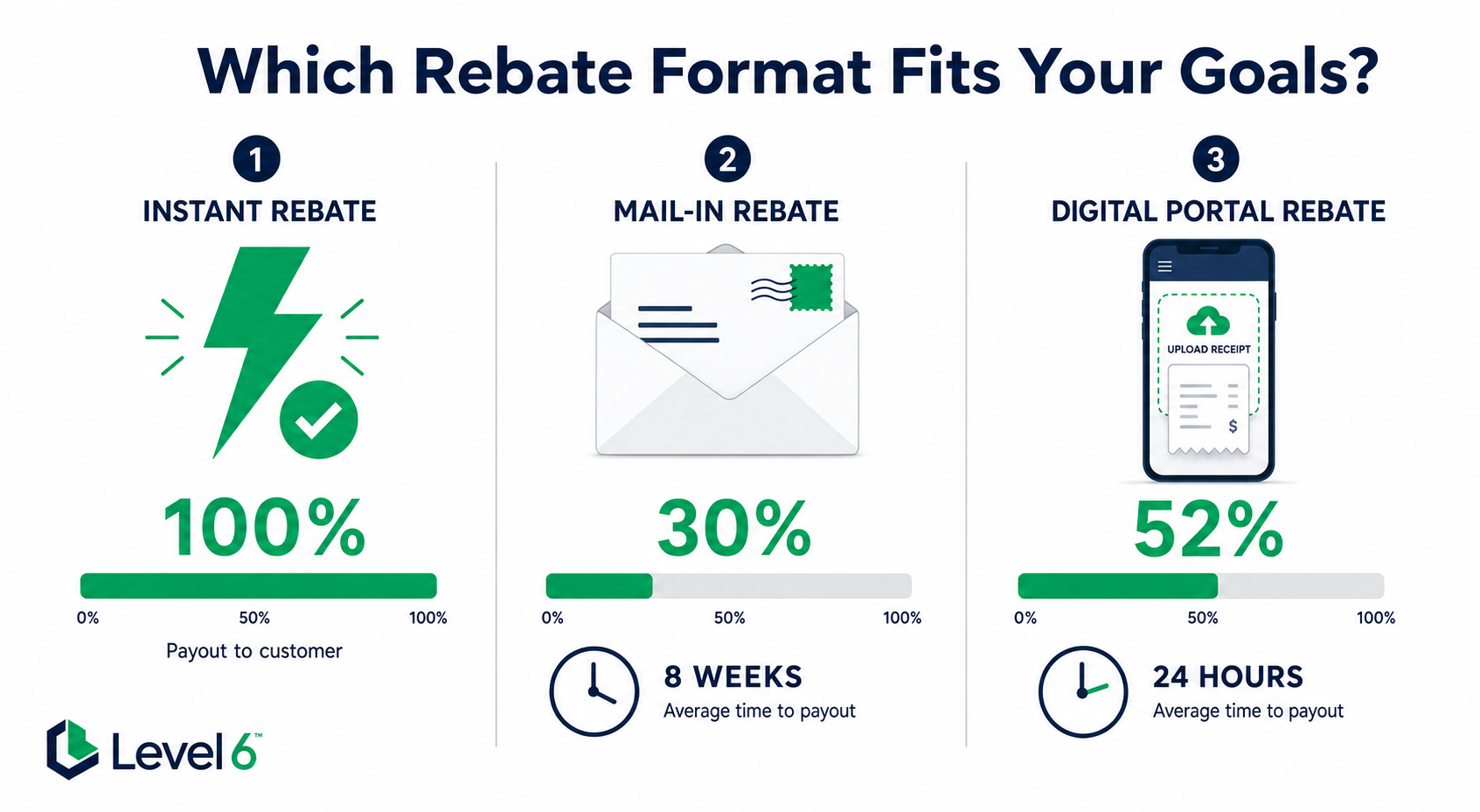
For a digital rebate program manufacturer comparison: choose instant rebates for velocity and post-purchase digital portals for data and margin control. Mail-in is obsolete: low-value offers redeem near 30% versus roughly 52% for digital. Digital pays in 24 hours instead of 6–10 weeks and captures first-party data on every claim.
Promotions teams must move units, protect margin, and finish the campaign owning a customer record. Mail-in rebates fail all three. This digital rebate program manufacturer guide compares instant, mail-in, and post-purchase portal mechanics on redemption, payout speed, fraud exposure, and data capture.
What Is a Manufacturer-to-Consumer Digital Rebate?
A manufacturer-to-consumer digital rebate is a post-purchase refund funded by the manufacturer and claimed online. The consumer submits proof of purchase, the program validates eligibility, and payment is delivered by virtual card, ACH, or digital gift.
Unlike an instant discount, the buyer pays full price first. Unlike mail-in, the claim, status, and payment move electronically; our walkthrough of how the rebate process works covers each stage.
Every digital rebate program manufacturer workflow does two jobs: pay the right people quickly, and convert an anonymous transaction into a permissioned brand relationship.
How Do Instant, Mail-In, and Digital-Portal Rebates Compare?
Post-purchase digital portals give most manufacturers the strongest balance. Instant rebates maximize uptake but surrender buyer-level insight; mail-in preserves breakage at the cost of friction and almost no fraud visibility.
| Decision factor | Instant rebate | Mail-in rebate | Post-purchase digital portal |
|---|---|---|---|
| Consumer action | None beyond purchase | Complete form, mail paper claim | Upload receipt by phone |
| Expected redemption | Approaches 100% | About 30% for low-value offers | About 52% across digital CPG offers |
| Payout speed | At checkout | Typically 6–10 weeks | Same day or within 24 hours |
| First-party data | Low unless retailer shares data | Collected, but hard to activate | High and structured for integration |
| Fraud controls | Depends on point-of-sale controls | Manual and retrospective | Automated rules and duplicate detection |
| Budget profile | Highest redemption liability | Lowest liability, high friction | Moderate, forecastable liability |
| Best fit | Conversion, launches, short promotions | Legacy or offline-only audiences | Data, control, and optimization |
Digital CPG offers average roughly 52% redemption against approximately 30% for low-value mail-in offers, per Level 6’s analysis of 133 campaigns using 2024 data.
Read the table as a digital rebate program manufacturer comparison of tradeoffs, not a ranking. Redemption scales with face value — sub-$20 offers land near 38%, $50 near 50%, $100 around 60%, per our consumer rebate benchmark analysis.
Types of Manufacturer Rebates: Which Can a Digital Portal Run?
Nearly every manufacturer rebate format can run through one digital portal.
- Consumer receipt-based rebates — the focus of this guide: the buyer uploads a receipt, SKU-level validation confirms eligibility, and payout moves by prepaid card, PayPal/Venmo, or retailer gift card.
- Volume and tiered rebates — earned by distributors as purchase thresholds are met, calculated from ERP sales data rather than receipts.
- Growth or incremental rebates — paid on lift above a baseline, making accrual accuracy and audit trail discipline essential.
- Loyalty and repeat-purchase rebates — unlocked on a second or third qualifying purchase inside a defined window.
- Bundled product rebates — one reward triggered when two or more qualifying SKUs appear on the same receipt.
- Time-sensitive or seasonal rebates — short windows used for launches or competitive response.
- MDF, co-op funds, and SPAs (special pricing agreements) — handled separately, since they fund partner activity rather than a purchase claim.
While this guide focuses on manufacturer-to-consumer rebate programs, many manufacturers run both. Channel or distributor rebates — volume, tiered, and growth structures paid back to wholesale partners — operate on a different mechanic but can share the same reporting infrastructure. A digital rebate program manufacturer platform built for consumer submissions typically extends to channel program management with the addition of ERP integration and distributor-facing claim flows.
A modern digital rebate program manufacturer workflow can run most of these formats from a single platform — the key difference is the claim mechanic and who submits proof.
How to Launch a Digital Rebate Program: Step by Step
A first program takes four to six weeks to stand up. Work the sequence in order and lock steps one and two before any build starts — most launch delays trace back to eligibility rules that changed after the portal was configured.
- Define the objective and promotion budget. Decide whether the campaign buys sales velocity, trial, data capture, or loyalty, then size the reward pool against that goal.
- Set eligibility terms. Name qualifying SKUs and UPCs, participating retailers, the purchase window, and a per-household claim limit before anything is built.
- Build the submission and validation flow. Mobile receipt upload, OCR validation, SKU match, and clear approval logic keep abandonment low and manual review small.
- Configure fraud controls. Duplicate detection, behavioral scoring, and velocity limits run before any payment is released.
- Select payout rails. Match prepaid card, ACH, PayPal/Venmo, or retailer gift card to the demographic you are paying.
- Establish the reporting and accrual cadence. Set the liability reserve, refresh the redemption forecast weekly, and align to the ASC 606 gross-to-net close.
- Plan post-campaign data activation. Route consented claim records to CRM, warranty registration, and lifecycle marketing while intent is fresh.
Pilot on one SKU family before a national rollout. A single promotional window calibrates approval rates, fraud thresholds, and support volume.
Why Mail-In Rebates Are Losing Ground
Mail-in rebates lose on redemption, speed, and trust at once. The mechanic asks a buyer to complete a form, keep a receipt, cut a UPC, pay postage, then wait.
Non-redemption is attrition, not a decision. Roughly 41% of intending claimants forget, 25% lose the paperwork, and 14% give up on the process, per our benchmark analysis of consumer rebate behavior.
Industry estimates suggest 40–60% of mail-in rebates go unredeemed, representing billions in annual promotional breakage. Finance books it as free money; we read it as a promotion that never reached the buyer.
Behavior has moved the other way. Marketing Dive’s reporting on NCH coupon redemption research documented a 47% increase in paperless redemption, most of it on mobile.
Speed Is Now a Trust Signal
Payout timing is now part of the brand experience. Federal Reserve consumer payments research documents how quickly households have shifted toward digital and faster payment methods.
Roughly 74% of consumers prefer digital payment over a mailed check, per our benchmark analysis of consumer rebate redemption data. A digital rebate program manufacturer migration that fixes intake but still mails checks solves only half the friction.
Late Fulfillment Is a Compliance Risk
Rebate advertising is regulated speech. The Federal Trade Commission’s advertising guidance states that rebate promotions should prominently disclose the before-rebate cost, the rebate amount, purchase requirements, additional fees, and when consumers can expect payment.
Enforcement history reinforces it: in the FTC’s 2007 rebate fulfillment enforcement actions, the agency required terms be disclosed clearly up front and rebates delivered on time. Any digital rebate program manufacturer forecast should treat on-time fulfillment as a control.
The First-Party Data Advantage of Digital Rebate Programs
Every valid digital claim is a consented data event, yielding serial number, purchase date, retailer, ZIP code, contact details, and payout preference — a structured record instant rebates never generate.
That record feeds CRM enrichment, warranty registration, segmentation, lifecycle messaging, and retailer-level analysis. As McKinsey research on first-party data and personalization argues, data is only valuable when it is tied to the customer relationship it is meant to serve.
For manufacturers who sell through distribution and rarely meet the end user, this is the largest argument for a portal. A digital rebate program manufacturer data strategy turns the claim into the only reliable bridge to the buyer.
Measurement discipline is the weak link. Only 57% of organizations reliably track rebate submission, issuance, and redemption rates, according to Aberdeen research reported by Chief Marketer’s coverage of manufacturer and retailer rebate research. Digital platforms close that gap by default.
How Digital Rebate Programs Reduce Fraud Risk
Digital intake is the only rebate channel where fraud controls run before money moves. Automated deduplication, receipt OCR, serial-number validation, image forensics, identity checks, and velocity limits all operate on structured submissions.
Mail-in has no comparable detection layer, so patterns spanning multiple claims stay invisible until the checks clear.
The emerging 2026 threat is synthetic proof of purchase. Generative tools now produce receipts that survive casual inspection, making OCR alone insufficient. A credible digital rebate program manufacturer fraud stack pairs text extraction with duplicate-hash detection, retailer template matching, SKU and date validation, and human review.
Scale controls to exposure: a sub-$20 offer does not need the scrutiny of a $200 rebate. See how OCR and AI automate rebate workflows.

Instant Rebate vs. Post-Purchase Digital Portal: The Decision Matrix
Instant rebates maximize redemption; post-purchase portals maximize data and margin control. The choice is economics, not technology, and it changes by SKU.
Instant Rebate: What You Gain and What You Give Up
An instant rebate is applied at the point of sale, with the manufacturer reimbursing the retailer. Redemption approaches 100% because there is no claim step, as our review of rebate program pros and cons explains.
The tradeoffs: you budget at full liability, collect no first-party data, and depend on the retailer for reconciliation.
Post-Purchase Digital Portal: What You Gain and What You Give Up
A portal keeps the claim step but removes nearly all friction. You retain some breakage, capture the full data record, and validate before paying.
The cost is redemption: even an excellent portal lands in the 40% to 55% range, and you carry intake, validation, and support. That burden is what the automation market absorbs, reaching $1.67 billion in 2024 and growing at an 11.8% CAGR through 2033 per Dataintelo’s post-purchase rebate automation market report.
Choose Instant When
- Face value is under roughly $25, where claim effort exceeds the reward.
- You are defending shelf position against an advertised competitor price.
- The retailer relationship supports clean POS reimbursement.
- You already capture first-party data elsewhere, such as warranty registration.
- Speed to market matters more than learning about the buyer.
Choose a Post-Purchase Digital Portal When
- Face value is $50 or higher, where economics survive a claim step.
- The product is a durable good or serialized item with warranty value.
- You need end-user identity for lifecycle marketing or channel intelligence.
- Payouts are large or nationally advertised, so fraud exposure is material.
- You sell through distribution with no visibility into sell-through.
- Finance requires accrual driven by real-time claim data.
A Hybrid Structure Often Beats Either Extreme
Many of the strongest programs we operate run instant rebates on entry SKUs and a portal on premium SKUs in the same campaign. A second pattern pairs an instant discount with an optional registration bonus, holding redemption near 100% while recovering most of the lost data.
How to Measure ROI: Benchmarks for a Digital Rebate Program Manufacturer
A well-run digital rebate program manufacturer typically delivers 35–55% net redemption; ROI is measured as incremental gross profit minus reward liability and processing cost. Model redemption as a funnel, not a single percentage: awareness drives submissions, form design drives completion, and validation rules drive approval.
In a representative funnel, 100,000 eligible units produce 42,000 claims, roughly 88% approved — about 37,000 paid claims and a 37% redemption rate.
Translate the rate into dollars before launch. In our own experience, a national HVAC distributor serving more than 3,000 contractors saw redemption improve from 18% to 41% after switching to digital claims.
That lift pays only if the economics support it. On 20,000 qualifying purchases at a $50 rebate, 18% implies $180,000 of liability and 41% implies $410,000 — a $230,000 delta justified only by incremental margin or data value.
A complete digital rebate program manufacturer ROI model calculates incremental gross profit, reward liability, net contribution after fees, cost per incremental buyer, and consented data yield.
Run low, base, and high cases, and accrue against the upper bound rather than a paper-era average. A scorecard built on mail-in breakage assumptions finds the shortfall late. See Level 6 rebate program management and fulfillment.
What Finance Needs From the Program
Rebate liability is a revenue-recognition question under ASC 606, and digital claim timestamps make the estimate defensible. Because every submission, approval, and payout is dated, finance can true up the reserve against observed behavior instead of a paper-era breakage average.
Model gross-to-net margin impact by SKU so promotional spend is visible where pricing decisions are made, and keep a complete audit trail and settlement reporting for quarter-end review. ERP integration with SAP, Microsoft Dynamics 365, or NetSuite pushes claim data into the reserve in near real time, replacing manual month-end estimates.
What to Look for in a Digital Rebate Program Platform or Partner
Evaluate platforms on validation depth, payout breadth, and financial reporting rather than portal design. Use this checklist when comparing vendors or an in-house build.
- SKU-level receipt validation against qualifying UPCs, retailer, and purchase date.
- Fraud and duplicate detection, including AI-generated receipt screening.
- Payout rail breadth: prepaid and reloadable cards, PayPal/Venmo, ACH bank transfer, digital gift cards, and retailer gift cards.
- Real-time liability dashboard and accrual reporting finance can rely on.
- ERP and CRM integration (SAP, Microsoft Dynamics 365, NetSuite, and major CRM platforms).
- Audit trail and approval workflow governance on every claim decision.
- Consumer support SLA and a self-service claim status portal.
- Configurable eligibility rules: per-household limits, purchase window, SKU and retailer restrictions.
- Compliance and 1099/tax handling on rewards.
Weight the checklist against exposure: a $200 national offer needs deeper validation than a $10 promotion. For a wider comparison, see our guide to rebate management tools. To evaluate what a digital rebate program manufacturer infrastructure looks like for your brand, contact our team.
Frequently Asked Questions About Digital Rebate Programs for Manufacturers
The most common questions manufacturers ask about digital rebate programs — answered from 25+ years of program design and fulfillment experience.
What is a digital rebate program for a manufacturer?
A digital rebate program for a manufacturer is a post-purchase promotion where consumers submit proof of purchase through an online or mobile portal and receive payment electronically. It replaces paper forms, mailed receipts, and physical checks with photo upload, automated validation, and payout rails such as virtual card, ACH, or digital gift.
How much higher is digital rebate redemption versus mail-in?
Digital consumer packaged goods rebates average approximately 52% redemption, compared with roughly 30% for low-value mail-in offers, based on Level 6’s analysis of 133 campaigns using 2024 data. In our own program management experience, one anonymized HVAC distributor program improved from 18% to 41% after moving to digital claims.
When should a manufacturer use an instant rebate instead of a portal?
Use an instant rebate when face value is low, typically under $25, when shelf-edge price visibility drives the purchase decision, and when you already capture first-party data elsewhere. Instant rebates approach 100% redemption because there is no claim step, but they eliminate breakage and produce no consumer data.
Do digital rebates increase fraud risk?
No. Digital rebates reduce net fraud exposure because validation happens automatically at claim time. Automated deduplication, proof-of-purchase OCR, serial-number validation, image analysis, and identity checks all run before payment is released. Mail-in programs have no comparable detection layer, which matters as AI-generated receipts become a common attack vector.
How fast can a digital rebate be paid?
Digital rebates can pay same day or within 24 hours of approval, and well-run programs typically settle within seven to ten business days, while mail-in rebates take six to ten weeks. Approximately 74% of consumers prefer digital payment over a mailed check, per our consumer rebate benchmark data, making speed a direct driver of satisfaction.
What first-party data does a rebate claim capture?
A single digital rebate claim can capture serial number, purchase date, retailer, ZIP code, contact details, payout preference, and marketing consent. That record supports CRM enrichment, warranty registration, segmentation, remarketing, and lifecycle marketing. For manufacturers selling through distribution, the claim is often the only direct link to the end user.
How should finance accrue liability for a digital rebate program?
Accrue against the upper bound of your redemption range rather than a historical mail-in average. Frictionless digital claims routinely exceed forecasts, and programs budgeted on paper-era breakage assumptions create margin surprises. Real-time claim dashboards let finance adjust accruals within the promotion period instead of after the offer window closes.
Are mail-in rebates still legal and compliant?
Yes, mail-in rebates remain legal when advertised clearly, honored promptly, and free of exclusionary conditions. The Federal Trade Commission requires that rebate advertising state the before-rebate price, the rebate amount, purchase requirements, and when consumers can expect payment. Where no timeframe is stated, the FTC expects prompt fulfillment; the FTC advertising guidance and its Mail Order Rule both require clear disclosure and timely payment.
Final Takeaways
- Digital beats mail-in on every measurable axis. Roughly 52% average redemption versus near 30%, with 24-hour payout instead of six to ten weeks.
- Instant rebates buy redemption; portals buy data and margin control. Instant approaches 100% uptake but forfeits breakage and data.
- Face value should drive the mechanic. Under roughly $25, go instant; at $50 and above, run a portal or a hybrid.
- Layered validation is non-negotiable. A digital rebate program manufacturer playbook must assume synthetic receipts.
- Budget against the upper bound. A frictionless digital rebate program manufacturer budget built on paper-era breakage assumptions will miss its accrual.
Weighing an instant rebate, a portal, or a hybrid for your next promotion? Talk with the Level 6 team about your rebate strategy and we will model redemption, payout timing, and data capture against your SKU mix.
Mail-in rebates redeem near 30% and take six to ten weeks; digital offers average roughly 52% and can pay within 24 hours. This guide compares instant, mail-in, and post-purchase digital rebates on redemption, speed, fraud, and first-party data, with a decision matrix and ROI framework.