By Claudine Raschi, MS · Last updated: September 2026
Quick Answer: Which Incentive Payout Method Should You Use?
Use prepaid debit cards for SPIFFs, unbanked payees, and sub-$500 payouts — the card network handles 1099-K reporting so you don’t. Use ACH for large distributor rebates over $5,000 to established business accounts. Reserve paper checks for exceptions only — they cost the most and carry the heaviest compliance burden.
Why Payout Method Is a Strategic Decision, Not an Afterthought
An incentive payout method comparison weighs how money moves from a manufacturer to the people who earn it — dealer reps, distributors, retail associates, or channel partners — against cost, speed, compliance burden, and recipient experience. Most finance and incentive teams default to whatever method a program started with, often paper checks, without revisiting fit as the program scales.
The method you choose affects how quickly a reward reinforces behavior, how much staff time goes into reconciliation and tax paperwork, and who ends up filing a 1099. A SPIFF that arrives weeks after the sale, tied to a check that must be deposited and cleared, does little to reinforce the behavior it was designed to reward.
A rigorous incentive payout method comparison has to weigh speed, cost, banking access, and tax reporting together — because they interact in ways that surprise most program sponsors the first time they run at scale.
With 25+ years designing channel incentive and rebate programs, we’ve seen the same payout method mismatches surface repeatedly across industries. This incentive payout method comparison guide walks through ACH, prepaid debit cards, and paper checks side by side, with a decision matrix and two anonymous case studies illustrating what happens when programs switch rails.
How ACH, Prepaid Debit Cards, and Paper Checks Compare
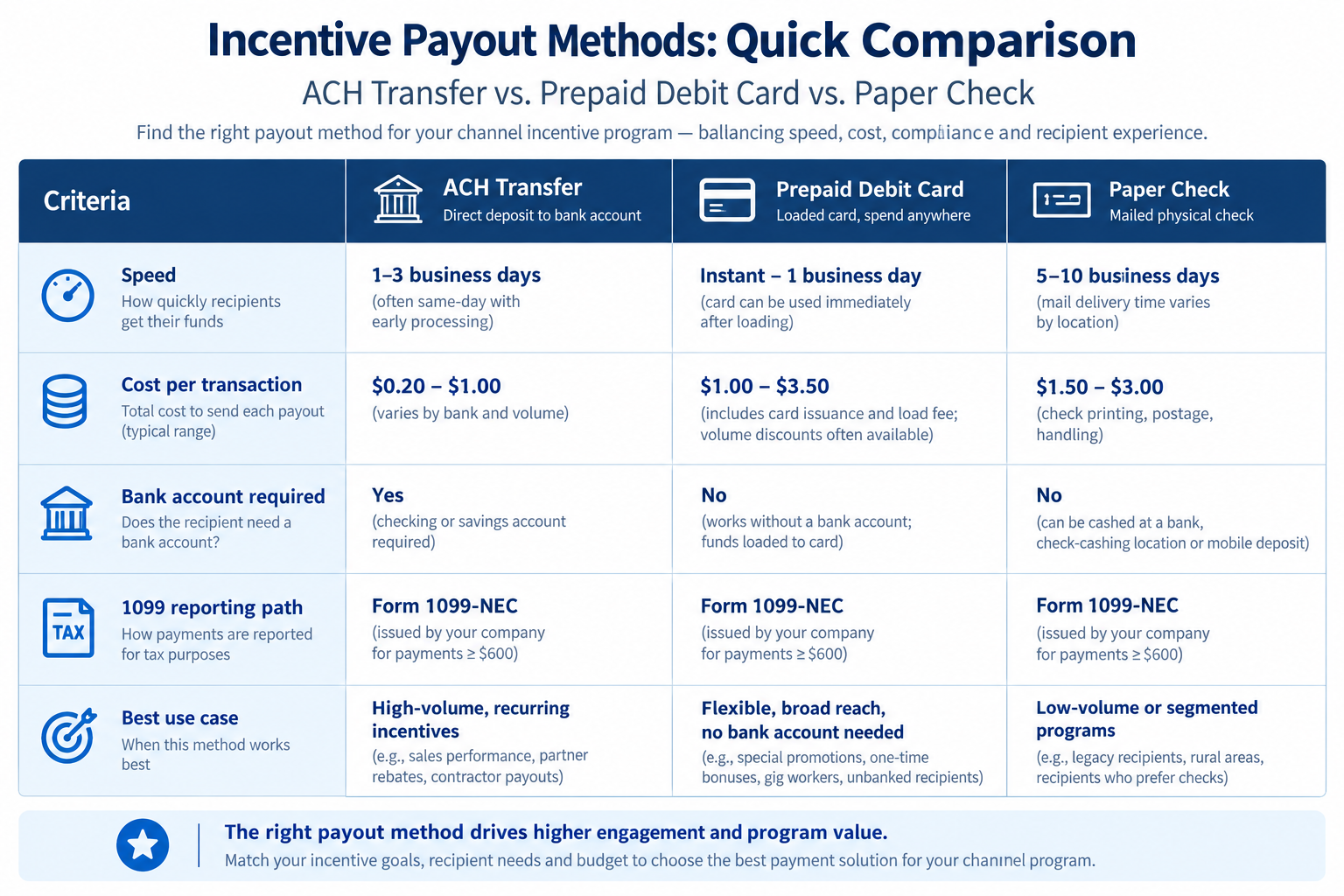
The table below summarizes this incentive payout method comparison across the factors that matter most to program administrators and channel finance teams.
| Factor | ACH Transfer | Prepaid Debit Card | Paper Check |
|---|---|---|---|
| Cost per transaction | ~$0.26–$0.50 | Card program fee; competitive at scale | $4–$20 all-in (print, postage, staff time) |
| Speed to funds | 1–3 business days | Instant-to-card load available | 3–5 day float plus mail time |
| Bank account required | Yes | No | No, but must be cashed at a bank or outlet |
| 1099 reporting path | Payer issues 1099-NEC at $600+ to non-employees | Card network issues 1099-K; payer generally does not issue 1099-NEC | Payer issues 1099-NEC at $600+ to non-employees |
| Reconciliation burden | Low to moderate | Low; consolidated card program reporting | High; manual tracking and reissuance |
| Best fit | Large distributor rebates, recurring payouts to banked accounts | SPIFFs, spot bonuses, unbanked or dispersed payees | Exceptions when digital enrollment fails |
Note on a fourth rail: Push-to-card (also called real-time card disbursement) is an emerging option that pushes funds directly to an existing debit card through Visa or Mastercard networks in near-real time. It combines ACH’s bank-account routing with prepaid-card-like instant availability. For channel programs, the primary limitation today is that it requires knowing the payee’s debit card number in advance — a data-collection hurdle that prepaid card programs avoid by issuing the card themselves. Programs evaluating push-to-card should assess enrollment complexity against their payee population before deploying at scale.
ACH Transfers: Low Cost, Reliable, Bank Account Required
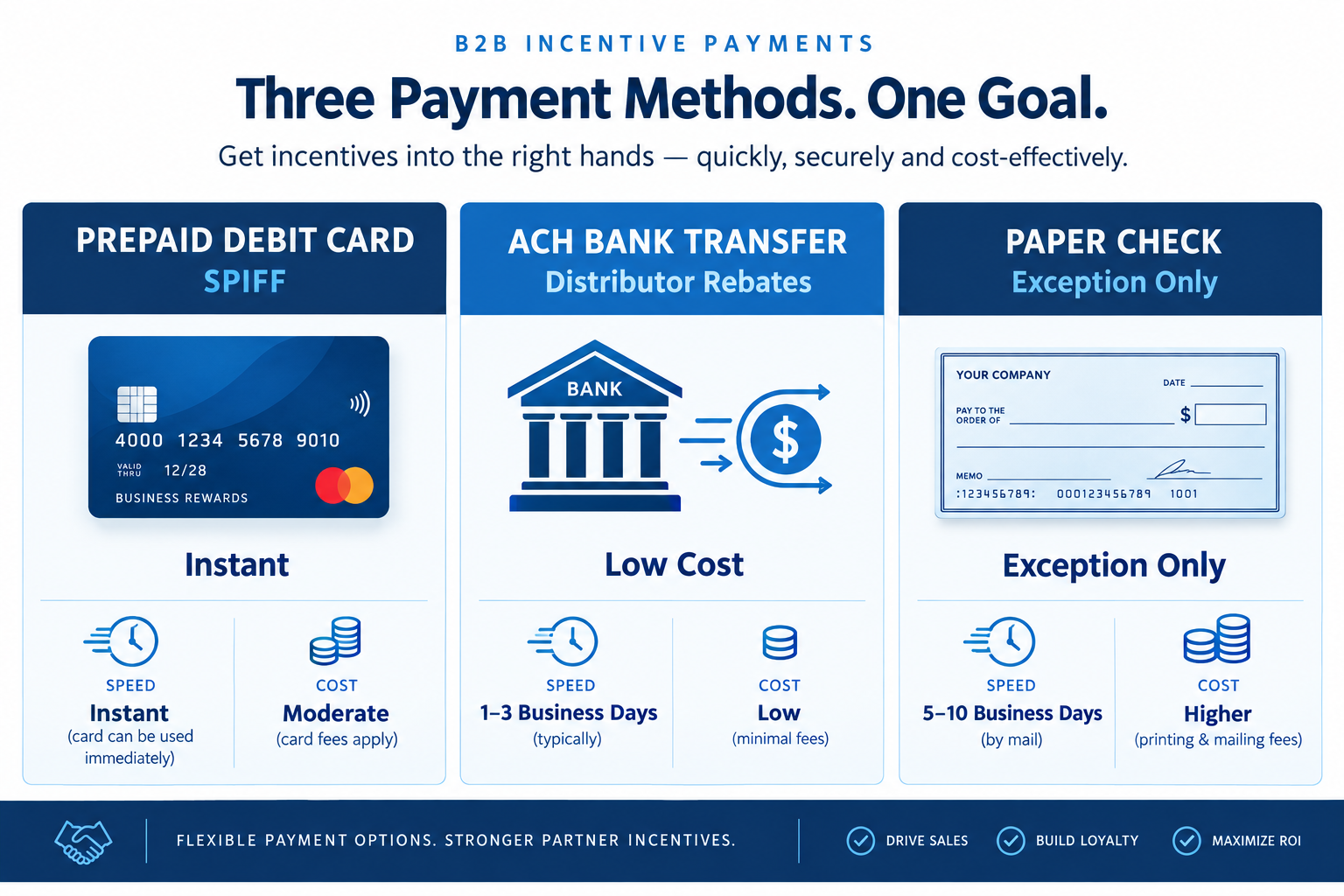
ACH (Automated Clearing House) transfers are the cheapest option in this incentive payout method comparison per transaction, running roughly $0.26 to $0.50, and settle in one to three business days — fast enough for most distributor rebate and channel-incentive cadences, per Level 6’s analysis of debit card versus ACH rewards. That makes ACH the natural fit for high-dollar recurring disbursements where the cost gap between rails compounds meaningfully at scale.
The structural constraint is enrollment: ACH requires the payee to have a bank account and provide routing and account numbers, often with a micro-deposit verification step. NACHA — the organization that governs ACH rules — sets the settlement windows and return code standards that determine when a failed ACH transfer gets reported back to the sender, typically within two business days. For established businesses — distributors, dealerships — this is a non-issue. For large, dispersed populations of individual dealer reps or retail associates, failed enrollment is the most common reason ACH payouts stall and revert to more expensive fallback methods.
Because ACH is paid directly by the company, it triggers a Form 1099-NEC once a non-employee payee’s annual total reaches $600, per IRS Publication 1099. That means collecting W-9s, tracking thresholds, and filing correctly at year-end — an administrative load that scales directly with payee count. Any honest incentive payout comparison has to count that staff time as a real cost of the ACH rail.
Prepaid Debit Cards: Instant Access, No Bank Account, Different Tax Path
Prepaid and reloadable debit cards support instant-to-card fund loading through a card network — typically Visa or Mastercard — meaning a dealer rep can complete a qualifying sale and have spendable funds within minutes. No bank account is required: the card functions as its own account, removing the enrollment barrier that is ACH’s biggest failure point for dispersed populations, according to Level 6’s guide to virtual and physical prepaid cards.
The most consequential difference in this incentive payout method comparison is tax treatment. Because prepaid and debit card loads settle through a card network, the payment settlement entity — not the paying company — issues Form 1099-K under IRS rules. The IRS’s own guidance on Form 1099-K confirms that payment card transactions, including stored-value and prepaid cards, are reported by the entity submitting the transfer instructions — the card network — not the merchant or manufacturer funding the card.
That shift matters operationally. A company running SPIFFs across hundreds of dealer reps that would otherwise need to collect W-9s, track $600 thresholds individually, and issue 1099-NEC forms to each participant can instead route payouts through prepaid cards and let the card network handle 1099-K reporting.
For programs that have been issuing hundreds of 1099-NEC forms manually each January, this is often the single most compelling reason to switch rails. The broader tax implications for incentive programs are covered in Level 6’s guide to taxes and incentive programs.
Prepaid cards do carry a higher per-transaction cost than ACH, and physical cards introduce card stock and activation logistics that virtual cards avoid. Virtual prepaid cards — delivered instantly by email or SMS — suit sub-$50 spot bonuses and micro-incentives where the cost and delay of physical card production would be disproportionate to the payout size.

Paper Checks: Highest Cost, Slowest Delivery, Full 1099-NEC Burden
Paper checks carry an all-in cost of $4 to $20 per payment once printing, postage, and reconciliation staff time are counted — well above ACH and competitive card programs. They float for three to five days before clearing, lost checks require reissuance, and manual reconciliation against incentive records consumes finance team hours that ACH and card programs eliminate, per Level 6’s payout method comparison.
Checks paid to non-employees trigger the same 1099-NEC obligation as ACH: $600 or more in a calendar year requires the paying company to issue the form, with no third party absorbing that responsibility, per IRS Publication 1099. They carry the highest cost and reconciliation burden of any rail in this incentive payout method comparison — with none of the tax-reporting relief available through the card route.
Checks still have a legitimate role as a fallback when a payee’s ACH enrollment fails repeatedly or when a payee explicitly requests one. Treating them as a fallback rather than a default is the posture that produces the biggest cost savings for high-volume programs.
The 1099-K vs. 1099-NEC Distinction: The Most Important Compliance Factor
The single most important compliance differentiator in any incentive payout method comparison is the 1099 reporting path. For ACH and paper checks paid directly by the company, the payer must issue a Form 1099-NEC to each non-employee who receives $600 or more in the calendar year — requiring W-9 collection, threshold tracking, and January filing for every qualifying payee.
Prepaid debit card payout method follows a fundamentally different tax path. Under IRS rules, payment card transactions — including debit, credit, and stored-value cards — are reported on Form 1099-K by the payment settlement entity, not by the business funding the card. The IRS confirms that there is no minimum threshold for 1099-K reporting on payment card transactions: even a one-cent card payment is reportable, but the obligation falls on the card network, not the incentive-paying manufacturer or brand.
Programs running thousands of SPIFF or spot-bonus payouts to dealer reps see the biggest relief from this shift. Moving that payee population to prepaid debit cards can eliminate a large share of a program’s 1099-NEC filing volume in a single structural change — one that also removes the W-9 collection step for participants who would otherwise need to provide tax identification before receiving payment.
Which Payout Method Fits Which Use Case?
The right incentive payout method depends on payout size, payee banking access, and how fast the money needs to move. Matching the rail to the use case is where most of the cost and compliance savings in this incentive payout method comparison are realized.
SPIFFs to Dealer or Retail Reps
Prepaid debit cards are the best fit for SPIFFs in this incentive payout method comparison — dealer-level reps are typically hourly retail staff without payroll relationships to the manufacturer. Instant-to-card loading means the rep sees the reward almost immediately after the qualifying sale, reinforcing the behavior the SPIFF was designed to drive. The 1099-K path through the card network removes the need to collect W-9s from potentially thousands of participants who may cycle through retail locations frequently.
Large Distributor Rebates ($5,000 and Up)
ACH is the more efficient choice once a single payout reaches $5,000 or more for distributor rebate programs. These payees are established businesses with existing banking relationships and predictable payout cadences, so enrollment friction is minimal. At this size, ACH’s low per-transaction cost compounds meaningfully, and funds arrive directly into the business account where the distributor’s own accounting team handles reconciliation.
Unbanked or Rural Payees
Prepaid debit cards are the only practical option for payees without bank accounts. ACH is structurally unavailable without one, and paper checks require access to a bank or check-cashing outlet. A card can be used wherever Visa or Mastercard is accepted, which covers almost all everyday spending, per U.S. Bank’s research on consumer payout strategy.
Sub-$50 Spot Bonuses and Micro-Incentives
Virtual prepaid cards are the natural fit for spot bonuses under $50. The cost of printing and mailing a check would exceed the value of some payouts entirely. A virtual card delivers the reward by email or SMS in minutes, with no physical card production cost and no mailing delay.
Case Study: A Furniture Manufacturer’s Move from Checks to Cards
A mid-size furniture manufacturer had run its multi-state dealer SPIFF program entirely through paper checks, manually tracking every payee against the $600 1099-NEC threshold at year-end. Senior accounting staff spent hundreds of hours annually printing checks, reconciling payment registers, and preparing individual 1099-NEC forms for qualifying reps — time that compounded as the program grew.
After switching to a reloadable prepaid card program, the manufacturer cut payout delivery from roughly a week to same-day funding and shifted much of its 1099 reporting obligation to the card network. The accounting team redirected the recovered hours toward program analysis and optimization rather than paperwork, and the program’s 1099-NEC filing count dropped substantially in the first year after the switch.
Case Study: A Jewelry Brand’s Switch from Spreadsheets to Monthly Cards
A jewelry brand paying more than 900 retail sales reps across independent retail partners had run quarterly paper check payouts tracked in spreadsheets, making it difficult to catch payout errors or reissue lost checks quickly. Reconciling which reps had cashed which checks, and which had outstanding W-9s on file, consumed a disproportionate share of the incentive team’s time each quarter.
The brand moved to monthly reloadable debit card payouts with 1099 handling included in the card program’s settlement obligations. Monthly payments replaced quarterly ones without materially increasing administrative load, the spreadsheet-based reconciliation cycle was eliminated, and 1099-NEC exposure shrank because the card network absorbed the reporting responsibility for card-based payouts.
Frequently Asked Questions
What is the main difference in an incentive payout method comparison between ACH and prepaid cards?
ACH costs roughly $0.26–$0.50 per transaction and settles in one to three business days, but requires the payee to have a bank account. Prepaid debit cards can load funds instantly with no bank account required. The more consequential difference is tax reporting: ACH payouts trigger a 1099-NEC from the payer at $600; prepaid card payouts are reported on 1099-K by the card network, shifting that obligation away from the paying company, per IRS guidance on Form 1099-K.
Do prepaid debit card incentive payouts require a 1099-NEC from the paying company?
Generally no. The IRS treats payment card transactions — including prepaid and stored-value cards — as reportable by the payment settlement entity on Form 1099-K, not by the business funding the card. This shifts the filing obligation away from the incentive-paying company and removes the need to collect W-9s and track $600 thresholds for card recipients, per IRS Form 1099-K FAQs.
At what dollar amount does an ACH or check incentive payout require a 1099-NEC?
Non-employee compensation paid via ACH or check generally requires a Form 1099-NEC once a payee’s total for the calendar year reaches $600, per IRS Publication 1099. This applies whether the amount accumulates from a single large payout or multiple smaller ones. The threshold applies to each payee individually, so a program paying hundreds of reps must track each separately.
Which payout method is best for SPIFFs paid to dealer reps?
Prepaid debit cards are generally the best fit for dealer SPIFF programs. They deliver funds almost instantly, require no bank account from the rep, and reinforce the reward at the point of use. ACH is a poor fit for most SPIFF populations because dealer reps expect same-day access, not a multi-day wait, and because ACH enrollment at scale across frequently changing retail staff is administratively burdensome.
Why are paper checks the most expensive incentive payout method?
Paper checks typically cost $4–$20 all-in once printing, postage, and reconciliation staff time are counted — well above ACH’s $0.26–$0.50 per transaction. They also float for three to five days before clearing, carry float and reissuance risk, and still trigger a 1099-NEC obligation at the same $600 threshold as ACH — with none of the tax-reporting relief available through prepaid card programs.
Is a virtual prepaid card better than a physical one for small incentive payouts?
For payouts under roughly $50, virtual prepaid cards are usually more efficient: they issue instantly by email or SMS, avoid card stock and mailing costs, and let the recipient spend the balance online immediately. Physical cards still have advantages for larger payouts, in-store use where tap-to-pay adoption is lower, and programs where a branded card itself carries recognition value.
Should a program use more than one payout method?
Yes — most large incentive programs benefit from a two-rail approach. ACH handles large, recurring distributor rebates to established business accounts, while prepaid debit cards serve individual reps, unbanked payees, and smaller frequent payouts. Standardizing on one rail for every payee type tends to either overpay on per-transaction costs (if cards are used for everything) or create enrollment failures that generate check fallbacks (if ACH is used for everyone).
Final Takeaways
- ACH is the most cost-efficient incentive payout method in this incentive payout method comparison for large, recurring distributor rebates to established business accounts — $0.26–$0.50 per transaction, 1–3 day settlement, but requires a bank account and triggers 1099-NEC at $600.
- Prepaid debit cards win on speed, banking-access flexibility, and tax-reporting relief: the card network issues 1099-K instead of the payer issuing 1099-NEC, removing W-9 collection and threshold tracking for card recipients.
- Paper checks cost $4–$20 all-in per payment, float for days, and carry the same 1099-NEC burden as ACH — treat them as a fallback, not a default.
- Most programs benefit from a two-rail approach: ACH for distributor-level payouts, prepaid cards for individual reps, unbanked payees, and sub-$50 spot bonuses.
- Getting the incentive payout method comparison right cuts both per-transaction cost and year-end 1099 overhead — two line items that compound significantly at program scale.
Running a mixed-payee incentive program and want help mapping the right payout rail to each segment? Contact our team to review your program’s payout structure and compliance posture.