By Claudine Raschi, MS · Last updated: May 2026
Quick Answer: What Is a Channel Incentive Program Audit?
A channel incentive program audit evaluates a manufacturer’s partner reward program across five domains: program design, payout timing, fraud controls, partner engagement, and ROI measurement. Score your program on 20 points to identify whether it is high-performing, leaking ROI, or due for a platform overhaul.
Why Manufacturers Need a Channel Incentive Program Audit Now
Every manufacturer should run a channel incentive program audit before adding more budget, more rewards, or another promotional layer. A strong audit shows whether your program is reinforcing the right partner behaviors, paying accurately, protecting margin, and proving value. A weak audit usually reveals the same pattern: rules that are too hard to explain, payouts that feel slow or opaque, controls that invite disputes, and reporting that cannot separate program lift from normal market movement.
More than 73% of world trade flows through an indirect sales channel, which means most manufacturer revenue depends on partner behavior rather than direct selling effort. When the program that shapes that behavior drifts out of alignment, revenue, margin, and partner loyalty all erode quietly before the lagging indicators appear on a dashboard.
Incentive design has an outsized commercial effect. McKinsey reports that smart revisions to compensation models can have a 50% greater impact on sales than changes in advertising investment, while Deloitte Insights cites partner research showing that 75% of partners complain about overly complicated programs. The Incentive Research Foundation reports that 48% of participants at top-performing companies actually earn awards — a useful benchmark for how broadly the channel should be able to win.
A channel incentive program audit is not a compliance exercise; it is a commercial performance review that helps you decide whether to optimize the current model or change the operating model behind it. See Level 6 sales incentive programs, Level 6 incentive solutions, and Level 6’s guide to building a channel incentive program.
What Types of Incentives Does a Channel Incentive Program Audit Cover?
A channel incentive program audit evaluates all incentive types in the program portfolio — not just the largest payout category. The five most common types manufacturers run, and that the audit covers, are:
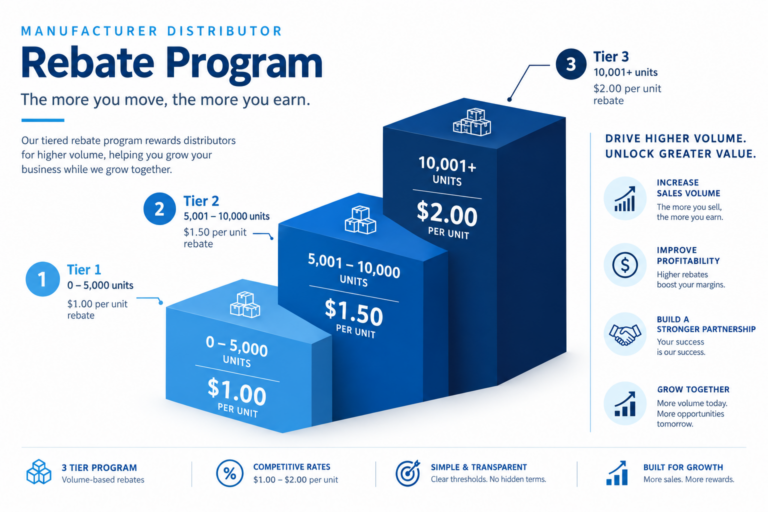
- Rebates: Volume-based or threshold-based payments to distributors or resellers after hitting a sales target. Rebates are typically the highest-dollar incentive type and the one most often under-measured for incremental lift.
- SPIFFs (Sales Performance Incentive Funds): Short-term cash payments to individual partner salespeople for pushing a specific product or meeting a quarterly goal. SPIFFs work fastest but require the tightest fraud controls of any incentive type.
- MDF / Co-op Funds: Market Development Funds and co-op reimburse partners for marketing activities — events, advertising, campaigns. MDF programs carry the highest claims-fraud risk, which is why the audit’s fraud-controls category scores them separately.
- Tiered Rewards: Escalating benefits (Gold, Silver, Platinum) tied to cumulative sales or certifications. Tier design is the single design question that most affects middle-of-channel engagement.
- Training and Certification Incentives: Rewards for completing product training, earning certifications, or achieving technical accreditations. These are the leading indicators that predict sell-through before revenue appears.
The audit’s 20-point scorecard applies equally to each incentive type. A program that scores well on rebate payout timing but poorly on MDF fraud controls is a different remediation problem than one that scores uniformly low across all five types.
How Partner Segmentation Affects Your Channel Incentive Program Audit Score
Audit scores frequently diverge across partner segments even when all partners are in the same program. A channel incentive program audit should be scored separately for each major segment before producing an overall program score.
The four segmentation variables that most affect audit outcomes are:
- Partner tier: Top-tier partners often score well on payout timing (they submit more claims, so the process is familiar) but poorly on tier achievability. Mid-tier and long-tail partners often score low on engagement because real-time dashboards are not showing them a realistic path to the next level.
- Partner type: Distributors, value-added resellers (VARs), managed service providers (MSPs), and dealers each use incentives differently. A SPIFF that motivates a dealer salesperson may be irrelevant to an MSP focused on recurring revenue.
- Geographic region: Regional programs must account for local tax treatment, currency, and partner-portal access differences. An audit that scores the U.S. program without segmenting the international program will mask regional compliance gaps.
- Partner maturity: New partners need onboarding incentives and clear documentation. Established partners need tier-upgrade visibility and product-mix incentives. The audit checks whether program rules serve both stages or only one.
When we audit a manufacturer program that scores between 8 and 12 overall, partner segmentation is almost always where the hidden variance lives. One tier or region is dragging the aggregate score down while another segment is performing well.
The Five Domains of a Channel Incentive Program Audit
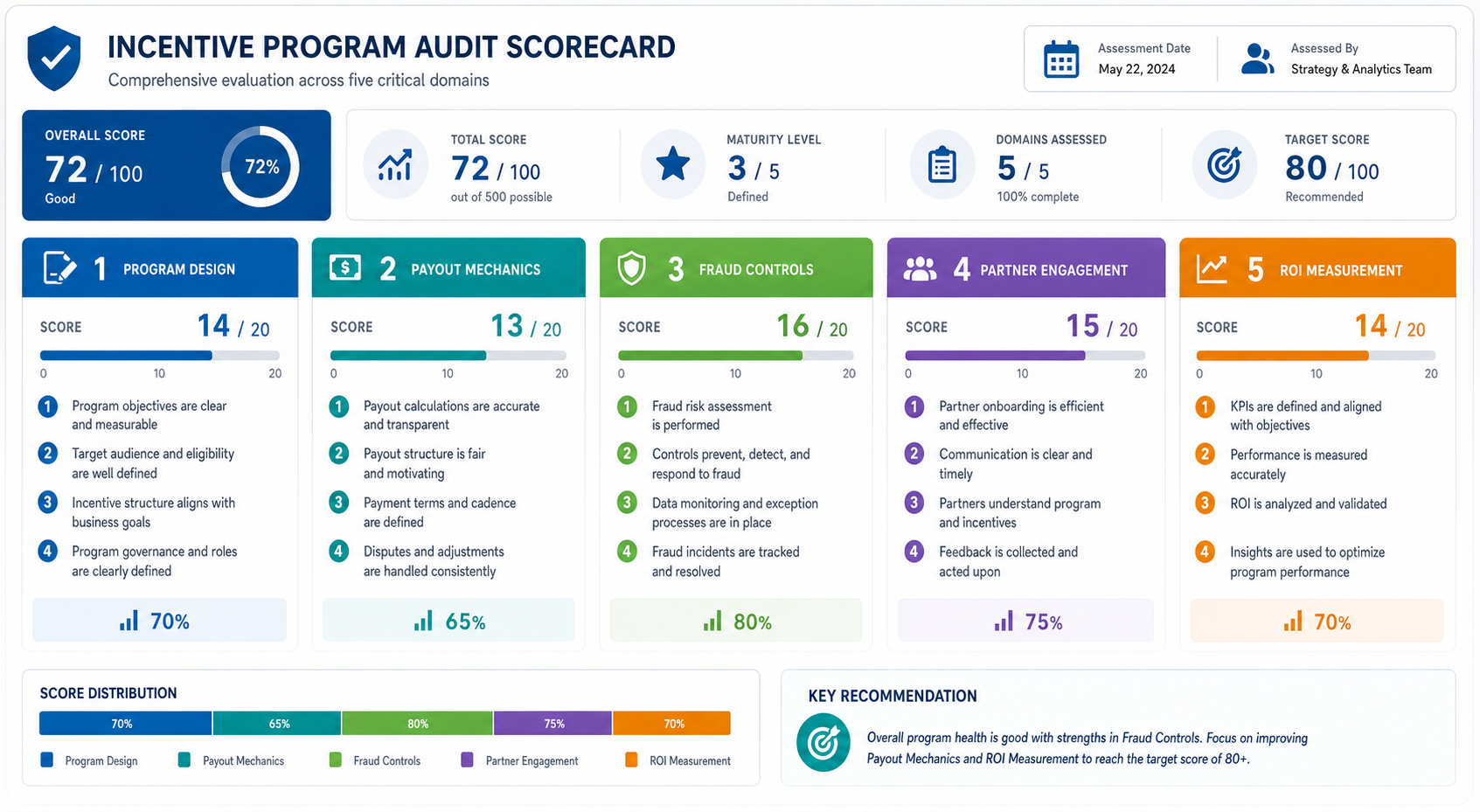
Our channel incentive program audit covers five domains, each scored on four equally weighted questions. The categories are deliberately balanced because over-engineering one — typically fraud controls or payout speed — at the expense of others is the single most common failure pattern in manufacturer programs.
1. Program design: reward the behaviors that actually move the channel
The first job of a channel partner incentive audit is to test whether your rewards are tied to the behaviors you need, not just the revenue you hope appears at quarter end. In manufacturing channels, those behaviors include deal registration, certifications, stocking commitments, product-mix shifts, renewals, and expansion into targeted accounts.
McKinsey argues that incentive systems work best when they align with role-based goals and observable behaviors rather than blunt revenue crediting. The harder design question is whether enough of the partner base can realistically win: the Incentive Research Foundation found that top-performing companies emphasize reach over exclusivity, with 48% of participants earning awards. If only the same small group can ever reach the top tier, the program teaches the middle of the channel to stop trying.
2. Payout timing and accuracy: make the reward feel real
Payout discipline is where trust becomes visible. If claims disappear into manual review queues or payment status is unclear, partners experience the program as friction rather than motivation. McKinsey notes that long sales cycles demotivate participants when rewards are delayed until the very end, which is why many manufacturers build milestone-based reinforcement into their programs.
Best-performing programs pay within 30 days of qualification; once payouts stretch past 60 days, the behavioral link between action and reward weakens. The Incentive Research Foundation documented this in a distribution-channel case that found $37.2 million in incremental purchases, $7.44 million in incremental profit, and 112.5% ROI on $3.5 million of program investment — results that depended on partners staying engaged through a fast, visible payout cycle.
3. Fraud controls: design for honest participation, not blind trust
A credible channel incentive program audit checks whether your process assumes good intent without verifying claims. Duplicate invoices, serial-number reuse, false submissions, and questionable timing patterns drain budget and create disputes with honest partners. Harvard Business Review warns that incentive systems invite gaming when designers fail to imagine how participants might exploit them, noting that sandbagging alone can reduce sales revenue by 4% to 6%.
Based on our experience managing manufacturer incentive programs, and consistent with NIST on protecting sensitive business systems, a layered fraud defense includes field-level data validations, duplicate invoice and serial number checks, manual audit thresholds, and a documented strike policy. In our experience working with large manufacturers, co-op and MDF claims fraud can absorb 15–25% of allocated budgets when controls are inadequate. A serious channel incentive audit tests those controls against real submission samples and verifies secure access — NIST notes passwords alone are not effective and recommends multi-factor authentication as an added barrier.
4. Partner engagement: prove the program is alive between launch and payout
Engagement is the domain most manufacturers under-measure. A program can look funded and operational internally while feeling invisible to partners who do not know their status, cannot see their progress, or only hear from the brand when it wants more sell-through. The Incentive Research Foundation reports that top-performing businesses are 86% more likely to integrate channel incentives into broader company communications.
Real-time dashboards that show partners their tier progress, accrued earnings, and pending payouts are among the most consistent engagement drivers we see across manufacturer programs. The Incentive Research Foundation recommends an alignment chain that runs from manufacturer objectives to target partner behaviors to incentive constructs to measurement loops. If any link in that chain is missing, the program funds activity that does not move the strategy forward.
5. ROI measurement: isolate lift instead of reporting activity
ROI measurement is where audits most often expose a credibility gap. The Incentive Research Foundation documented a 112.5% ROI on a distributor incentive program, a reduction in accounts receivable from 59 days to 32 days, and inventory turnover that shortened from 89 days to 70 days during a nine-month program period. In the same analysis, incremental purchases reached $37.2 million; at a 20% gross margin and a $3.5 million investment, incremental profit reached $7.44 million.
Those results are only credible because the program isolated incremental lift against a documented projected baseline. Our audit separates participation rate from payout rate and includes operational metrics such as AR days, inventory movement, and product-mix change — without those, the numbers cannot be defended to a CFO.
The 20-Point Channel Incentive Program Audit Scorecard
Score one point for every “yes.” Total each category, then sum for an overall score out of 20. We recommend completing the channel incentive program audit with at least one channel manager, one finance partner, and one operations lead in the room — the answers usually differ across roles, and the gaps are diagnostic on their own.
Category 1: Program design (4 points)
- Are all incentive types (SPIFF, rebate, MDF, training) tied to specific, measurable partner behaviors? Rewards should link to concrete actions, not ambiguous outcomes.
- Do 60–70% of active partners have a realistic path to earn a meaningful reward? If only the top 10–20% can reach the highest tiers, the rest of the channel disengages.
- Can partners explain the program rules without reading the guide? Complexity is the silent killer of participation.
- Is the incentive mix reviewed and updated at least annually based on performance data? Stagnant programs lose motivational power.
Category 2: Payout timing and accuracy (4 points)
- Are payouts processed within 30 days of verified qualification? Beyond 60 days the behavioral reinforcement loop breaks.
- Is payout accuracy rate ≥ 98% (fewer than 2 errors per 100 claims)? Higher error rates erode channel confidence.
- Are multiple payout methods available to partners (prepaid, ACH, check)? Prepaid cards, ACH, and checks reduce friction across partner segments.
- Do partners receive status notifications for submitted claims and pending payouts? Automated notifications eliminate support-desk pings.
Category 3: Fraud controls (4 points)
- Are submission forms validated at entry (field types, quantity caps, date limits)? Entry-level validation stops fraud before it starts.
- Does the system run duplicate checks against prior submissions (invoice numbers, serial numbers)? Automated cross-referencing prevents double-dipping.
- Is there a defined dollar or volume threshold above which claims are manually reviewed? High-value claims should get human review before approval.
- Is there a documented fraud strike policy with defined consequences? Bad actors need clear consequences, alongside multi-factor authentication on participant access.
Category 4: Partner engagement (4 points)
- Do partners have real-time dashboard access to their tier standing, accruals, and pending payouts? A monthly emailed spreadsheet is no longer acceptable.
- Are partners receiving at least monthly program communications (email, portal)? Silence leads directly to apathy.
- Does the program include non-revenue behaviors (training, certifications, deal registration) with incentive value? These leading indicators predict future sales.
- Is partner satisfaction measured at least annually (CSAT or NPS)? Waiting for revenue decline in quarterly reports is too late.
Category 5: ROI measurement (4 points)
- Is there a documented baseline for measuring incremental revenue lift (vs. pre-program or control group)? Total revenue growth alone does not prove ROI.
- Is cost-to-incentive ratio tracked (total payout ÷ incremental revenue)? Measure participation rate separately from payout rate.
- Are operational metrics tracked beyond revenue (AR days, inventory turns, product mix shift)? Operational improvements often deliver as much bottom-line value as top-line growth.
- Are program elements tested individually to isolate which levers drive results? A/B test rather than treating the program as a monolith.
How to Interpret Your Channel Incentive Program Audit Score
The scoring bands below are diagnostic, not punitive. A low score is useful information; it tells you exactly which categories deserve investment before the next program year begins.
| Score | Diagnosis | Recommended action |
|---|---|---|
| 18–20 | High-performing program | Focus on optimization, A/B testing, and partner experience refinement. |
| 13–17 | Functional but leaking ROI | Address the lowest-scoring categories first; expect double-digit ROI recovery. |
| 8–12 | Significant gaps | Risk of partner disengagement and compliance exposure; plan a structural redesign. |
| 0–7 | Underdelivering | Platform and process overhaul warranted; the current spend is likely subsidizing baseline behavior. |
What a Typical Audit Reveals
In a recent engagement with a national HVAC manufacturer, the channel incentive program audit scored 11 out of 20 — functional but leaking ROI. Payout timing and engagement were strong; fraud controls and ROI measurement were almost entirely absent. Within two quarters of addressing the two failing categories, the manufacturer cut suspected duplicate claims by more than half and produced its first defensible incremental-lift report.

A major industrial distributor scored 6 out of 20 on the same audit. Their program had been running on legacy spreadsheet workflows for nearly a decade; partners had no real-time visibility, payouts ran 75–90 days, and there was no baseline against which to measure lift. The score made the case for a platform switch that the channel team had been arguing for internally for two years.
Common Failure Patterns We See in Channel Incentive Programs
Three patterns account for the majority of audit failures. Recognizing them early shortens the remediation cycle.
Pattern 1: Rewarding outcomes instead of behaviors
Programs that pay only on closed revenue tend to reward partners who would have sold anyway. McKinsey notes that compensation should be tied to the behaviors each role contributes to the sale — not only to the final transaction. For channel partners, deal registration, certification, and product mix shift are the leading indicators that produce sustained revenue.
Pattern 2: Tiers no one can reach
When only the top decile of partners can hit the top tier, the program becomes a bonus for the elite few. The other 80–90% disengage, and engagement metrics decline a full quarter before revenue does — which is why our audit treats tier achievability as a design question.
Pattern 3: ROI claims without baselines
“Revenue went up after we launched the program” is not an ROI claim — it is a correlation. The IRF methodology requires a documented projected baseline that adjusts for economic, industry, and customer factors so incremental lift can be isolated from market movement.
What Usually Signals a Platform Switch
A low score does not automatically mean you need new software, but repeated failures in the same domains usually do. If your channel program audit shows manual claim review bottlenecks, weak fraud controls, limited dashboard visibility, fragmented data, and no credible ROI baseline, the issue is often structural rather than tactical.
We usually see switch conditions when the business wants to support more incentive types, move faster on payout, automate approval logic, reduce disputes, and report performance without stitching together spreadsheets after the quarter closes. If that sounds familiar, this is the right time to compare your current operating model with a platform built for automated tracking, transparent dashboards, and measurable ROI, such as Level 6.
Technology Checklist: What the Audit Evaluates in Your Platform Stack
A complete channel incentive program audit evaluates the technology stack that runs the program — not just the program design. Platform gaps are often the root cause of low scores in payout timing, fraud controls, and ROI measurement.
The six platform capabilities the audit checks:
- CRM and ERP integration: Does the platform sync with your CRM and ERP to pull sales data automatically, or is someone manually exporting spreadsheets to calculate payouts? Manual data handoffs are the most common source of payout errors and delayed claims processing.
- PRM / partner portal: Does the partner relationship management (PRM) portal show real-time tier standing, accrued earnings, and claim status? Portals that require a support ticket to check payout status fail the engagement dimension.
- Claim validation automation: Are claims validated at entry with field-type enforcement, quantity caps, and duplicate-invoice checks? Manual claim review that catches duplicates only on exception audit is a fraud-control gap.
- Payout workflow automation: Can the platform route claims through approval tiers, trigger payout on qualification, and process multiple payout methods (prepaid, ACH, check) without manual steps? Platforms that require a finance team member to initiate each payout batch are structurally unable to hit 30-day cycles at scale.
- Audit trail and documentation: Does the platform log every claim submission, approval decision, payout trigger, and exception action with a timestamp and user ID? A documented audit trail is required for finance review, dispute resolution, and compliance audits.
- Analytics and incremental-lift reporting: Can the platform produce a baseline-vs.-actuals report that isolates program-driven revenue from market trends? Without this capability, ROI measurement depends on spreadsheet reconstruction after the quarter closes — a process that rarely survives CFO scrutiny.
Manufacturers running programs on legacy spreadsheet workflows or disconnected point tools almost always score below 10 on the 20-point audit. The platform is not a nice-to-have — it is the infrastructure that makes every other scorecard category achievable.
What to Do After the Audit
The audit produces a score; the score produces a roadmap. We recommend the following sequence, in priority order, based on what we typically find in manufacturer programs.
- Fix payout timing first. It is the cheapest, fastest engagement lever and the one partners notice immediately.
- Install baseline measurement next. Without it, every other improvement is invisible to the CFO.
- Harden fraud controls in parallel. Recovered leakage typically funds the rest of the remediation.
- Redesign tiers and behaviors. This is the most strategic change and the one that requires partner communication.
- Re-audit annually. The channel incentive program audit is a continuous instrument, not a one-time exercise.
For manufacturers ready to address the structural gaps the audit exposes, our incentive and loyalty solutions overview describes how we engineer channel programs around the five domains, and our Level 6 sales incentive programs page details the platform capabilities the audit evaluates.
Governance and Compliance: What Manufacturers Often Miss
Governance is the audit category that most manufacturers underestimate. A channel incentive program audit includes a governance check because control failures do not show up in revenue reports until a dispute, a fraud incident, or a finance audit forces a reconstruction.
Four governance checks the audit always includes:
- Eligibility documentation: Is there a written record of which partners qualify, under what criteria, and who approved their enrollment? Eligibility documentation is the baseline audit trail — without it, a disputed payout has no defensible resolution path.
- Approval authority for large payouts: Is there a defined process for approving high-value payouts or unusual claim patterns above a specified threshold? Programs that route every payout through a single approver create a bottleneck; programs with no approval tier for large payouts create a fraud exposure.
- Tax and 1099 compliance: Are payout recipients tracked against IRS 1099-NEC thresholds ($600 per recipient per year for non-employee compensation)? Manufacturers paying individual partner salespeople through SPIFFs have 1099 obligations that are frequently overlooked until a year-end audit. IRS is the governing reference.
- Dispute resolution process: Is there a documented procedure for a partner to challenge a payout, have the claim reviewed, and receive a decision within a defined timeline? Programs without a formal dispute process lose partner trust faster than slow payouts do — because at least slow payouts eventually arrive.
Frequently Asked Questions
The following questions cover the most common decision points manufacturers face when running or commissioning a channel incentive audit — from frequency and ownership to scoring interpretation and self-administration.
How often should we run a channel incentive program audit?
Annually at minimum, and after any major program change. A channel incentive program audit is most valuable as a year-over-year score trend, not a single snapshot. Manufacturers running multiple programs across regions or business units should audit each independently, because scores frequently diverge across segments.
Who should conduct the audit?
A cross-functional team: channel marketing, finance, sales operations, and ideally an external incentive specialist. Internal-only audits tend to score generously on categories the team owns. An outside perspective surfaces blind spots in fraud controls and ROI measurement, where we most often see inflated self-scoring.
How long does a channel incentive program audit take?
A focused audit on a single program typically takes two to four weeks from kickoff to report. The first week is data gathering — claims samples, payout logs, partner survey results, and program documentation. The remaining time is scoring, validation interviews, and roadmap development.
What does a passing score actually mean?
A score of 18–20 means the program is structurally sound and ready for optimization rather than overhaul. It does not mean the program is producing maximum ROI; it means the design, controls, and measurement systems are in place to support continued improvement through A/B testing.
How does the audit handle programs with multiple incentive types?
Each incentive type — SPIFF, rebate, MDF, training, certification — is scored against the same 20-point framework, then aggregated. Programs that mix types frequently score well on one and poorly on another, which is itself a useful finding. A strong rebate program with a weak MDF program is a different remediation problem than a uniformly weak portfolio.
How do we communicate a new or revised channel incentive program to partners?
Communication is a scoreable dimension in the channel incentive program audit. Effective program communication uses a multi-touch sequence: a pre-launch email that explains the rules and reward path, a portal walkthrough or onboarding video, and a monthly progress update tied to partner dashboard data. Partners who cannot explain the program rules after receiving communications represent a design or communication failure — not a partner failure.
How do we differentiate our channel incentives from the many competing programs partners already receive?
Differentiation starts with visibility and payout speed. Partners who can see their real-time progress toward a reward and who receive payouts within 30 days of qualification reliably rank that program above alternatives with larger payouts but opaque tracking. The second differentiator is achievability: a program that 60–70% of active partners can earn from generates more loyalty than one that concentrates rewards in the top 10–20% of performers.
What if our score is below 8?
A score below 8 means the program is likely underdelivering relative to spend. We recommend pausing major new feature investments and conducting a structural review of platform, process, and partner segmentation. In most low-scoring engagements, the issue is not the size of the budget — it is that the budget is funding behaviors that would have occurred anyway.
Final Takeaways
A channel incentive program audit is the most direct way to convert program spend into a defensible ROI story — and to identify exactly which category of failure is costing margin before it shows up in a quarterly miss.
- A channel incentive program audit evaluates five domains — design, payout, fraud, engagement, ROI — on a 20-point scorecard that produces a defensible diagnosis.
- Most manufacturer programs we audit score between 8 and 14, indicating functional programs that are leaking measurable ROI in one or two specific categories.
- Payout speed and baseline measurement are the highest-leverage fixes; addressing them first typically funds the rest of the remediation.
- Tier achievability and behavior-based rewards are the design questions that separate sustained programs from one-year revenue spikes.
- Re-running the audit annually turns it from a diagnostic tool into a continuous improvement system.
Ready to Score Your Program?
If your team is weighing a platform switch, a program redesign, or simply a defensible answer to the CFO’s next ROI question, we can help. Prefer to talk it through? Reach out to our channel incentives team to schedule an audit walkthrough with one of our channel incentive strategists.