By Claudine Raschi, MS · Last updated: April 2026
Claudine Raschi has designed channel, consumer, and employee incentive programs for manufacturers, distributors, and B2B technology companies for more than 25 years. She holds an MS and leads program strategy at Level 6, where her work spans SPIFFs, rebate platforms, recognition systems, and sales performance incentives across dozens of industry verticals.
The Difference Between Rewards and Incentives — Quick Answer
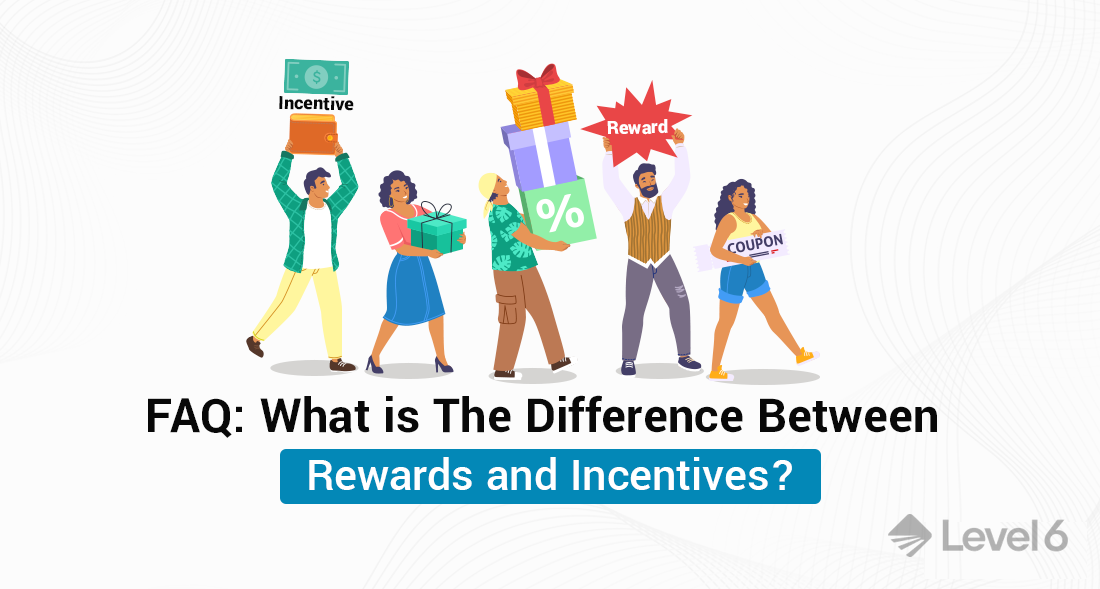
The difference between rewards and incentives is timing. A reward is given after an achievement, as recognition. An incentive is offered before the work, as motivation to hit a pre-defined goal. Most effective programs use both — incentives to shape future behavior and rewards to reinforce past performance.
Most program managers use “rewards” and “incentives” interchangeably — and then wonder why their employee rewards and incentives programs don’t deliver the performance lift the proposal promised. The words sound similar, but the mechanics are different enough to change program design, budget, and ROI. Getting the difference between rewards and incentives right is one of the highest-leverage decisions a benefits, sales, or channel leader can make.
We’ve designed incentive and rewards programs for manufacturers, distributors, and B2B organizations for more than 25 years. In that time we’ve seen the same pattern: companies that treat the two concepts as interchangeable end up with programs that confuse their audience, dilute their budget, and fail to move the metric they were built to move.
Below we unpack the difference between rewards and incentives, show where each tool works best, and walk through the research on what actually motivates performance.
What is a reward?
A reward is something given in recognition of past work, service, or achievement. It is backward-looking: it acknowledges something that has already happened.
Rewards can be monetary (a bonus, a spot cash award, a branded prepaid card) or non-monetary (extra PTO, a flexible schedule, a public shout-out, or a traditional service anniversary gift). They are often — though not always — a surprise, and their power comes largely from the recognition they carry rather than the cash value alone.
Common situations that earn a reward:
- A team delivers a project ahead of schedule or under budget.
- A rep exceeds a quarterly target that wasn’t tied to a pre-announced contest.
- An employee hits a service milestone (5, 10, 20 years).
- A channel partner handles a difficult escalation especially well.
The scale of the reward should match the scale of the achievement. Small efforts deserve small gestures; career-defining contributions deserve meaningful, memorable awards. Mismatches in either direction — a token gift for a heroic effort, or an outsized bonus for routine work — do more harm than good.
What are the advantages of a reward system?
Reward systems work because they deliver recognition, and recognition is one of the best-studied drivers of engagement. According to Gallup’s ongoing workplace engagement research, “recognition for good work” is one of the 12 workplace experiences most strongly linked to performance outcomes and retention.

A well-designed reward program produces several compounding benefits:
- Reinforces behavior you want repeated. When people see their peers recognized, they learn what “good” looks like at your company.
- Strengthens discretionary effort. Employees who feel their work is seen are more likely to go beyond the job description.
- Reduces turnover. Recognition is a stronger retention lever than most leaders realize — and cheaper than the cost of replacement.
- Creates positive brand association inside and outside the company. Recognition stories travel.
The downside: rewards given inconsistently — where one person is celebrated and a peer who did equivalent work is overlooked — can damage morale faster than no program at all. Consistency and transparency in criteria matter more than the absolute dollar value.
What is an incentive?
An incentive is something offered in advance as motivation to achieve a specific, measurable outcome. Where rewards look backward, incentives look forward.
If rewards can be summarized in one word — recognition — incentives can be summarized in another: motivation. An incentive is announced, published, and tied to criteria participants can see and track. The existence of the award is itself the lever.
Examples of incentives in a B2B context include:
- A tiered sales contest where reps earn escalating payouts for hitting 90%, 100%, and 110% of quota.
- A channel SPIFF that pays a fixed amount on every qualifying unit sold during a 60-day window.
- A training incentive that pays a bonus for completing a certification by a deadline.
- A consumer rebate that drops the effective price of a product for the end buyer.
Incentives don’t have to be cash. Harvard Business School research on sales compensation found that salespeople often value non-cash incentives (travel, merchandise, exclusive experiences) more highly than an equivalent cash amount — in part because non-cash awards carry a story and don’t get absorbed into household expenses.
What are the advantages of an incentive system?
A well-designed incentive program gives leaders a short, measurable feedback loop: set a goal, publish the rules, track performance, and pay on results. The benefits show up in three places:
- Direction. Incentives tell the field exactly which behavior matters this quarter.
- Intensity. Public, pre-announced payouts create urgency that discretionary effort alone rarely produces.
- Measurability. Because the goal is defined up front, ROI is clean to calculate after the fact.
There’s one important caveat worth pulling out on its own.
A 40-year meta-analysis of 183 studies published in Psychological Bulletin found that extrinsic incentives predict the quantity of performance, while intrinsic motivation predicts quality (Cerasoli, Nicklin, and Ford, 2014).
Key Takeaway: Extrinsic incentives predict quantity of performance; intrinsic motivation predicts quality (Cerasoli et al., Psychological Bulletin, 2014).
The practical translation: incentives work well for quota-style targets, volume, and well-defined tasks. They work less well — and can actively backfire — when the goal is creative problem-solving, customer satisfaction, or behavior that’s hard to measure cleanly.
Types of rewards and incentives
Not all rewards and incentives are the same. Most programs draw from four broad categories, and each fits different motivational needs:
- Monetary rewards and incentives. Cash bonuses, spot awards, commissions, branded prepaid cards, and gift cards. Easy to administer and universally understood, but the lowest story value.
- Non-monetary rewards. Extra PTO, flexible schedules, public recognition, leadership visibility, career development, and service anniversary awards. Often the highest-impact tools for culture and retention.
- Experiential incentives. Travel awards, events, exclusive experiences, and peer trips. Repeatedly shown in Harvard Business School research to outperform equivalent-value cash for sales audiences.
- Channel-specific incentives. SPIFFs, co-op funds, tiered rebates, and partner reward banks. Built for audiences that sell multiple brands and need push-through promotions.
Key Takeaway: Harvard Business School research on sales compensation found that non-cash incentives (travel, merchandise, experiences) are often valued more highly than an equivalent cash amount because they carry story value and don’t disappear into household spending.
Beyond sales contexts, several non-sales incentive types are increasingly common in modern programs:
- Wellness incentives — payouts or rewards tied to biometric screenings, activity goals, or preventive-care engagement.
- Professional development incentives — tuition reimbursement, certification bonuses, conference stipends, and internal mobility awards.
- Referral incentives — structured payouts for employee referrals, typically tiered by role and retention milestone.
- Flexible-work incentives — additional remote days, compressed schedules, or PTO banks earned through goal attainment.
The HR industry calls the combination of base pay, incentives, and rewards Total Rewards. Treating the three layers as a single system — rather than isolated line items — is how program budgets compound.
Can rewards be incentives, and vice versa?

Yes — there is overlap, and the same prize can play either role depending on how it’s communicated. A $500 Visa card given at year-end with no warning is a reward. The same $500 card, announced in January as the payout for Q1 quota attainment, is an incentive. The mechanics are identical; the framing is everything.
The single factor that determines which is which is awareness before the behavior. If participants know the prize and the criteria in advance, it’s an incentive. If they don’t, it’s a reward.
What are the primary differences between rewards and incentives?

The table below summarizes the operational difference between rewards and incentives that most affects program design:
| Dimension | Rewards | Incentives |
|---|---|---|
| Timing | After the fact (retroactive) | Announced in advance (proactive) |
| Primary purpose | Recognize what happened | Motivate what you want to happen |
| Awareness | Often a surprise | Publicized with clear rules |
| Criteria | Subjective or discretionary | Pre-defined and measurable |
| Best use | Service, culture, retention | Quota, volume, short-term behavior |
| Risk if misused | Perceived favoritism | Gaming the system, quality erosion |
One dimension deserves a closer look: the risk of gaming.
In a recent Harvard Business Review discussion of when sales incentives backfire, researchers from the Huntsman School of Business described eight common ways sales reps bend incentive rules — sandbagging deals, falsifying data, or coaching customers through promotional sign-ups that get cancelled later. None of this is unique to sales; any poorly designed incentive can be gamed.
The fix isn’t to abandon incentives. It’s to design them with “immoral imagination” — asking up front how the rules could be exploited and closing those loopholes before launch.
Intrinsic vs. extrinsic rewards and incentives: what does the research say?
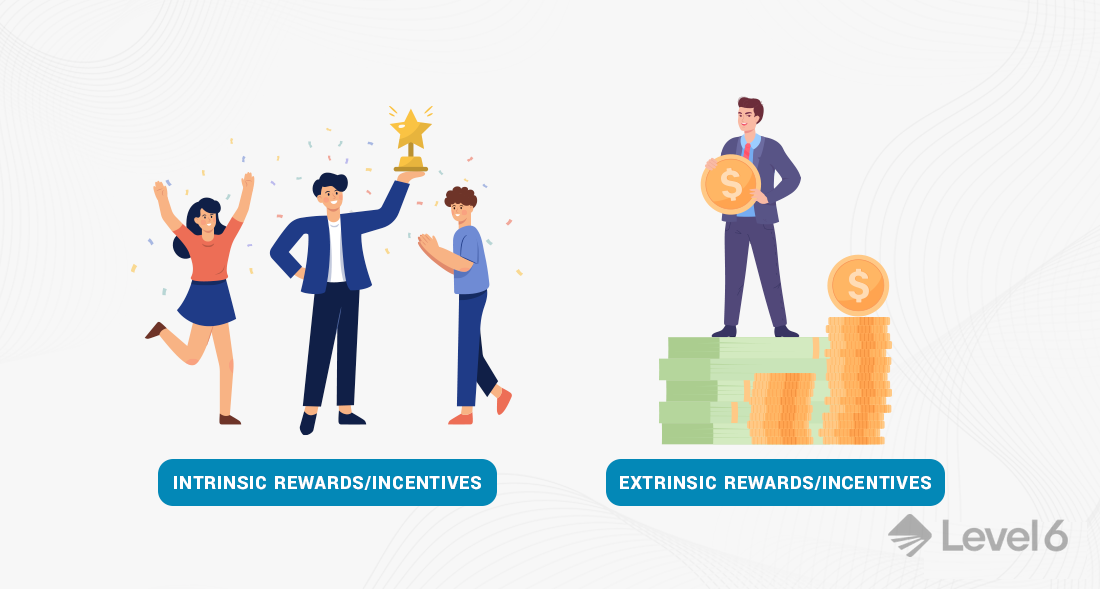
Every reward or incentive sits on an intrinsic-extrinsic spectrum:
- Extrinsic: coming from outside the person — cash, gift cards, travel, public recognition, status symbols.
- Intrinsic: coming from within — the satisfaction of mastering a skill, the meaning of the work, pride in serving a customer well.
For decades the debate in organizational psychology has been whether extrinsic incentives “crowd out” intrinsic motivation.
Self-Determination Theory (Deci & Ryan) identifies autonomy, competence, and relatedness as the three basic psychological needs that intrinsic motivation fulfills. Incentives that feel controlling undermine all three; incentives that reinforce mastery or autonomy strengthen them.
The 2014 meta-analysis we cited above — drawing on 183 studies and more than 212,000 participants — settled a big piece of the argument: intrinsic motivation and extrinsic incentives are not antagonists. They are both independent predictors of performance, and the smartest programs use them together.
Extrinsic incentives drive volume; intrinsic motivation drives quality; removing either one weakens the system.
The classic warning from Alfie Kohn’s influential HBR essay “Why Incentive Plans Cannot Work” still applies as a design discipline: if you pay people only to hit narrow targets, you’ll get narrow behavior. But you don’t avoid that problem by eliminating incentives — you avoid it by pairing measurable incentives with meaningful work, autonomy, and recognition of quality.
For a deeper dive, read our full guide to intrinsic and extrinsic employee rewards and our companion post on the incentive theory of motivation.
Should your company use a rewards program?
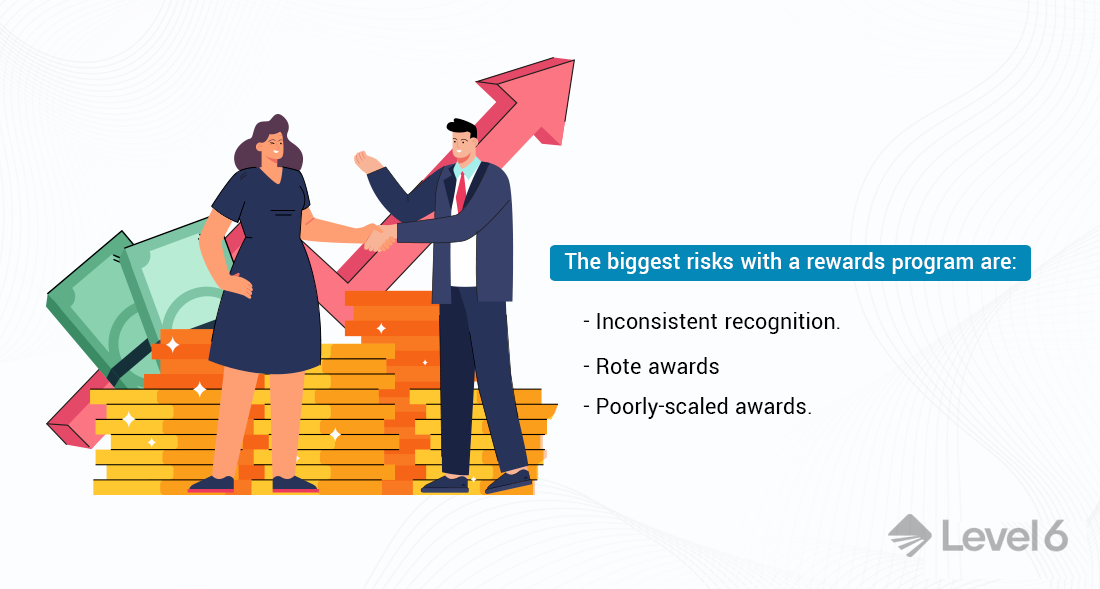
For almost every organization, yes. A reward program — typically structured inside a formal employee recognition and rewards framework — formalizes what good leaders already do: catching people doing the right thing and acknowledging it. The three most common failure modes we see are:
- Inconsistent recognition. Two employees deliver the same caliber of work; one gets celebrated, one doesn’t. The un-recognized employee’s engagement drops further than the recognized employee’s engagement rises.
- Rote, formulaic awards. If the process feels like a checkbox (“every 90 days we hand out a certificate”), the signal value collapses.
- Mis-scaled awards. A small gift for a major contribution feels insulting; an outsized prize for routine work sets an unsustainable bar.
Done well, rewards are sporadic, personalized, and proportional to the effort or achievement. They should feel like they were chosen for this specific person at this specific moment — because that’s when recognition actually lands.
Recognition is also one of the highest-ROI retention levers available. According to SHRM, the cost of replacing an employee can run 50–200% of annual salary once recruiting, onboarding, and lost productivity are included — which means a well-designed rewards program typically pays for itself the first time it saves a key hire.
Should your company use an incentive program?
If you have a measurable behavior you need to change — sales volume in a specific product line, channel partner mix, certification completion, rebate redemption rates — an incentive program is usually the fastest, most auditable tool available. The UK’s Chartered Institute of Personnel and Development evidence review on incentives and recognition found that incentives are most motivating when participants believe the linked goal is genuinely important. In other words, design matters more than budget.
For detailed program-design guidance, see our guides on how to design an incentive program and the most common reasons incentive programs fail. Level 6 builds and manages sales incentive programs across manufacturing, distribution, and B2B technology.
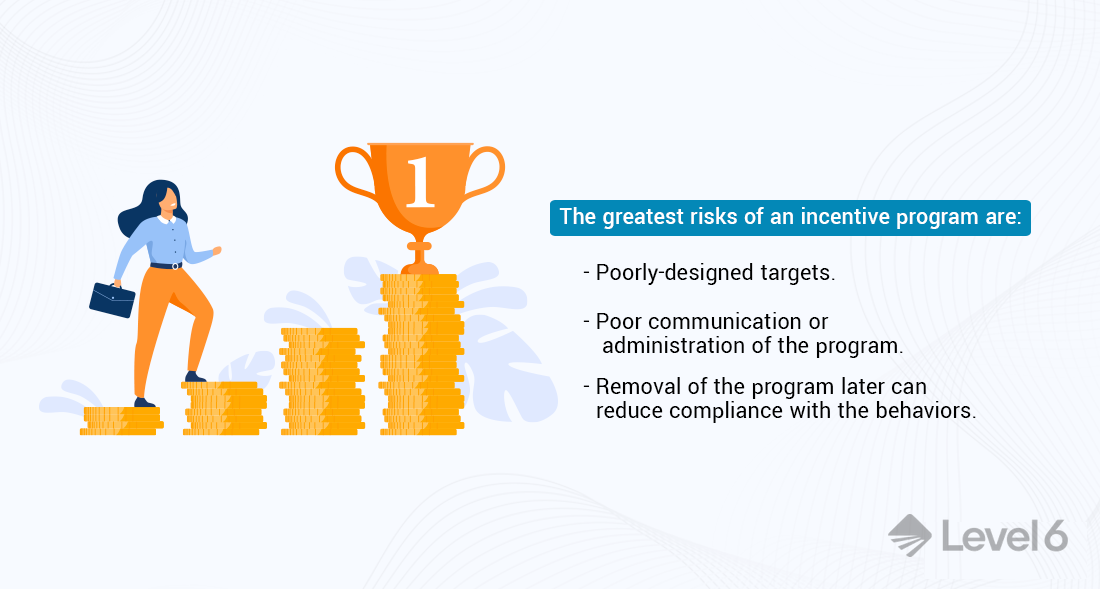
Common incentive program pitfalls to avoid:
- Poorly calibrated targets. Too low and the incentive is trivial; too high and it’s unreachable. Both kill motivation.
- Thin communication. If participants don’t understand the rules, the incentive doesn’t exist for them. Launch materials, reminders, and leaderboards all matter.
- Abrupt removal. Pulling a long-running incentive without a replacement typically drops behavior below pre-program levels.
- Single-metric design. Pay only for revenue and you’ll see discount-heavy deals. Pay only for volume and quality slips. Good incentive design includes modifiers.
How do incentives work differently for channel partners?
Channel incentives follow the same motivational psychology as employee incentives but operate under different constraints. Partners sell multiple brands, carry their own internal compensation structures, and often require the incentive to be routed through the partner’s sales leadership to reach the rep on the floor.
As a result, channel programs lean more heavily on points, co-op, tiered rebates, and SPIFFs than employee programs. Successful designs also include brand preference signals (co-branded training, certification tiers, joint marketing funds) rather than relying on cash payouts alone. With 25+ years of experience designing channel incentives for manufacturers and distributors, we’ve found the programs that hold up over time treat partner reps as a distinct audience with their own motivations — not as employees with an extra step.
Key Takeaway: Channel programs must account for partners selling multiple competing brands, which means push-through motivation via co-op, SPIFFs, and tiered rebates typically matters more than individual payout amounts.
Should your company use rewards and incentives together?
In most mature programs, yes. Rewards and incentives solve different problems, and using them together creates a more complete engagement system. A practical framework we use with clients:
- Base compensation and benefits cover the table stakes — fair pay for the job.
- Incentives drive the specific short-term behaviors the business needs this quarter or year.
- Rewards acknowledge the qualitative, cultural, and service contributions that don’t fit neatly into a formula.
When these three layers are aligned, each one amplifies the others. When they’re misaligned — for example, when a restaurant uses tips as a substitute for base pay rather than a layer on top of it — employees feel the incentive system is compensating for a broken foundation, and engagement suffers.
One anonymized example from our own portfolio: a major industrial OEM we work with ran a sales SPIFF (incentive) for a new product line while simultaneously launching a peer-nominated “above-and-beyond” award (reward) for the field reps who helped customers integrate the product into complex installations. The SPIFF drove volume; the recognition award drove the hand-holding that made those volume numbers stick after the quarter closed. Neither tool alone would have produced the outcome.
Frequently Asked Questions
What are examples of rewards and incentives?
Common rewards include spot bonuses, branded prepaid cards, extra PTO, public recognition, and service anniversary awards. Common incentives include tiered sales contests, channel SPIFFs, training completion bonuses, consumer rebates, and travel awards for top quota attainment. The same prize (like a $500 Visa card) can be either — depending on whether participants know about it before the behavior.
What are the benefits of employee rewards and incentives?
Well-designed employee rewards and incentives deliver three compounding benefits: (1) direction — incentives signal which behaviors matter most; (2) retention — recognition is one of the strongest predictors of engagement in Gallup’s workplace research; (3) measurable ROI — published rules and defined targets make post-program analysis straightforward. Programs that combine both tools outperform single-lever approaches on almost every measure.
Is a bonus a reward or an incentive?
It depends entirely on timing. A year-end bonus announced in advance with specific performance criteria is an incentive. A discretionary bonus handed out after the fact in recognition of contribution is a reward. The same dollar amount can play either role; what changes is whether employees knew about it before they did the work.
Are incentives always monetary?
No. Effective incentives can be non-cash — travel, merchandise, branded prepaid cards, experiences, additional PTO, or public status awards. Harvard Business School research on sales compensation has shown that non-cash incentives are often valued more highly than equivalent cash, because they carry story value and don’t disappear into household spending.
Do incentives reduce intrinsic motivation?
Sometimes, but not reliably. A 40-year meta-analysis in Psychological Bulletin found that intrinsic motivation and extrinsic incentives jointly predict performance — they are independent levers rather than opposites. Incentives can undermine intrinsic motivation when they feel controlling, when they’re tied to simply starting or finishing a task, or when they replace recognition entirely.
What’s the best reward for long-tenured employees?
For service milestones (5, 10, 20+ years), the reward that lands hardest is one that’s personalized and visible. Generic gifts miss the moment. Experience-based awards, meaningful tangible items that reflect the person’s contribution, and public recognition from senior leadership consistently outperform an equivalent-value gift card.
How do we avoid sales reps gaming an incentive program?
Design with the assumption that every rule will be tested. Include modifiers for deal quality, margin, and customer retention — not just top-line revenue. Audit payouts against customer-level outcomes 6 and 12 months later. Involve field sales leaders in the plan design so hidden loopholes surface before launch.
How often should rewards be given out?
There’s no universal cadence, but the most effective programs combine a steady rhythm of peer-to-peer recognition (available any day of the year) with occasional high-impact moments like quarterly or annual awards. Frequency alone doesn’t drive engagement — specificity, authenticity, and consistency across the team do far more of the work.
What are the types of employee incentives?
Employee incentives fall into several categories: sales incentives (quota-based contests, commissions, SPIFFs), wellness incentives tied to biometric or activity goals, professional development incentives like certification bonuses or tuition reimbursement, referral incentives for bringing in new hires, and flexible-work incentives like remote days or compressed schedules. Most mature programs combine two or three of these alongside traditional rewards.
What is Total Rewards in HR?
Total Rewards is the HR industry term for the full set of tools an employer uses to compensate and motivate employees: base pay, benefits, incentives, and rewards. Treating these layers as a single, integrated system — rather than isolated budget lines — is how modern compensation teams align spend with retention, engagement, and performance outcomes.
Do channel partners respond to incentives the same way employees do?
The underlying psychology is similar, but channel programs have additional design constraints: partners sell multiple brands, have their own internal compensation structures, and often require the incentive to be pushed through the partner’s sales leadership to reach the rep on the floor. Channel incentives also tend to rely more heavily on points, co-op, and rebate structures than employee programs.
Final Takeaways
- The difference between rewards and incentives is timing: a reward is given after an achievement, as recognition, while an incentive is offered before, as motivation. The same prize can play either role depending on when participants learn about it.
- Rewards shine in qualitative contexts — service, culture, retention. Incentives shine in quantitative, measurable contexts — sales volume, quota attainment, certification completion.
- The research is clear: intrinsic motivation and extrinsic incentives are not opposites. The strongest programs combine both.
- Poor incentive design invites gaming; poor reward design invites resentment. Pre-launch stress-testing prevents both.
- Most mature organizations use rewards and incentives together, layered on top of fair base compensation — not as a substitute for it.
If you’re building or refreshing a program and want to get the mix of rewards and incentives right the first time, talk to our team — we’ve spent 25+ years designing channel, consumer, and employee programs that hold up under scrutiny and deliver measurable ROI.